Sunday, December 28, 2025

Prediction Consensus: What The Experts See Coming In 2026

   The role of "predictions" has always been either to reassure people, investors in this case, or panic them. And if it is called a consensus, i.e. an average, you can be absolutely certain that nothing is been predicted. More of the same on steroid.

   The difficulty of predicting is not in tracing linear trends. Anybody can do that, especially economists. Nor in identifying breaking points which is just a tad more difficult. Here usually, you just get the timing wrong. No, the complexity is in understanding interference between unrelated factors and the phenomenon of emergence. This is what almost nobody can do well. 
 
   This is also why our lives are worth living. If the reductionists were right, then the whole would just be the sum of the parts and knowing these, accurate predictions would indeed be possible. Conversely, if the constructivists or post modern, the main source of the woke ideology, were right, then everything being a social construct, nothing much would make sense beyond the meaning we give to things, what they call "the narrative" and our society would dissolve into meaninglessness. Why bother since there is no "meaning" beyond that which is assigned arbitrarily? Which is in fact one of the main demons our Western societies are grappling with currently.
 
   Thankfully, thanks to the work of Thomas Kuhn and his Paradigm Shift, we now understand that reality is more complex. It is composed of phases of emergence, development or arm race and maturation before complexity gives rise to a new paradigm, or the emergence of a new level which itself will follow these rules. This is what happens in nature and consequently, this is also what happens to human societies. 
 
   Unfortunately the behavior of complex systems can have three outcomes: Stabilize as a cycle and vegetate, exhaust resources and crash, or give rise to a new emergent paradigm and "escape" in a new orthogonal direction. We tend to be very good at predicting the first two outcomes but abysmally bad at predicting the third which mostly we understand only a-posteriori, that is after it happens.    
   Let's take just one example: The war in Ukraine in 2026. It could go on. That's the first scenario. It could stop because one side has exhausted its resources, that is the second scenario... or we could look at it as a lesson. See that more and more, humans are being replaced by drones and robots and in doing so, understand that it is necessarily the party with access to more resources which will win future wars. How is this different to the second scenario? Well, now the process becomes measurable and therefore predictable. You do not need to start a war for AI to help you predict the outcome. Could we therefore be approaching the end of wars? Very unlikely unfortunately but more positively, it means that from now on, major powers will be less and less in a position to confront each others directly. Is this a "progress"? Well, if it results in fewer wars, maybe but more importantly, this is a paradigm shift towards a more peaceful future which maybe, we could understand in 2026.

For the seventh straight year, Visual Capitalist sifted through the forecast landscape to bring you the Prediction Consensus, a synthesis of what analysts, thought leaders, and industry experts expect for the year ahead.

This year, Nick Routley analyzed over 2,000 individual predictions from a wide variety of sources including Morgan Stanley, Goldman Sachs, the IMF, The Economist, Deloitte, Microsoft, Gartner, and dozens more.

By mapping where these forecasts overlap, we’ve distilled the noise into 25 high-conviction themes displayed in our “Bingo Card” format, with the number of dabs reflecting the volume of supporting predictions.

To get the full analysis of the Prediction Consensus and to see what’s ahead for 2026, become a member of VC+ or purchase the full Global Forecast Series report and package.

The General Vibe of 2026

If 2025 was a year of adjustment - markets recalibrating to higher rates, geopolitics reshuffling around a second Trump administration and tariffs, and AI moving from hype to deployment - then 2026 is shaping up as a year of consolidation and consequence.

The consensus mood is cautiously optimistic but shot through with uncertainty. Morgan Stanley describes 2026 as “The Year of Risk Reboot,” a period where market focus shifts from macro anxieties to micro fundamentals, creating fertile ground for risk assets. The policy backdrop is unusually supportive: fiscal stimulus, continued (if slower) monetary easing, and deregulation form what analysts call a “policy triumvirate” rarely seen outside of recessions.

Yet The Economist strikes a more sober tone, warning that 2026 will be defined by uncertainty as Trump’s reshaping of geopolitical norms continues to ripple worldwide. The old rules-based order is drifting further, and the line between war and peace grows ever more blurred through gray-zone provocations, cyber incursions, and an ambient rivalry between nations.

In short: risk assets may thrive, but the world beneath them remains turbulent.

AI: Once Again, the Big Story

For the third consecutive year, artificial intelligence dominates the prediction landscape, but the narrative has evolved. Where 2024 forecasts centered on whether AI hype was justified and 2025 focused on deployment at scale, the 2026 conversation is about integration and consequences.

From Tool to Partner

Across industries, AI is moving beyond answering questions to actively collaborating with people and amplifying their expertise.

This is the year of the agentic AI build-out. Deloitte predicts that by year-end 2026, as many as 75% of companies may be investing in agentic AI (autonomous systems that can plan, act, and adapt with limited human oversight). These AI agents are set to become “digital colleagues,” helping small teams punch above their weight. Microsoft envisions a future where a three-person marketing team can launch a global campaign in days, with AI handling data crunching and content generation while humans steer strategy.

After years of anticipation, productivity gains from AI are finally expected to materialize in measurable ways. Morgan Stanley points to AI-driven efficiency as one of six key drivers of their bullish earnings outlook. Software and internet companies are expected to see generative AI revenue grow more than 20-fold over the next three years.

Of course, AI will impact the job market in other ways as well. Professional and knowledge-worker classes that previously felt insulated are now beginning to feel anxiety around job security.

Market Predictions: Riding the AI Wave

Conveniently, AI also dominates the market story. The consensus is unmistakably bullish, though tempered by valuation concerns and awareness of concentration risks.

S&P 500: Double-Digit Gains Expected

Wall Street strategists are clustered in a tight range for year-end 2026 S&P 500 targets:

The bull case from JPMorgan sees the index potentially topping 8,000 if the Fed eases more than expected. Morgan Stanley calls it their most bullish outlook in years, driven by returning operating leverage, AI efficiency gains, accommodative tax and regulatory policy, and contained interest rates.

Importantly, analysts expect earnings to do the heavy lifting in 2026. Bank of America’s Savita Subramanian projects 14% EPS growth but notes that P/E multiples may actually contract by 10 points, meaning the market climbs a wall of valuation skepticism. Morgan Stanley forecasts S&P 500 EPS of $317 in 2026 (17% growth).

Gold’s Super-Cycle Continues

Gold remains a favorite. Morgan Stanley targets $4,500 per ounce—about 9% upside from current levels. The World Gold Council notes that gold achieved over 50 all-time highs in 2025 and may post its fourth-strongest annual return since 1971.

The drivers are structural: central bank buying, geopolitical hedging, and concerns about fiscal sustainability. In a “doom loop” scenario of accelerating fiscal deterioration, gold could surge 15-30% from current levels.

Economic Predictions: Soft Landing, With Caveats

The IMF projects global growth at 3.2% in 2025 and 3.1% in 2026—below the pre-pandemic average of 3.7% but not recessionary. Morgan Stanley expects similar numbers: 3.0% global growth in 2025, 3.2% in 2026 and 2027.

Advanced economies are expected to grow around 1.5-1.6%, while emerging markets hold above 4%. The consensus is a soft landing: growth moderates, inflation continues its gradual descent, and central banks ease policy—but not aggressively.

The “Higher for Longer” Era Fades

Central bank policy is expected to continue normalizing. Morgan Stanley’s base case has the Fed cutting to 3.0-3.25% by mid-year and then pausing for an extended period. The BoE is expected to bring rates to 2.75% before pausing. The ECB, facing below-target inflation and sluggish growth, may cut further than markets currently price.

Japan remains the outlier: the only major developed market central bank potentially hiking, with the BoJ expected to reach 0.75% by December before pausing.

Geopolitical & Trade Predictions: Tariffs and Tensions

Tariffs Become the New Normal

Perhaps no theme generates more consensus than this: the tariff regime is here to stay. Trump’s reciprocal tariffs are bringing in close to $300 billion in revenue annually, and while they may face legal challenges (Barclays expects the Supreme Court to deem them illegal), the effective tariff rate has peaked at 12.1%—the highest since 1934.

The economic impact is being absorbed more gracefully than many feared. UBS expects a “soft patch” in early 2026 as tariffs affect U.S. prices, followed by a broadening and strengthening of growth from Q2 onward. But the structural shift is profound: trade may reroute permanently, supply chains are diversifying, and the U.S. is explicitly using tariffs as a tool of economic leverage.

China Leans on Exports and Manufacturing

Facing deflation, a property crisis, and slowing domestic growth, China is pivoting to manufacturing and export dominance. The country is positioning itself as a more reliable partner, particularly in the Global South, striking trade agreements as the U.S. retreats from multilateralism.

Morgan Stanley expects China’s real GDP to expand 5% in 2026, helped by front-loaded government support. But the strategy creates global tensions: industrial overcapacity could flood world markets, and tariff battles may intensify.

Gray-Zone Provocations Increase

The Economist warns that Russia and China will test American commitment to allies through “gray-zone” provocations in northern Europe and the South China Sea. Tensions will rise in the Arctic, in orbit, on the sea floor, and in cyberspace.

This “ambient rivalry” short of outright war but beyond normal peacetime friction is expected to accelerate. Great-power competition will increasingly involve space-based intelligence, drone technology, and AI-powered cyber operations.

Assessing the Consensus

History teaches humility about forecasting. Previous years have contained unforeseen developments, and there’s no reason to expect 2026 to unfold precisely as consensus expects.

What’s valuable isn’t the specific predictions, but themes where informed observers are concentrating their attention. Examples include the transition from AI experimentation to building out infrastructure to support its widespread use. Or stablecoins becoming mainstream financial instruments.

Some of these themes will prove accurate; others will be derailed by events. But taken together, they sketch the landscape that institutions, investors, and policymakers are navigating as they position for the year ahead.

Saturday, December 27, 2025

Stockman: The Real Story Behind The Russia–Ukraine War... And What Happens Next

  And here's the bigger picture of the Ukraine conflict by david Stockman. Frankly, you may want these mindless Eurocrats to read this although their reaction would probably be to add David Stockman to the naughty list.  

  As discussed earlier, the outcome of the conflict will probably depend of the current fight between the realist (Trump) and the shadow Imperialists of the Deep State, spearheaded by the British. What comes out of this fight is far from obvious. Trump is powerful and resourceful but he has no long term strategy, just sneaky business (well Las Vegas style) tactics to rely on and the team around him is abysmally incompetent. Remember the words of Sun Tsu about Tactic without strategy: The noise before defeat!  

Authored by David Stockman via InternationalMan.com,

Notwithstanding the historic fluidity of borders, there is no case whatsoever that Russia’s invasion of Ukraine in February 2022 was “unprovoked” and unrelated to NATO’s own transparent provocations in the region.

The details are arrayed below, but the larger issue needs be addressed first.

Namely, is there any reason to believe that Russia is an expansionist power looking to gobble up neighbors which were not integral parts of its own historic evolution, as is the case with Ukraine?

After all, if despite Rubio’s treachery President Trump does manage to strike a Ukraine peace and partition deal with Putin you can be sure that the neocons will come charging in with a false Munich appeasement analogy.

The answer, however, is a resounding no!

Our firm rebuke of the hoary Munich analogy as it has been falsely applied to Putin is based on what might be called the double-digit rule. To wit, the true expansionary hegemons of modern history have spent huge parts of their GDP on defense because that’s what it takes to support the military infrastructure and logistics required for invasion and occupation of foreign lands.

For instance, here are the figures for military spending by Nazi Germany from 1935–1944 expressed as a percent of GDP. This is what an aggressive hegemon looks like in the ramp-up to war: German military spending had already reach 23% of GDP, even before its invasion of Poland in September 1939 and its subsequent commencement of actual military campaigns of invasion and occupation.

Not surprisingly, the same kind of claim on resources occurred when the United States took it upon itself to counter the aggression of Germany and Japan on a global basis. By 1944 defense spending was equal to 40% of America’s GDP, and would have totaled more than $2 trillion per year in present day dollars of purchasing power.

Military Spending As A Percent Of GDP In Nazi Germany

  • 1935: 8%.
  • 1936: 13%.
  • 1937: 13%.
  • 1938: 17%.
  • 1939: 23%.
  • 1940: 38%.
  • 1941: 47%.
  • 1942: 55%.
  • 1943: 61%.
  • 1944: 75%

By contrast, during the final year before Washington/NATO triggered the Ukraine proxy war in February 2022, the Russian military budget was $65 billion, which amounted to just 3.5% of its GDP.

Moreover, the prior years showed no build-up of the kind that has always accompanied historic aggressors. For the period 1992 to 2022, for instance, the average military spending by Russia was 3.8% of GDP– with a minimum of 2.7% in 1998 and a maximum of 5.4% in 2016.

Needless to say, you don’t invade the Baltics or Poland—to say nothing of Germany, France, the Benelux and crossing the English Channel—on 3.5% of GDP! Not even remotely.

Since full scale war broke out in 2022 Russian military spending has increased significantly to 6% of GDP, but all of that is being consumed by the Demolition Derby in Ukraine—barely 100 miles from its own border.

That is, even at 6% of GDP Russia has not yet been able to subdue its own historic borderlands. So if Russia self-evidently does not have the economic and military capacity to conquer its non-Ukrainian neighbors in its own region, let alone Europe proper, what is the war really about?

In short, it is rooted in territorial disputes and civil strife in lands which have been vassals or integral parts of greater Russia for several centuries. As indicated, Ukraine actually means “borderlands” in the Russian language, connoting stateless areas that were first assembled into a coherent polity by Lenin, Stalin and Khrushchev by force of arms after 1920.

In fact, prior to the communist takeover of Russia, no country that even faintly resembled today’s Ukrainian borders had ever existed. So what NATO’s proxy war actually amounts to is an insensible attempt to enforce the dead hand of the Soviet presidium, as we amplify below.

For avoidance of doubt here are sequential maps that tell the story, and which make mincemeat of the Washington/NATO sanctity of borders malarkey. The first of these is a 220-year-old map from 1800, where the yellow area depicts the approximate territory of the five regions—Donetsk, Luhansk, Kherson and Zaporizhia plus Crimea—that will be allowed to go their own way, including back to Mother Russia, if the key ingredients of the Donald’s 28-point peace place can be resurrected.

As it has happened, these regions have voted overwhelmingly during referendums in 2023 and 2014, respectively, to separate from Ukraine in favor of affiliation with Russia.

Collectively, the five regions were historically known as the aforementioned Novorossiya or “New Russia” and had been acquired by Russian rulers, including Catherine the Great between 1734 and 1791.

The red markings within the yellow areas of the map designate the year of Russian acquisition. Self-evidently, therefore, the Russian Empire had gradually gained control over this vast area north of the Black Sea before the end of the 18th century. To that end, it had signed peace treaties with the Cossack Hetmanate (1734) and with the Ottoman Empire at the conclusion of the various Russo-Turkish Wars of that era.

Pursuant to this expansion drive – which included massive Russian investment and the in-migration of large Russian populations to the region – Russia established the “Novorossiysk Governaorate” in 1764. The latter was originally to be named after the Empress Catherine, but she decreed that it should be called “New Russia” instead.

The Provinces Of Ukraine Slated For Partition By The Trump Plan Were Part Of Russia Before The US Constitution Was Even Written

Map: © Роман Днепр, CC BY-SA 3.0

Completing the assemblage of New Russia, Catherine forcefully liquidated its aforementioned century-long Cossack ally known as the Zaporizhian Sich (present day Zaporizhia) in 1775 and annexed its territory to Novorossiya, thus eliminating the independent rule of the Ukrainian Cossacks. Later in 1783 she acquired Crimea from the Turks, which was also added to Novorossiya, as shown in yellow area of the map above.

During this formative period, the infamous shadow ruler under Catherine, Prince Grigori Potemkin, directed the sweeping settlement and Russification of these lands. Effectively, Catherine had granted him the powers of an absolute ruler over the area from 1774 onward.

The spirit and importance of “New Russia” at this time is aptly captured by the historian Willard Sunderland,

“The old steppe was Asian and stateless; the current one was state-determined and claimed for European-Russian civilization. The world of comparison was now even more obviously that of the Western empires. Consequently, it was all the more clear that the Russian empire merited its own “New Russia” to go along with everyone else’s New Spain, New France and New England. The adoption of the name of New Russia was in fact the most powerful statement imaginable of Russia’s national coming of age.

In fact, the passage of time solidified the borders of Novorossiya even more completely. One century later the light-yellow area of the 1897 map below gave an unmistakable message: To wit, in the late Russian Empire there was no doubt as to the paternity of the lands adjacent to the Azov Sea and the Black Sea: They were now part of the 125 years-old “New Russia”.

Where’s Waldo—Ukraine—on This Map

After the Russian Revolution, of course, the pieces and parts in this region of the old Czarist Empire were bundled-up into a convenient administrative entity by the new red rulers of Moscow, who christened it the “Ukrainian SSR” (Soviet Socialist Republic). In a like manner, they created similar administrative entities in Belorussia, Georgia, Moldavia, Turkmenistan etc.—ultimately confecting 15 such faux “republics”.

During the course of this communist state-building, here is how and when these brutal tyrants attached each piece of today’s Ukrainian map to the territories acquired or seized by the Russian Czars over 1654-1917 (yellow area):

  • The old Novorossiya of the Donbas and Black Sea rim was added to the Ukraine SSR by Lenin in 1922.

  • The western territory around Lviv that been known as Little Poland and Galicia were captured by Stalin in 1939 and thereafter when he and Hitler carved up Poland.

  • Upon the death of the bloody Stalin in 1954, Khrushchev made a deal with his Presidium allies to transfer Crimea from the Russian SSR to the Ukrainian SSR in return for their support in the battle for succession.

In a word, Ukraine is the bastard spawn of communist blood and iron. Yet during the last decade the Washington and the NATO warhawks have spent upwards of $300 billion to ensure that the handiwork of autocratic Czars and Commissars remains intact into the 21st century and presumably beyond.

It is ironic, therefore, that the historically illiterate Donald Trump has the good sense to dispense with one of the stupidest crusades that the War Party on the Potomac has yet concocted. So doing, he would enable the failed handiwork of communist tyrants to be made right with history—an outcome that can now happen if and only if the Donald gets the Rubio digression back on track.

Modern Ukraine: Born In Communist Blood and Iron

Image: © Sven Teschke et al., CC BY-SA 3.0.

Of course, had the above-mentioned 20th century communist trio been noble benefactors of mankind, perhaps their subsequent map-making handiwork and reassignment of Novorossiya to Ukraine might have been justified. Under this benign counterfactual, they would have presumably combined peoples of like ethnic, linguistic, religious and politico-cultural history into a cohesive natural polity and state. That is, a nation worth perpetuating, defending and perhaps even dying for.

Alas, the reason that Trump is right to attempt to end this bloody catastrophe via partition is that the very opposite was true. From 1922 to 1991 modern Ukraine was held together by the monopoly on violence of its brutally totalitarian rulers. And that became more than evident when the Kremlin temporarily lost control of Ukraine during the military battles of World War II. During that especially bloody interlude, the communist administrative entity called Ukraine came apart at the seams.

That is, local Ukrainian nationalists joined Hitler’s Wehrmacht in its depredations against Jews, Poles, Roma and Russians when it first swept through the country from the west on its way to Stalingrad; and then, in turn, the Russian populations from the Donbas and south campaigned with the Red Army during its vengeance-wreaking return from the east after winning the bloody 1943 battle of Stalingrad that turned the course of WWII.

Not surprisingly, therefore, virtually from the minute it came out from under the communist yoke when the Soviet Union was swept into the dustbin of history in 1991, Ukraine has been engulfed in political and actual civil war. The elections which did occur were essentially 50/50 at the national level but reflected dueling 80/20 vote breakouts within the regions. That is, the Ukrainian nationalist candidates tended to get vote margins of 80% + in the West/Central areas, while Russian-sympathizing candidates got similar pluralities in the mainly Russian-speaking East and South.

This pattern transpired because once the iron-hand of totalitarian rule ended in 1991, the deep and historically rooted conflict between Ukrainian nationalism, language and politics of the central and western regions of the country and the Russian language and historical religious and political affinities of the Donbas and south came rushing to the surface.

Accordingly, so-called democracy barely survived these contests until February 2014 when one of Washington’s “color revolutions” finally “succeeded”. That is to say, the Washington fomented and financed nationalist-led coupe d état ended the fragile post-communist equilibrium.

That’s the true meaning of the Maidan coup. It ended the tenuous cohesion that kept the artificial state of Ukraine intact for barely two decades after the Soviet demise. So save for Washington’s destructive intervention, the partition of a communist-confected state that had never been built to last would have materialized all on its own–perhaps like in Czechoslovakia—-and likely sooner than later.

At the end of the day, therefore, the necessary impending partition of the rogue state of Ukraine is not a case at all of legitimate sovereign borders being violated. Nor does it involve an assault on the hypocritical notion of a “rules-based international order” that has not actually ever existed and which, instead, has been a cover for Washington’s global hegemony all along.

But the lessons are nonetheless profound. History accumulates and eventually leads to destructive, but wholly unnecessary outcomes.

That is the case today with the utterly foolish action of Washington during the 1990s and 2000s to bring former Warsaw Pact Nations, and even breakaway Soviet Republics into a NATO alliance whose mission was over and done in 1991.

It should have been dismantled then and there. When the old Soviet monster with its 50,000 tanks and 7,000 nuclear warheads disappeared into the dustbin of history, there was no longer a threat to the east. There was no “front line” to defend.

At that point Washington should have and easily could have led the world to disarmament and to a revival of the lasting peace that had disappeared in the “Guns of August” in 1914.

But now the NATO section 5 mutual defense commitment to these 31 nations is equivalent to a stupid charity that the nearly bankrupt Federal government cannot afford in any case.

There is absolutely nothing in it for the enhancement of America’s homeland security, and huge incentives for the politicians of these nations to caterwaul against Russia rather than seek peaceful accommodation.

So here is the historic moment before us: The Donald now needs to tell Rubio in no uncertain terms to take a hike and then return to the essence of the 28-point plan and agree with Putin to a partition of Ukraine.

So doing, he would not only end the utter stupidity of NATO’s proxy war on Russia, but in the process accomplish something more of literally epic proportions: Namely,the defenestration of the neocons, official Washington, NATO, the rules based international order and all the other globalist humbug that has saddled America with $1.5 trillion per year Warfare State and Global Empire that it cannot afford and doesn’t need.

"Common Sense" Is Back: UK Finally Scraps Non-Crime Hate Incident Laws Nationwide

   Wait, you mean no more pre-crimes and thought crimes in the UK? 

   Finally a step in the right direction while Big Brother thought "1984" was an instruction manual? Amazing. Does it mean all hopes are not lost? That hell can wait another year until Dante takes up for a tour?  

   Let's not get carried away with optimism. The Deep State is still there, lurking in the shadow, busy undermining every effort by the Trump administration to arrange a soft landing in Ukraine. Now, this latest trick of Trump to have the anti-corruption team investigate everyone around Zelinski while he is on his way to Florida is pure genius, Godfather-style I mean. The MI6 office will be busy this weekend, and for once, not investigating a guy who wrote a mean Twit.   

Police chiefs will reportedly seek to scrap non-crime hate incidents in plans they will present to the Home Secretary next month.

The Telegraph reports that police leaders have decided that NCHIs are no longer “fit for purpose” after warnings that recording them undermines freedom of speech and diverts officers away from fighting crime.

Under the plans, NCHIs will be replaced with a new “common sense” system, where only a fraction of such incidents will be recorded under the most serious category of anti-social behaviour.

An NCHI falls short of being criminal but is perceived to be motivated by hostility or prejudice towards a person with a particular characteristic.

They stay on police records indefinitely and can come up in background checks.

The move to scrap them follows high-profile cases such as that of Graham Linehan, the Father Ted co-creator, whose arrest for a series of posts on X was criticized by the Trump administration as a “departure from democracy”.

The plans will be published next month by the College of Policing and National Police Chiefs’ Council (NPCC) and are expected to be backed by Shabana Mahmood, the Home Secretary.

Lord Herbert, the chairman of the College of Policing, told The Telegraph:

“NCHIs will go as a concept. That system will be scrapped and replaced with a completely different system."

“There will be no recording of anything like it on crime databases. Instead, only the most serious category of what will be treated as anti-social behaviour will be recorded. It’s a sea change.”

Their exclusion from crime databases means any incidents will no longer have to be declared as part of checks in job applications.

Police forces would be instructed not to log “hate” incidents on crime databases, instead treating them as “intelligence” reports.

Police guidance on the recording of NCHIs was first published in 2005, following recommendations by an inquiry into the murder of Stephen Lawrence - the London teenager who was stabbed to death in a racist attack in 1993.

As The BBC reports, Lord Herbert said "an explosion of social media" in the years since they were introduced has meant police had been drawn into monitoring "mere disputes" online.

Officers do not want to be "policing tweets", he told BBC Radio 4's Today program.

Last year, The Telegraph reported that 43 police forces in England and Wales had recorded more than 133,000 NCHIs since 2014.

US, China and the Future of the Global Order by Kishore Mahbubani

  The raw, un-edulcolored view of the West and especially Europe by Kishore Mahbubani from Singapore. I agree, mostly. 

  Does this make Singapore a paradise? Not quite but reality is always messy and complex. 

  The inability of Europe to talk to Russia or to understand China makes it unable to change and evolve. Maybe that's what it means for a society to be "old"?

  A profound and knowledgeable analysis well worth listening to below:   

https://www.youtube.com/watch?v=VQxnxbuweUc

Friday, December 26, 2025

The Stoic's Guide To Life: Ancient Wisdom For Modern Struggles

   This is THE most unsettling realization of our modern world: What if we are not as advanced as we believe we are? Yes, our technology has moved by leaps and bounds, but our philosophy has become atrophied. And although history has not ended as some suspected, our ability to "think" has definitively taken a hit and as AI is just about to deliver the final blow, maybe now is the time to revisit the ancients and listen once again to their wisdom. They did write it on stone!  

Authored by Duncan Burch via The Epoch Times,

Epictetus, a Greek Stoic philosopher who flourished during the early second century, said the chief task in life is to separate what is within one’s control from what is not.


Externals are not in my power; will is in my power,” the famed Stoic said, according to a series of teachings compiled by his student Arrian and known as “The Discourses.” “Where shall I seek the good and the bad? Within, in the things which are my own.”

The philosophy of Stoicism promotes the reliance on reason and logic to determine what is good or virtuous and calls on its adherents not only to make such a determination but to act on it.

Stoic ideas have had a profound effect on Western culture, including in the fields of philosophy, literature, ethics, and even mathematics, and many of the teachings remain popular today.

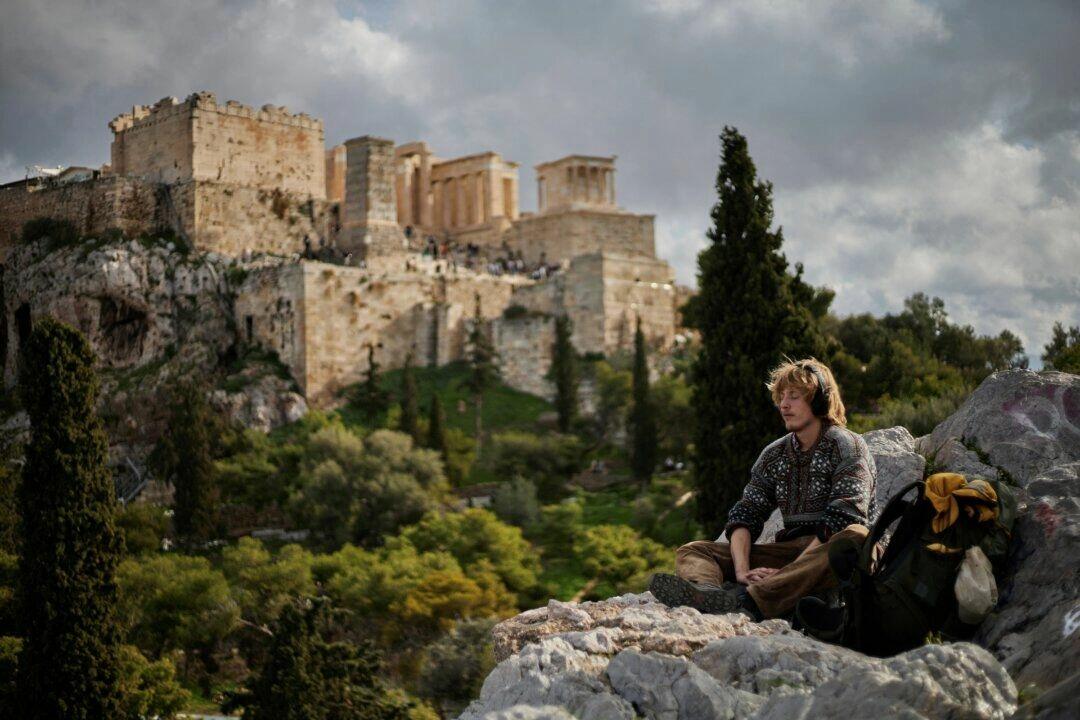
The word “Stoic” derives from the Greek term “Stoa Poikile,” or “painted portico,” which refers to a colonnade adorned with murals depicting famous battles in the central public hub of ancient Athens. It was along this decorated colonnade that Zeno of Citium, the founder of Stoicism, walked with his students, imparting the tenets of his philosophy.

Born into a merchant family during the reign of Alexander the Great, Zeno initially took up his father’s trade. However, after surviving a shipwreck, he went to Athens, where he discovered teachings by Socrates and decided to devote himself to philosophy.

After studying under several prominent Athenian philosophers, Zeno opened up his own school. He taught regularly in the public marketplace for almost 40 years, until his death around 262 B.C., and his ideas became the foundation of what became known as Stoicism.

Although most of the writings of Zeno and the other early Stoic philosophers did not survive, their ideas had a profound influence on the philosophical discourse of the time, in Athens and beyond.

They became especially popular in the early period of the Roman Empire, where Stoic ideas were often part of the educational curriculum and espoused by prominent statesmen such as Cicero and Seneca, and even by the emperor Marcus Aurelius.

Statue of Socrates at the Academy of Sciences, Humanities and Fine Arts in Athens on January 11, 2023. Photo by Martin Bertrand/Hans Lucas/AFP via Getty Images

Zeno and other early Stoics were undoubtedly influenced by Socrates, and the philosophy of Stoicism shares certain basic ideas with other philosophers in the Socratic tradition.

The four cardinal virtues taught by the Stoics—prudence, fortitude, temperance, and justice—were also discussed in the writings of both Plato and Aristotle. Stoics considered these virtues to be the highest virtues, on which all other virtues depend.

Prudence

It’s not the accident that distresses this person,” said Epictetus, according to a short manual of practical Stoic ideas compiled by Arrian known as “Enchiridion.” “[It] is the judgement which he makes about it.”

Prudence comes from the Latin word “prudentia,” meaning foresight or sagacity. It is described by Stoics as the ability to discipline one’s thoughts and actions through the use of reason.

Stoics taught that each individual has the potential to think and act in accordance with the divine reason of the universe by employing the portion of reason that resides in his or her own mind. By applying the intellect to the impressions created by the universe, one can make logical judgments concerning what is good or virtuous and what is not.

One of the main themes of Stoic philosophy is distinguishing between external factors that one can’t control and internal factors that one can. While many things that occur in the world are beyond our control, what we can control are our thoughts, actions, and reactions.

Fortitude

Roman statesman Seneca, who faced his death at the order of Roman emperor Nero with Stoic calmness, had written in one of his letters: “He who has learned to die has unlearned slavery; he is above any external power, or, at any rate, he is beyond it. What terrors have prisons and bonds and bars for him?”

Fortitude refers not only to patience and endurance, but also to courage and bravery. Stoics pointed to the importance of forbearance, of calmly enduring those things in life that cause pain and suffering, and of accepting those things as part of the world in which we live.

Suffering is an inevitable part of human existence. Though we can’t stop or prevent it, we can control how we react to it. To consider it reasonably and bear it nobly is wisdom.

Yet it is not only suffering that must be faced with courage, but also fear. Whether the fear of battle, loss, poverty, or even death, Stoics believe that it should be overcome with reason and faced with bravery.

Roman emperor Marcus Aurelius (121–180) is known for his “Meditations.” Biba Kayewich

According to his student Arrian in “Enchiridion,” Epictetus said, “I must die. If now, I am ready to die. If, after a short time, I now dine because it is the dinner-hour; after this I will then die. How? Like a man who gives up what belongs to another.”

Another theme that recurs frequently in Stoic writings is that of acting in accordance with one’s beliefs. It is not enough to merely attain wisdom; one must act in a manner that conforms to the wisdom one has attained. This is especially true when those actions might bring trouble, condemnation, or even death, as a violation of one’s conscience is worse than all of those.

Temperance

Temperance means self-control or self-restraint, and it was often used by Stoics to refer to guarding against both the indulgence in pleasure and the avoidance of pain.

The early Stoic philosopher Chrysippus described passion, or strong emotions, as a misleading force resulting from a failure to reason. In his treatise “On Passions,” Chrysippus identified the four primary passions to guard against: sorrow, pleasure, fear, and desire.

He referred to sorrow and pleasure as present emotions, while identifying fear and desire as emotions directed at the future. In all cases, he believed these emotions should be constrained by reason whenever they appear in one’s mind.

Stoics did not believe in seeking pleasure, nor in pursuing wealth, fame, or status. They also did not advise avoiding hardship or shying away from difficult, unpleasant, or uncomfortable tasks. They believed in using reason to determine what is right, and in acting on that determination regardless of whatever emotions may arise.

Justice

Cicero, who wrote extensively on Stoic ideas in “On Duties,” deemed justice as “the crowning glory of the virtues” and its primary duty to “keep one man from doing harm to another.”

He said that justice constitutes the common bond of human society and of a virtuous community of life. The Stoic virtue of justice is based on acting in accordance with the highest good.

Volunteers serve food during the "Turkey and Blessing" dinner at Lindale Church in Houston on Nov. 25, 2025. Ronaldo Schemidt/AFP via Getty Images

In other words, justice compels each person to conscientiously perform whatever duties fall to them, and it requires doing what is best for the community in which one lives. Thinking and acting with justice means fulfilling your duties to your fellow man, whatever they may be.

Justice, then, to the Stoic, is not some external system of punishment and reward, but rather a way of thinking and acting.

“Neither the senate nor the people can give us any dispensation for not obeying this universal law of justice,” Cicero wrote in “Treatise on the Commonwealth.” “It needs no other expositor and interpreter than our own conscience.”

Enduring Value of Stoic Virtues

These four cardinal virtues of Stoicism—prudence, fortitude, temperance, and justice—are interdependent.

Courage without prudence or temperance, or for purely selfish means, is not true courage, and neither is wisdom of any value without the fortitude to act on it. And of course, temperance, prudence, and fortitude are all necessary components of acting in service of the highest good, which is justice.

The virtues of Stoicism still provide guidance to the people living in modern society. The fact that this ancient philosophy has endured throughout the centuries and continues to inspire people around the world is a testament to its inherent value.

“The true felicity of life is to be free from perturbations, to understand our duties towards God and man, [and] to enjoy the present without any anxious dependence upon the future,” Seneca wrote in “Seneca’s Morals of a Happy Life, Benefits, Anger and Clemency.”

“[Rest] satisfied with what we have, which is abundantly sufficient; for he that is so, wants nothing,” he continued. “The great blessings of mankind are within us, and within our reach.”

"This Is The Finale Of The Great Financial Reset"; 'Dr.Gold' Warns They're Gobbling Up All The Physical Supply

   The silver to gold ratio has held steady in the ancient world between 8 and 12 to 1 for almost two millenniums. It was lower for the Egyptian at 2.5 to 1, then stabilized during the Roman times around 8 to 1 before moving up again to 9.5 in the Middle Ages. 

   Gold was said to be the Money of the kings, Silver the money of the upper class and copper (bronze) the money of the people. In French, money is called "Argent" (silver) because the Celts were using it extensively. In Chinese and Japanese, a bank is where you deposit your silver (银行 and 銀行 respectively) and the mountain of wealth in Peru (now Bolivia), the Potola was in fact a huge silver mine. 

   Since, silver has lost its luster. The Central Banks around the world kept their gold but sold their silver so much so that the ratio recently jumped to 100 to 1. This should not have been. If fact silver is rare and useful. Today, there are no silver mines left around the world. Silver has become a byproduct of the mining of other metals and over time this has resulted in a systematic deficit of production. 

   Markets should have reacted. The price of silver should have shot up. But it didn't. Slowly, during the 20th Century, actual metal deliveries were replaced by paper contracts on the Comex and other exchanges, so much so that eventually 98% of the market became virtual.

   This didn't mater much during the good times. Silver is bulky. Who wants to receive 2 tons of silver, monthly? It costs money to move and to store. 

   But then new technologies emerged and suddenly once again people needed silver It is a very good electric conductor. Plus, it was cheap and convenient. 

   It is only a few years ago that we started reading alarming reports: "Where was the silver going to come from in a few years?" Demand was exploding and no new mines were planned anywhere around the globe. 

   This leads us to the current market where suddenly, everyone is realizing that there is no silver left and consequently is asking for deliveries of actual metal. Normally when this happens, the price spikes (already the case as the ratio went from 100 to 50 in 2 years), reserves are found and the price comes down. Except that this time, it is truly different: There are no reserves available. 

   What happens then? Well, we are about to see, but nothing good. Markets are complex these days and deliveries have transportation, 30 day delays and other quirks baked in the cake (or rather in the contracts). The market will not implode overnight. But if deliveries fail, the market will implode. Confidence will be lost and the panic could quickly spread to other goods. If the silver market is broken, what else? 

   Well, welcome to 2026! 

by Greg Hunter’s USAWatchdog.com,

Financial writer and precious metals expert Bill Holter (aka Mr. Gold) has been sounding the alarm of the profound risk in the financial system.  

At the beginning of December, Mr. Gold warned about the record setting silver prices and said, “It’s pretty clear and pretty obvious that something behind the scenes is breaking.”

What is “breaking” is the extremely leveraged futures markets with not enough physical silver to deliver.  

Fast forward to the end of the month, and new record highs in gold and silver are happening every day.  Mr. Gold says,

They are gobbling up all the supply available because they understand this is the end of the fiat currency experiment that started August 15 of 1971.  Fiats are collapsing. 

This is the Hunt brothers on steroids because you have the entire world buying physical.  The Hunt brothers got into trouble because they were buying paper contracts, and COMEX changed the rules.  COMEX can change any rules they want . . . it won’t matter because the rest of the world is buying cash and carry . . . they will not accept paper contracts.  They want real physical metal.”

Here is where it gets both interesting and dangerous.  What happens if the short sellers cannot deliver the silver promised?  Mr. Gold says,

“People say if they can’t deliver, and I am going to tell you at some point they will not be able to deliver, when that moment happens, it’s game over for the entire financial system.  Silver, and I believe it will be silver that fails to deliver, silver is the blasting cap to the gold nuclear bomb.  When silver fails to deliver, then immediately there will be a pile into COMEX gold, and they will not be able to deliver the gold.  Once that happens, you have failures of contracts that are proven fraudulent.  They are zeroed out and cannot perform.  Then it spreads to cattle, pork bellies, grains and you name it.  This is not to mention the financials of stocks and bonds.  Once you prove fraud in silver, that’s going to spread to all the derivatives, and we will have a derivative meltdown. . .. The world wants gold and silver because those are the only two monies that cannot default.

What you are seeing in the gold and silver markets now is far from a top.  This is just getting started.  Mr. Gold says,

“These contracts are a zero-sum game.  There is a winner and a loser.  If the loser loses so big that they go belly up, then the winner becomes a loser because they can’t get paid.  That is the problem. . .. When this actually hits and there is a failure to deliver, gold and silver will be wiped off the shelves, and there will be none to be bought. . .. This will be a run for safety, and fear is the greatest emotion there is.  Fear is a far greater emotion than greed. . .. This is going to turn into a reverse bank run into gold and into silver because they cannot default in a world that is defaulting. . ..  What you are witnessing is the end of trust.  When you have the end of trust, the confidence breaks and credit is forthcoming only when there is trust.  Once confidence breaks, the credit markets will begin to seize up. . .. When credit stops, it’s game over.  You will see markets, institutions and stores shutter.”

2020 - COVID Christmas: Never Forget

   It is essential indeed to remember what happened in 2020.

   In 2001 after 9/11 they came for transportation. In 2020 for the jugular as the rules imposed extended all the way to our living rooms.

    The key question we need to answer is who organized this? And no, it wasn't the politicians who did, they just broadcasted the message. Those who did organize the Covid cabal are the people behind the curtain, those who really control the system through key national and international organisms. 

   The more un-elected organizations we build like the BIS, World Bank, WHO, EU and the likes, the freer these people become to arrange their schemes above the heads of governments who end up being completely unable to resist the pressure. Especially when they are spineless politician with no popular support whatsoever. 

   It doesn't mean we do not need supra-national organizations, just that we need to escape from the people who have put their hands over the Western dominated bodies. And for this, we need ASEAN or BRICS to rebalence the international world order with a heavier and better representation of emerging powers. 

  This will take place, sooner or later. Unfortunately, nobody in the West, especially the people who have the real power will renounce their control voluntarily. The war in Ukraine as well as tensions in Asia, the Middle East, Africa and South America are just the beginning, Expect the next coming phase to be far more heated.   

COVID Christmas: Never Forget

Yes, it's been five years.

Yes, it's the season of joy and forgiveness, blah blah blah.

But, fuck that!

In 2020, while the sheeple huddled in fear-porn isolation, a cabal of power-hungry bureaucrats and pharma-shilling "experts" pulled off the greatest heist in modern history: they stole Christmas.

Not with guns or tanks, but with "emergency decrees," arbitrary lockdowns, and endless streams of hysterical propaganda about a virus with a 99.7% survival rate for most.

Across the West, authoritarian governors and health czars like California's Gavin Newsom and New York's Andrew Cuomo played Grinch-in-Chief.

Family gatherings? Banned.

Churches closed on the holiest night of the year, while big-box retailers like Walmart raked in billions—essential, you see.

Travel restrictions grounded flights, borders slammed shut, and millions faced solitary holidays, Zoom "celebrations" replacing real human connection.

In the UK, Boris Johnson's last-minute Tier 4 lockdown crushed plans for millions, proving politicians love nothing more than moving goalposts.

And to ensure we don't forget (or forgive) those that imposed such a farce upon so many, Martin Armstrong dug up some images as a reminder...

The economic carnage was deliberate: small businesses gutted, restaurants shuttered, while Amazon's Jeff Bezos laughed all the way to his yacht.

Fauci the Flip-Flopper pontificated from his ivory tower, warning against singing carols or hugging grandma, as if seasonal joy itself was a superspreader event.

This wasn't public health - it was social engineering on steroids.

Fear was the weapon, compliance the goal.

The tyrants wrapped their theft in "science" bows, but the data later exposed the scam: excess deaths from despair, suicides, delayed treatments far outweighed their "saved" lives narrative.

Five years on, the damage lingers: fractured families, eroded trust, and a precedent for endless control.

Christmas 2020 wasn't just stolen - it was sacrificed on the altar of technocratic tyranny.

Never forget: they hated the Whos down in Whoville, and they'll do it again given half a chance.

Never Again!


Censorship at the BBC (Video - 2mn)

 Listen carefully to the short speech below. This is all you need to understand about the West at this stage:  https://www.youtube.com/sho...