Friday, December 26, 2025

The Stoic's Guide To Life: Ancient Wisdom For Modern Struggles

   This is THE most unsettling realization of our modern world: What if we are not as advanced as we believe we are? Yes, our technology has moved by leaps and bounds, but our philosophy has become atrophied. And although history has not ended as some suspected, our ability to "think" has definitively taken a hit and as AI is just about to deliver the final blow, maybe now is the time to revisit the ancients and listen once again to their wisdom. They did write it on stone!  

Authored by Duncan Burch via The Epoch Times,

Epictetus, a Greek Stoic philosopher who flourished during the early second century, said the chief task in life is to separate what is within one’s control from what is not.


Externals are not in my power; will is in my power,” the famed Stoic said, according to a series of teachings compiled by his student Arrian and known as “The Discourses.” “Where shall I seek the good and the bad? Within, in the things which are my own.”

The philosophy of Stoicism promotes the reliance on reason and logic to determine what is good or virtuous and calls on its adherents not only to make such a determination but to act on it.

Stoic ideas have had a profound effect on Western culture, including in the fields of philosophy, literature, ethics, and even mathematics, and many of the teachings remain popular today.

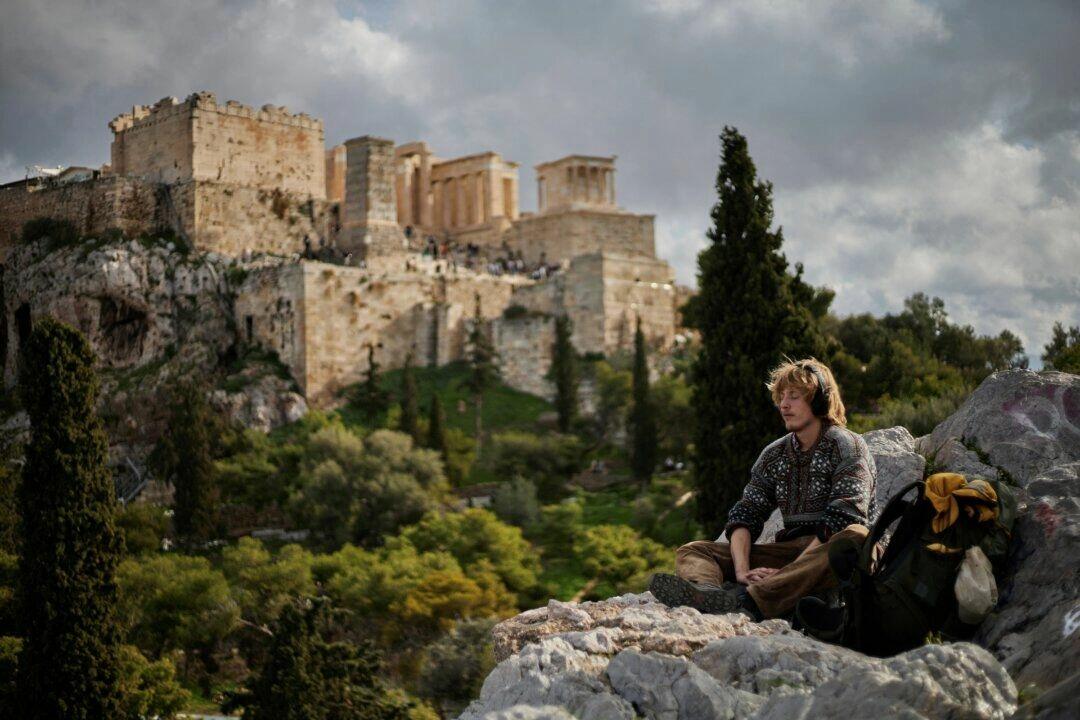
The word “Stoic” derives from the Greek term “Stoa Poikile,” or “painted portico,” which refers to a colonnade adorned with murals depicting famous battles in the central public hub of ancient Athens. It was along this decorated colonnade that Zeno of Citium, the founder of Stoicism, walked with his students, imparting the tenets of his philosophy.

Born into a merchant family during the reign of Alexander the Great, Zeno initially took up his father’s trade. However, after surviving a shipwreck, he went to Athens, where he discovered teachings by Socrates and decided to devote himself to philosophy.

After studying under several prominent Athenian philosophers, Zeno opened up his own school. He taught regularly in the public marketplace for almost 40 years, until his death around 262 B.C., and his ideas became the foundation of what became known as Stoicism.

Although most of the writings of Zeno and the other early Stoic philosophers did not survive, their ideas had a profound influence on the philosophical discourse of the time, in Athens and beyond.

They became especially popular in the early period of the Roman Empire, where Stoic ideas were often part of the educational curriculum and espoused by prominent statesmen such as Cicero and Seneca, and even by the emperor Marcus Aurelius.

Statue of Socrates at the Academy of Sciences, Humanities and Fine Arts in Athens on January 11, 2023. Photo by Martin Bertrand/Hans Lucas/AFP via Getty Images

Zeno and other early Stoics were undoubtedly influenced by Socrates, and the philosophy of Stoicism shares certain basic ideas with other philosophers in the Socratic tradition.

The four cardinal virtues taught by the Stoics—prudence, fortitude, temperance, and justice—were also discussed in the writings of both Plato and Aristotle. Stoics considered these virtues to be the highest virtues, on which all other virtues depend.

Prudence

It’s not the accident that distresses this person,” said Epictetus, according to a short manual of practical Stoic ideas compiled by Arrian known as “Enchiridion.” “[It] is the judgement which he makes about it.”

Prudence comes from the Latin word “prudentia,” meaning foresight or sagacity. It is described by Stoics as the ability to discipline one’s thoughts and actions through the use of reason.

Stoics taught that each individual has the potential to think and act in accordance with the divine reason of the universe by employing the portion of reason that resides in his or her own mind. By applying the intellect to the impressions created by the universe, one can make logical judgments concerning what is good or virtuous and what is not.

One of the main themes of Stoic philosophy is distinguishing between external factors that one can’t control and internal factors that one can. While many things that occur in the world are beyond our control, what we can control are our thoughts, actions, and reactions.

Fortitude

Roman statesman Seneca, who faced his death at the order of Roman emperor Nero with Stoic calmness, had written in one of his letters: “He who has learned to die has unlearned slavery; he is above any external power, or, at any rate, he is beyond it. What terrors have prisons and bonds and bars for him?”

Fortitude refers not only to patience and endurance, but also to courage and bravery. Stoics pointed to the importance of forbearance, of calmly enduring those things in life that cause pain and suffering, and of accepting those things as part of the world in which we live.

Suffering is an inevitable part of human existence. Though we can’t stop or prevent it, we can control how we react to it. To consider it reasonably and bear it nobly is wisdom.

Yet it is not only suffering that must be faced with courage, but also fear. Whether the fear of battle, loss, poverty, or even death, Stoics believe that it should be overcome with reason and faced with bravery.

Roman emperor Marcus Aurelius (121–180) is known for his “Meditations.” Biba Kayewich

According to his student Arrian in “Enchiridion,” Epictetus said, “I must die. If now, I am ready to die. If, after a short time, I now dine because it is the dinner-hour; after this I will then die. How? Like a man who gives up what belongs to another.”

Another theme that recurs frequently in Stoic writings is that of acting in accordance with one’s beliefs. It is not enough to merely attain wisdom; one must act in a manner that conforms to the wisdom one has attained. This is especially true when those actions might bring trouble, condemnation, or even death, as a violation of one’s conscience is worse than all of those.

Temperance

Temperance means self-control or self-restraint, and it was often used by Stoics to refer to guarding against both the indulgence in pleasure and the avoidance of pain.

The early Stoic philosopher Chrysippus described passion, or strong emotions, as a misleading force resulting from a failure to reason. In his treatise “On Passions,” Chrysippus identified the four primary passions to guard against: sorrow, pleasure, fear, and desire.

He referred to sorrow and pleasure as present emotions, while identifying fear and desire as emotions directed at the future. In all cases, he believed these emotions should be constrained by reason whenever they appear in one’s mind.

Stoics did not believe in seeking pleasure, nor in pursuing wealth, fame, or status. They also did not advise avoiding hardship or shying away from difficult, unpleasant, or uncomfortable tasks. They believed in using reason to determine what is right, and in acting on that determination regardless of whatever emotions may arise.

Justice

Cicero, who wrote extensively on Stoic ideas in “On Duties,” deemed justice as “the crowning glory of the virtues” and its primary duty to “keep one man from doing harm to another.”

He said that justice constitutes the common bond of human society and of a virtuous community of life. The Stoic virtue of justice is based on acting in accordance with the highest good.

Volunteers serve food during the "Turkey and Blessing" dinner at Lindale Church in Houston on Nov. 25, 2025. Ronaldo Schemidt/AFP via Getty Images

In other words, justice compels each person to conscientiously perform whatever duties fall to them, and it requires doing what is best for the community in which one lives. Thinking and acting with justice means fulfilling your duties to your fellow man, whatever they may be.

Justice, then, to the Stoic, is not some external system of punishment and reward, but rather a way of thinking and acting.

“Neither the senate nor the people can give us any dispensation for not obeying this universal law of justice,” Cicero wrote in “Treatise on the Commonwealth.” “It needs no other expositor and interpreter than our own conscience.”

Enduring Value of Stoic Virtues

These four cardinal virtues of Stoicism—prudence, fortitude, temperance, and justice—are interdependent.

Courage without prudence or temperance, or for purely selfish means, is not true courage, and neither is wisdom of any value without the fortitude to act on it. And of course, temperance, prudence, and fortitude are all necessary components of acting in service of the highest good, which is justice.

The virtues of Stoicism still provide guidance to the people living in modern society. The fact that this ancient philosophy has endured throughout the centuries and continues to inspire people around the world is a testament to its inherent value.

“The true felicity of life is to be free from perturbations, to understand our duties towards God and man, [and] to enjoy the present without any anxious dependence upon the future,” Seneca wrote in “Seneca’s Morals of a Happy Life, Benefits, Anger and Clemency.”

“[Rest] satisfied with what we have, which is abundantly sufficient; for he that is so, wants nothing,” he continued. “The great blessings of mankind are within us, and within our reach.”

"This Is The Finale Of The Great Financial Reset"; 'Dr.Gold' Warns They're Gobbling Up All The Physical Supply

   The silver to gold ratio has held steady in the ancient world between 8 and 12 to 1 for almost two millenniums. It was lower for the Egyptian at 2.5 to 1, then stabilized during the Roman times around 8 to 1 before moving up again to 9.5 in the Middle Ages. 

   Gold was said to be the Money of the kings, Silver the money of the upper class and copper (bronze) the money of the people. In French, money is called "Argent" (silver) because the Celts were using it extensively. In Chinese and Japanese, a bank is where you deposit your silver (银行 and 銀行 respectively) and the mountain of wealth in Peru (now Bolivia), the Potola was in fact a huge silver mine. 

   Since, silver has lost its luster. The Central Banks around the world kept their gold but sold their silver so much so that the ratio recently jumped to 100 to 1. This should not have been. If fact silver is rare and useful. Today, there are no silver mines left around the world. Silver has become a byproduct of the mining of other metals and over time this has resulted in a systematic deficit of production. 

   Markets should have reacted. The price of silver should have shot up. But it didn't. Slowly, during the 20th Century, actual metal deliveries were replaced by paper contracts on the Comex and other exchanges, so much so that eventually 98% of the market became virtual.

   This didn't mater much during the good times. Silver is bulky. Who wants to receive 2 tons of silver, monthly? It costs money to move and to store. 

   But then new technologies emerged and suddenly once again people needed silver It is a very good electric conductor. Plus, it was cheap and convenient. 

   It is only a few years ago that we started reading alarming reports: "Where was the silver going to come from in a few years?" Demand was exploding and no new mines were planned anywhere around the globe. 

   This leads us to the current market where suddenly, everyone is realizing that there is no silver left and consequently is asking for deliveries of actual metal. Normally when this happens, the price spikes (already the case as the ratio went from 100 to 50 in 2 years), reserves are found and the price comes down. Except that this time, it is truly different: There are no reserves available. 

   What happens then? Well, we are about to see, but nothing good. Markets are complex these days and deliveries have transportation, 30 day delays and other quirks baked in the cake (or rather in the contracts). The market will not implode overnight. But if deliveries fail, the market will implode. Confidence will be lost and the panic could quickly spread to other goods. If the silver market is broken, what else? 

   Well, welcome to 2026! 

by Greg Hunter’s USAWatchdog.com,

Financial writer and precious metals expert Bill Holter (aka Mr. Gold) has been sounding the alarm of the profound risk in the financial system.  

At the beginning of December, Mr. Gold warned about the record setting silver prices and said, “It’s pretty clear and pretty obvious that something behind the scenes is breaking.”

What is “breaking” is the extremely leveraged futures markets with not enough physical silver to deliver.  

Fast forward to the end of the month, and new record highs in gold and silver are happening every day.  Mr. Gold says,

They are gobbling up all the supply available because they understand this is the end of the fiat currency experiment that started August 15 of 1971.  Fiats are collapsing. 

This is the Hunt brothers on steroids because you have the entire world buying physical.  The Hunt brothers got into trouble because they were buying paper contracts, and COMEX changed the rules.  COMEX can change any rules they want . . . it won’t matter because the rest of the world is buying cash and carry . . . they will not accept paper contracts.  They want real physical metal.”

Here is where it gets both interesting and dangerous.  What happens if the short sellers cannot deliver the silver promised?  Mr. Gold says,

“People say if they can’t deliver, and I am going to tell you at some point they will not be able to deliver, when that moment happens, it’s game over for the entire financial system.  Silver, and I believe it will be silver that fails to deliver, silver is the blasting cap to the gold nuclear bomb.  When silver fails to deliver, then immediately there will be a pile into COMEX gold, and they will not be able to deliver the gold.  Once that happens, you have failures of contracts that are proven fraudulent.  They are zeroed out and cannot perform.  Then it spreads to cattle, pork bellies, grains and you name it.  This is not to mention the financials of stocks and bonds.  Once you prove fraud in silver, that’s going to spread to all the derivatives, and we will have a derivative meltdown. . .. The world wants gold and silver because those are the only two monies that cannot default.

What you are seeing in the gold and silver markets now is far from a top.  This is just getting started.  Mr. Gold says,

“These contracts are a zero-sum game.  There is a winner and a loser.  If the loser loses so big that they go belly up, then the winner becomes a loser because they can’t get paid.  That is the problem. . .. When this actually hits and there is a failure to deliver, gold and silver will be wiped off the shelves, and there will be none to be bought. . .. This will be a run for safety, and fear is the greatest emotion there is.  Fear is a far greater emotion than greed. . .. This is going to turn into a reverse bank run into gold and into silver because they cannot default in a world that is defaulting. . ..  What you are witnessing is the end of trust.  When you have the end of trust, the confidence breaks and credit is forthcoming only when there is trust.  Once confidence breaks, the credit markets will begin to seize up. . .. When credit stops, it’s game over.  You will see markets, institutions and stores shutter.”

2020 - COVID Christmas: Never Forget

   It is essential indeed to remember what happened in 2020.

   In 2001 after 9/11 they came for transportation. In 2020 for the jugular as the rules imposed extended all the way to our living rooms.

    The key question we need to answer is who organized this? And no, it wasn't the politicians who did, they just broadcasted the message. Those who did organize the Covid cabal are the people behind the curtain, those who really control the system through key national and international organisms. 

   The more un-elected organizations we build like the BIS, World Bank, WHO, EU and the likes, the freer these people become to arrange their schemes above the heads of governments who end up being completely unable to resist the pressure. Especially when they are spineless politician with no popular support whatsoever. 

   It doesn't mean we do not need supra-national organizations, just that we need to escape from the people who have put their hands over the Western dominated bodies. And for this, we need ASEAN or BRICS to rebalence the international world order with a heavier and better representation of emerging powers. 

  This will take place, sooner or later. Unfortunately, nobody in the West, especially the people who have the real power will renounce their control voluntarily. The war in Ukraine as well as tensions in Asia, the Middle East, Africa and South America are just the beginning, Expect the next coming phase to be far more heated.   

COVID Christmas: Never Forget

Yes, it's been five years.

Yes, it's the season of joy and forgiveness, blah blah blah.

But, fuck that!

In 2020, while the sheeple huddled in fear-porn isolation, a cabal of power-hungry bureaucrats and pharma-shilling "experts" pulled off the greatest heist in modern history: they stole Christmas.

Not with guns or tanks, but with "emergency decrees," arbitrary lockdowns, and endless streams of hysterical propaganda about a virus with a 99.7% survival rate for most.

Across the West, authoritarian governors and health czars like California's Gavin Newsom and New York's Andrew Cuomo played Grinch-in-Chief.

Family gatherings? Banned.

Churches closed on the holiest night of the year, while big-box retailers like Walmart raked in billions—essential, you see.

Travel restrictions grounded flights, borders slammed shut, and millions faced solitary holidays, Zoom "celebrations" replacing real human connection.

In the UK, Boris Johnson's last-minute Tier 4 lockdown crushed plans for millions, proving politicians love nothing more than moving goalposts.

And to ensure we don't forget (or forgive) those that imposed such a farce upon so many, Martin Armstrong dug up some images as a reminder...

The economic carnage was deliberate: small businesses gutted, restaurants shuttered, while Amazon's Jeff Bezos laughed all the way to his yacht.

Fauci the Flip-Flopper pontificated from his ivory tower, warning against singing carols or hugging grandma, as if seasonal joy itself was a superspreader event.

This wasn't public health - it was social engineering on steroids.

Fear was the weapon, compliance the goal.

The tyrants wrapped their theft in "science" bows, but the data later exposed the scam: excess deaths from despair, suicides, delayed treatments far outweighed their "saved" lives narrative.

Five years on, the damage lingers: fractured families, eroded trust, and a precedent for endless control.

Christmas 2020 wasn't just stolen - it was sacrificed on the altar of technocratic tyranny.

Never forget: they hated the Whos down in Whoville, and they'll do it again given half a chance.

Never Again!


Thursday, December 25, 2025

This Flock Camera Leak is like Netflix For Stalkers (Video - 11mn)

  The video below highlight a detail: Many public video cameras are accessible on the Internet. No problem? Well, no, because together with other tools it becomes a breeze to identify you. 

  Face recognition and anybody knows who you are. Car plate registry and again address granted. You go to work on this specific road every day at 8am? Your house may be empty then? So face, data, patterns... there are hundreds of ways to link data and therefore countless possibilities to follow you. 

  We don't care so much for advertising since mostly the tracking is harmless, but if we talk about "anybody" on the Internet following you, it is not quite difficult to imagine quite a few very nasty applications.     

  Most of these applications used to be difficult and technical to implement. Not anymore with AI, and that's when the true nightmare begins. 

  Privacy is important. When our identity is compromised, we may lose more than a few banknotes. The explosion of tracking devices and cameras is slowly building a network that will soon be not only inescapable but with AI, aware of our presence at any given time in a specific location. 

  Is this really the future we want?   

https://www.youtube.com/watch?v=vU1-uiUlHTo&t=192s

Wednesday, December 24, 2025

Doug Casey’s Top Predictions for 2026…

   Doug Casey below is on the pessimistic side, clearly but then again, reality for now has vindicated the trends he is exposing. In a crisis, people expect "events". They do come, from time to time, but mostly you recognize them after the facts or when we decide that it was indeed a turning point. Case in point: Nothing much happened on the 14th of July 1789 in Paris. The Bastille was a poorly guarded citadel with only 6 prisoners, mostly wealthy, kept in comfortable conditions, so the "Storming of the Bastille" was probably quite an overstatement. But the Revolution had to start "somewhere" so history decided that "Bastille" it would be. 

  It is the same today. One day we may decide that DeepSeek, Unitree Robotics or a Taikonaut on the Moon marked the progress of China, although in reality, this was a 50-year event starting with Deng Xiaoping in the late 1970s.  

  I do believe that events in 2026 are likely because some of the current trends are approaching a breaking point. Although unlikely, the US buildup in the Caribbean Sea could dissolve, the Ukraine war could last another year and Europe keep closing itself with more and more control of the Internet. But all this wouldn't be "nothing", just the continuation of downward trends which eventually will result in major changes.

  Think about the world before the Covid Crisis in 2020 or 9/11 in 2001. These are events. Conversely, it is not the crisis of 2008 which changed the financial landscape, as we just dodged the bullet at the time. The crash of the Repo market in 2019 (which I believe was what triggered the artificial Corona Crisis in order to inject massive trillions of subsidies to "save" the system a few months later), or the explosion of gold in 2025 which underline the gradual marginalization of the dollar currency in international trade, are appropriately true silent events taking place over months rather than days triggering a cascade of consequences which in the end are over time transforming our world drastically. 

  2025 was one of these "almost" event-less years. High in tensions, low in happenings. 2026 could be too, but probably won't. We may finally have reached the gate of "interesting times".    

Doug Casey’s Top Prediction for 2026… What It Means for You and Your Money

Via International Man

International Man: What do you see as the single most important thing that people should prepare for in 2026?

Doug Casey: Strauss and Howe asked that question in their book, The Fourth Turning. We’re at a major turning point in the U.S.

I’ve felt for years that the U.S. was heading toward something like a civil war. It could be as serious as the unpleasantness of the 1860s, just different. The red people and the blue people in the U.S. really dislike each other; they can’t even talk to each other. When things get to that stage, things are typically solved by force; I expect that’s what’s going to happen. Very likely during the next three years, while Trump is still in office. He’s the perfect catalyst.

It’s going to be exacerbated by the long-term migration trends. If we look 100 years down the road, it’s pretty clear that with modern travel and communications technologies, the migration of people from poor countries to rich countries all around the world will accelerate. Eventually, the U.S. won’t even exist in its present form. Of course, that’s true of every country. The colors of the map on the wall have been running since Day One.

I hope a catastrophic upset doesn’t happen in the near future for any number of reasons. For one, it won’t be any fun. For another, I’m a huge fan of traditional America. It was a unique institution in world history—the only country ever founded on the concepts of free thought, free markets, and individualism. A civil war—regardless of what form it takes—would likely overturn those things.

While I hope things mellow out, hope isn’t the best foundation for making plans.

International Man: Geopolitically, tensions continue to build across Europe, the Middle East, and East Asia.

Where do you expect the major flashpoints to emerge in 2026?

Doug Casey: The politicians who run Europe are uniformly despicable non-entities, from Ursula von der Leyen, She-Wolf of the EU, on down. One proof of that statement is that I could be prosecuted just for saying so in much of Europe. They’re soulless bureaucrats who stand for nothing but statism and collectivism. They’re driving Europe to actively rearm, doubling military budgets, reinstituting the draft, and talking about the necessity of war with Russia. I suspect they’ll get their war; I just hope it doesn’t go nuclear or biological. Odd, in that it’s over the Ukraine, the most backward and corrupt country on the continent. Perverse, in that it was never even a country until Lenin created it in 1923.

But that’s not all. The euro, an Esperanto currency, the “Who owes you nothing?” of fiat currencies, is a dead duck. All of the EU’s member countries are bankrupt welfare states. In fact, the European Union itself is going to break up. What’s good for individual countries is totally at odds with what the 80,000—and that’s an accurate number—EU employees in Brussels want to impose. NATO, which should have been disbanded when the USSR collapsed, will also disappear. Europe will, best case, become a petting zoo for Chinese tourists and a luxury resort for Third World migrants.

The Middle East? While Trump is in office, we might as well adopt Israel as the 51st state. That won’t go down well with the world’s two billion Muhammadans. Don’t confuse the friendly relations of Washington with the governments of Saudi Arabia, Qatar, and others among the 55 Muslim countries with political stability. Most are economic basket cases and extremely unstable.

East Asia? It’s perfectly irrational for China to attack Taiwan. The result would be widespread destruction on both sides—even if the US and/or Japan didn’t join the party. But governments do irrational things, unpredictably. What will happen with China’s claims on the East and South China Seas? It should be between them and six of their maritime neighbors. But the US could turn a regional border dispute into WW3.

But the unexpected flashpoint, I think, is going to be Africa. Over the last 60 years, the 55 African states (that’s only an approximate number since we don’t know how places like Libya, Western Sahara, Somaliland, or Darfur will wind up) have developed significant armies, aided by weapons and training from Europe and the US. They survive on the export of raw materials (causes of perpetual conflict) and aid from Europe and the U.S. (which is likely to evaporate). All of them (like almost everywhere in the Middle East and Central Asia) are artificial constructs with arbitrary borders. They’re all unstable kleptocracies run from the presidential palace.

The question is: to what degree will Europe, or especially the U.S., or especially Trump, stick their nose into African border wars and civil wars? There will be lots of them. I think Africa is the big powderkeg that nobody’s talking about.

International Man: The U.S. domestic political situation remains combustible, with deep cultural and economic fractures.

How do you expect America’s internal divisions to evolve in 2026 as we approach the midterms?

Doug Casey: Trends in motion tend to stay in motion. Despite the fact that corporations, the entertainment industry, academia, and the media seem to be backing away from truly insane levels of wokeism, the issue is in doubt. The trend toward Wokeism has built momentum for decades, and the country’s been indoctrinated with it for generations. It’s not going away overnight.

Trump is purposefully and overtly polarizing. As I discussed last week (link), although he may see himself as Cincinnatus, he’s more like Caesar. He’ll keep stirring things up, if only because he knows what his adversaries will do to him when he’s out of office. While most sensible people love his antiwokeism, most of his economic and international interventionism will backfire—bigly. I suspect he’ll lose the midterms, and the Dems in the House will impeach him again. Will they succeed in the Senate this time? The natives will get restless no matter what.

International Man: With Trump poised to replace Fed Chair Powell, he will exert a stronger influence over central bank policy. What do you expect the monetary environment of 2026 to look like?

Doug Casey: The dollar will approach its intrinsic value as Trump and the Fed create a trillion more of them. It’s a formula for chaos.

Trump is a big believer in mercantilist-style economics, which holds that the US must export more than it imports. I think he’ll try to force that issue with foreign exchange controls of some type, creating yet more distortions.

You want to exit the dollar, own precious metals, avoid the stock market and bond markets, and get your money out of the U.S. None of this is a formula for domestic tranquility, either in 2026, 2027, 2028, or beyond. And I’m assuming there will be a normal election in 2028, which is not a very safe assumption.

International Man: Investors are torn between chasing the current market bubble and preparing for a potential financial reckoning.

Where do you think the biggest risks and opportunities will be in 2026, and which asset classes are positioned to benefit most from the turbulence ahead?

Doug Casey: There’s no question about the fact that most of Trump’s business success has been due to borrowing. Leverage, low interest rates, and inflation made the man.

Trump’s history and incorrect understanding of economics tell me that the Fed will buy and monetize more government debt than ever, doing everything they can to artificially depress interest rates. For the short run, that could argue for the stock market going higher in 2026. But it’s a high-risk bet. Do you feel lucky?

With gold over $4,000 and silver over $60, they’re probably where they “should” be relative to other things. But as unstable as the world is, and because of their unique advantages, they’re going higher. The smart thing is to speculate on the shares of miners; they’re really cheap, and neither the public nor the institutions even know they exist, for reasons I’ve discussed in the past. All-in sustaining costs of producing gold is about $1,500 an ounce. It’s not hard to do the math.

In the last 50 years, we’ve had five 10-to-1 mining bull markets. I think we’re about to experience one more. A big one. Many of the smaller stocks have already gone three or four to one. Nobody cares… which is good.
 

Via International Man

International Man: What do you see as the single most important thing that people should prepare for in 2026?

Doug Casey: Strauss and Howe asked that question in their book, The Fourth Turning. We’re at a major turning point in the U.S.

I’ve felt for years that the U.S. was heading toward something like a civil war. It could be as serious as the unpleasantness of the 1860s, just different. The red people and the blue people in the U.S. really dislike each other; they can’t even talk to each other. When things get to that stage, things are typically solved by force; I expect that’s what’s going to happen. Very likely during the next three years, while Trump is still in office. He’s the perfect catalyst.

It’s going to be exacerbated by the long-term migration trends. If we look 100 years down the road, it’s pretty clear that with modern travel and communications technologies, the migration of people from poor countries to rich countries all around the world will accelerate. Eventually, the U.S. won’t even exist in its present form. Of course, that’s true of every country. The colors of the map on the wall have been running since Day One.

I hope a catastrophic upset doesn’t happen in the near future for any number of reasons. For one, it won’t be any fun. For another, I’m a huge fan of traditional America. It was a unique institution in world history—the only country ever founded on the concepts of free thought, free markets, and individualism. A civil war—regardless of what form it takes—would likely overturn those things.

While I hope things mellow out, hope isn’t the best foundation for making plans.

International Man: Geopolitically, tensions continue to build across Europe, the Middle East, and East Asia.

Where do you expect the major flashpoints to emerge in 2026?

Doug Casey: The politicians who run Europe are uniformly despicable non-entities, from Ursula von der Leyen, She-Wolf of the EU, on down. One proof of that statement is that I could be prosecuted just for saying so in much of Europe. They’re soulless bureaucrats who stand for nothing but statism and collectivism. They’re driving Europe to actively rearm, doubling military budgets, reinstituting the draft, and talking about the necessity of war with Russia. I suspect they’ll get their war; I just hope it doesn’t go nuclear or biological. Odd, in that it’s over the Ukraine, the most backward and corrupt country on the continent. Perverse, in that it was never even a country until Lenin created it in 1923.

But that’s not all. The euro, an Esperanto currency, the “Who owes you nothing?” of fiat currencies, is a dead duck. All of the EU’s member countries are bankrupt welfare states. In fact, the European Union itself is going to break up. What’s good for individual countries is totally at odds with what the 80,000—and that’s an accurate number—EU employees in Brussels want to impose. NATO, which should have been disbanded when the USSR collapsed, will also disappear. Europe will, best case, become a petting zoo for Chinese tourists and a luxury resort for Third World migrants.

The Middle East? While Trump is in office, we might as well adopt Israel as the 51st state. That won’t go down well with the world’s two billion Muhammadans. Don’t confuse the friendly relations of Washington with the governments of Saudi Arabia, Qatar, and others among the 55 Muslim countries with political stability. Most are economic basket cases and extremely unstable.

East Asia? It’s perfectly irrational for China to attack Taiwan. The result would be widespread destruction on both sides—even if the US and/or Japan didn’t join the party. But governments do irrational things, unpredictably. What will happen with China’s claims on the East and South China Seas? It should be between them and six of their maritime neighbors. But the US could turn a regional border dispute into WW3.

But the unexpected flashpoint, I think, is going to be Africa. Over the last 60 years, the 55 African states (that’s only an approximate number since we don’t know how places like Libya, Western Sahara, Somaliland, or Darfur will wind up) have developed significant armies, aided by weapons and training from Europe and the US. They survive on the export of raw materials (causes of perpetual conflict) and aid from Europe and the U.S. (which is likely to evaporate). All of them (like almost everywhere in the Middle East and Central Asia) are artificial constructs with arbitrary borders. They’re all unstable kleptocracies run from the presidential palace.

The question is: to what degree will Europe, or especially the U.S., or especially Trump, stick their nose into African border wars and civil wars? There will be lots of them. I think Africa is the big powderkeg that nobody’s talking about.

International Man: The U.S. domestic political situation remains combustible, with deep cultural and economic fractures.

How do you expect America’s internal divisions to evolve in 2026 as we approach the midterms?

Doug Casey: Trends in motion tend to stay in motion. Despite the fact that corporations, the entertainment industry, academia, and the media seem to be backing away from truly insane levels of wokeism, the issue is in doubt. The trend toward Wokeism has built momentum for decades, and the country’s been indoctrinated with it for generations. It’s not going away overnight.

Trump is purposefully and overtly polarizing. As I discussed last week (link), although he may see himself as Cincinnatus, he’s more like Caesar. He’ll keep stirring things up, if only because he knows what his adversaries will do to him when he’s out of office. While most sensible people love his antiwokeism, most of his economic and international interventionism will backfire—bigly. I suspect he’ll lose the midterms, and the Dems in the House will impeach him again. Will they succeed in the Senate this time? The natives will get restless no matter what.

International Man: With Trump poised to replace Fed Chair Powell, he will exert a stronger influence over central bank policy. What do you expect the monetary environment of 2026 to look like?

Doug Casey: The dollar will approach its intrinsic value as Trump and the Fed create a trillion more of them. It’s a formula for chaos.

Trump is a big believer in mercantilist-style economics, which holds that the US must export more than it imports. I think he’ll try to force that issue with foreign exchange controls of some type, creating yet more distortions.

You want to exit the dollar, own precious metals, avoid the stock market and bond markets, and get your money out of the U.S. None of this is a formula for domestic tranquility, either in 2026, 2027, 2028, or beyond. And I’m assuming there will be a normal election in 2028, which is not a very safe assumption.

International Man: Investors are torn between chasing the current market bubble and preparing for a potential financial reckoning.

Where do you think the biggest risks and opportunities will be in 2026, and which asset classes are positioned to benefit most from the turbulence ahead?

Doug Casey: There’s no question about the fact that most of Trump’s business success has been due to borrowing. Leverage, low interest rates, and inflation made the man.

Trump’s history and incorrect understanding of economics tell me that the Fed will buy and monetize more government debt than ever, doing everything they can to artificially depress interest rates. For the short run, that could argue for the stock market going higher in 2026. But it’s a high-risk bet. Do you feel lucky?

With gold over $4,000 and silver over $60, they’re probably where they “should” be relative to other things. But as unstable as the world is, and because of their unique advantages, they’re going higher. The smart thing is to speculate on the shares of miners; they’re really cheap, and neither the public nor the institutions even know they exist, for reasons I’ve discussed in the past. All-in sustaining costs of producing gold is about $1,500 an ounce. It’s not hard to do the math.

In the last 50 years, we’ve had five 10-to-1 mining bull markets. I think we’re about to experience one more. A big one. Many of the smaller stocks have already gone three or four to one. Nobody cares… which is good.

Tuesday, December 23, 2025

UK Proposes 24/7 Phone Surveillance & VPN Age Verification (Video - 18mn)

  This is truly unbelievable. The UK is turning full Orwell 1984. Not as a metaphor, as reality. All the DEI, foreign invasion, anti-white propaganda, pro-LGBT woke policies were just the appetizer. Now the dish has been served. This is truly the end of freedom, not just the beginning of the end. The inquisition is on its way, soon they will lit the fires. Heretics will be hunted once again. 

 https://www.youtube.com/watch?v=uzmR4nt1rpE

  Same in the EU by the way. Except for European parliamentarians who wisely exclude themselves from the laws they want to apply to other people down below. Pure serfdom in other words!  

https://www.youtube.com/watch?v=QqbVjHzLRqs

Venezuela - Cloud of confusion; PSYOP, oil, and coup (Video - 39mn)

  Very interesting take of the Duran concerning what happened in Venezuela as a coup d'etat. This is both convincing and likely as it ex...