Authored by David Stockman via InternationalMan.com,
Notwithstanding
the historic fluidity of borders, there is no case whatsoever that
Russia’s invasion of Ukraine in February 2022 was “unprovoked” and
unrelated to NATO’s own transparent provocations in the region.
The details are arrayed below, but the larger issue needs be addressed first.
Namely,
is there any reason to believe that Russia is an expansionist power
looking to gobble up neighbors which were not integral parts of its own
historic evolution, as is the case with Ukraine?
After
all, if despite Rubio’s treachery President Trump does manage to strike
a Ukraine peace and partition deal with Putin you can be sure that the
neocons will come charging in with a false Munich appeasement analogy.
The answer, however, is a resounding no!
Our
firm rebuke of the hoary Munich analogy as it has been falsely applied
to Putin is based on what might be called the double-digit rule. To wit,
the true expansionary hegemons of modern history have spent huge parts
of their GDP on defense because that’s what it takes to support the
military infrastructure and logistics required for invasion and
occupation of foreign lands.
For instance, here are the figures
for military spending by Nazi Germany from 1935–1944 expressed as a
percent of GDP. This is what an aggressive hegemon looks like in the
ramp-up to war: German military spending had already reach 23% of GDP,
even before its invasion of Poland in September 1939 and its subsequent
commencement of actual military campaigns of invasion and occupation.
Not
surprisingly, the same kind of claim on resources occurred when the
United States took it upon itself to counter the aggression of Germany
and Japan on a global basis. By 1944 defense spending was equal to 40%
of America’s GDP, and would have totaled more than $2 trillion per year
in present day dollars of purchasing power.
Military Spending As A Percent Of GDP In Nazi Germany
- 1935: 8%.
- 1936: 13%.
- 1937: 13%.
- 1938: 17%.
- 1939: 23%.
- 1940: 38%.
- 1941: 47%.
- 1942: 55%.
- 1943: 61%.
- 1944: 75%
By
contrast, during the final year before Washington/NATO triggered the
Ukraine proxy war in February 2022, the Russian military budget was $65 billion, which amounted to just 3.5% of its GDP.
Moreover,
the prior years showed no build-up of the kind that has always
accompanied historic aggressors. For the period 1992 to 2022, for
instance, the average military spending by Russia was 3.8% of GDP– with a minimum of 2.7% in 1998 and a maximum of 5.4% in 2016.
Needless
to say, you don’t invade the Baltics or Poland—to say nothing of
Germany, France, the Benelux and crossing the English Channel—on 3.5% of GDP! Not even remotely.
Since full scale war broke out in 2022 Russian military spending has increased significantly to 6% of GDP, but all of that is being consumed by the Demolition Derby in Ukraine—barely 100 miles from its own border.
That
is, even at 6% of GDP Russia has not yet been able to subdue its own
historic borderlands. So if Russia self-evidently does not have the
economic and military capacity to conquer its non-Ukrainian neighbors in
its own region, let alone Europe proper, what is the war really about?
In
short, it is rooted in territorial disputes and civil strife in lands
which have been vassals or integral parts of greater Russia for several
centuries. As indicated, Ukraine actually means “borderlands” in the
Russian language, connoting stateless areas that were first assembled
into a coherent polity by Lenin, Stalin and Khrushchev by force of arms
after 1920.
In fact, prior to the communist takeover of Russia, no
country that even faintly resembled today’s Ukrainian borders had ever
existed. So what NATO’s proxy war actually amounts to is an insensible attempt to enforce the dead hand of the Soviet presidium, as we amplify below.
For
avoidance of doubt here are sequential maps that tell the story, and
which make mincemeat of the Washington/NATO sanctity of borders
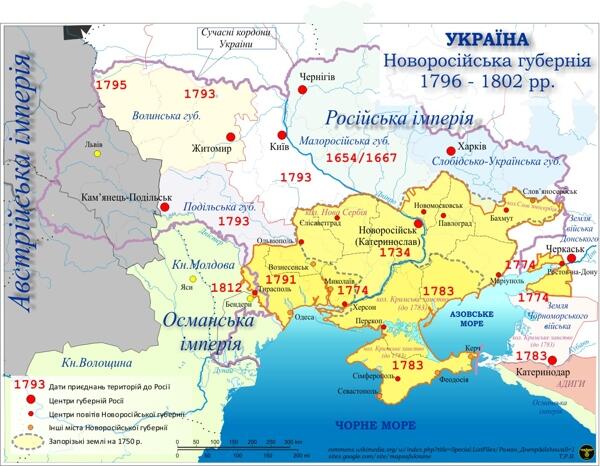
malarkey. The first of these is a 220-year-old map from 1800, where the
yellow area depicts the approximate territory of the five
regions—Donetsk, Luhansk, Kherson and Zaporizhia plus Crimea—that will
be allowed to go their own way, including back to Mother Russia, if the
key ingredients of the Donald’s 28-point peace place can be resurrected.
As
it has happened, these regions have voted overwhelmingly during
referendums in 2023 and 2014, respectively, to separate from Ukraine in
favor of affiliation with Russia.
Collectively, the five regions
were historically known as the aforementioned Novorossiya or “New
Russia” and had been acquired by Russian rulers, including Catherine the
Great between 1734 and 1791.
The red markings within the yellow
areas of the map designate the year of Russian acquisition.
Self-evidently, therefore, the Russian Empire had gradually gained
control over this vast area north of the Black Sea before the end of the
18th century. To that end, it had signed peace treaties with the
Cossack Hetmanate (1734) and with the Ottoman Empire at the conclusion
of the various Russo-Turkish Wars of that era.
Pursuant to this
expansion drive – which included massive Russian investment and the
in-migration of large Russian populations to the region – Russia
established the “Novorossiysk Governaorate” in 1764. The latter was
originally to be named after the Empress Catherine, but she decreed that
it should be called “New Russia” instead.
The Provinces Of Ukraine Slated For Partition By The Trump Plan Were Part Of Russia Before The US Constitution Was Even Written
Map: © Роман Днепр, CC BY-SA 3.0
Completing
the assemblage of New Russia, Catherine forcefully liquidated its
aforementioned century-long Cossack ally known as the Zaporizhian Sich
(present day Zaporizhia) in 1775 and annexed its territory to
Novorossiya, thus eliminating the independent rule of the Ukrainian
Cossacks. Later in 1783 she acquired Crimea from the Turks, which was
also added to Novorossiya, as shown in yellow area of the map above.
During
this formative period, the infamous shadow ruler under Catherine,
Prince Grigori Potemkin, directed the sweeping settlement and
Russification of these lands. Effectively, Catherine had granted him the
powers of an absolute ruler over the area from 1774 onward.
The spirit and importance of “New Russia” at this time is aptly captured by the historian Willard Sunderland,
“The
old steppe was Asian and stateless; the current one was
state-determined and claimed for European-Russian civilization. The
world of comparison was now even more obviously that of the Western
empires. Consequently, it was all the more clear that the Russian empire
merited its own “New Russia” to go along with everyone else’s New
Spain, New France and New England. The adoption of the name of New
Russia was in fact the most powerful statement imaginable of Russia’s
national coming of age.
In fact, the passage of time solidified
the borders of Novorossiya even more completely. One century later the
light-yellow area of the 1897 map below gave an unmistakable message: To
wit, in the late Russian Empire there was no doubt as to the paternity
of the lands adjacent to the Azov Sea and the Black Sea: They were now
part of the 125 years-old “New Russia”.
Where’s Waldo—Ukraine—on This Map
After
the Russian Revolution, of course, the pieces and parts in this region
of the old Czarist Empire were bundled-up into a convenient
administrative entity by the new red rulers of Moscow, who christened it
the “Ukrainian SSR” (Soviet Socialist Republic). In a like manner, they
created similar administrative entities in Belorussia, Georgia,
Moldavia, Turkmenistan etc.—ultimately confecting 15 such faux
“republics”.
During the course of this communist state-building,
here is how and when these brutal tyrants attached each piece of today’s
Ukrainian map to the territories acquired or seized by the Russian
Czars over 1654-1917 (yellow area):
The old Novorossiya of the Donbas and Black Sea rim was added to the Ukraine SSR by Lenin in 1922.
The
western territory around Lviv that been known as Little Poland and
Galicia were captured by Stalin in 1939 and thereafter when he and
Hitler carved up Poland.
Upon the death of the bloody
Stalin in 1954, Khrushchev made a deal with his Presidium allies to
transfer Crimea from the Russian SSR to the Ukrainian SSR in return for
their support in the battle for succession.
In a word,
Ukraine is the bastard spawn of communist blood and iron. Yet during the
last decade the Washington and the NATO warhawks have spent upwards of
$300 billion to ensure that the handiwork of autocratic Czars and
Commissars remains intact into the 21st century and presumably beyond.
It
is ironic, therefore, that the historically illiterate Donald Trump has
the good sense to dispense with one of the stupidest crusades that the
War Party on the Potomac has yet concocted. So doing, he would enable
the failed handiwork of communist tyrants to be made right with
history—an outcome that can now happen if and only if the Donald gets
the Rubio digression back on track.
Modern Ukraine: Born In Communist Blood and Iron
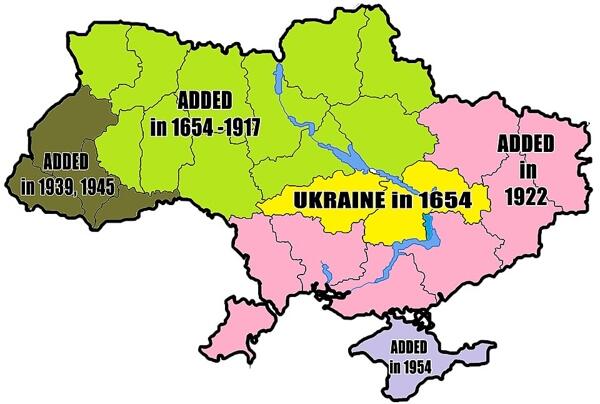
Image: © Sven Teschke et al., CC BY-SA 3.0.
Of
course, had the above-mentioned 20th century communist trio been noble
benefactors of mankind, perhaps their subsequent map-making handiwork
and reassignment of Novorossiya to Ukraine might have been justified.
Under this benign counterfactual, they would have presumably combined
peoples of like ethnic, linguistic, religious and politico-cultural
history into a cohesive natural polity and state. That is, a nation
worth perpetuating, defending and perhaps even dying for.
Alas,
the reason that Trump is right to attempt to end this bloody catastrophe
via partition is that the very opposite was true. From 1922 to 1991
modern Ukraine was held together by the monopoly on violence of its
brutally totalitarian rulers. And that became more than evident when the
Kremlin temporarily lost control of Ukraine during the military battles
of World War II. During that especially bloody interlude, the communist
administrative entity called Ukraine came apart at the seams.
That
is, local Ukrainian nationalists joined Hitler’s Wehrmacht in its
depredations against Jews, Poles, Roma and Russians when it first swept
through the country from the west on its way to Stalingrad; and then, in
turn, the Russian populations from the Donbas and south campaigned with
the Red Army during its vengeance-wreaking return from the east after
winning the bloody 1943 battle of Stalingrad that turned the course of
WWII.
Not surprisingly, therefore, virtually from the minute it
came out from under the communist yoke when the Soviet Union was swept
into the dustbin of history in 1991, Ukraine has been engulfed in
political and actual civil war. The elections which did occur were
essentially 50/50 at the national level but reflected dueling 80/20 vote
breakouts within the regions. That is, the Ukrainian nationalist
candidates tended to get vote margins of 80% + in the West/Central
areas, while Russian-sympathizing candidates got similar pluralities in
the mainly Russian-speaking East and South.
This pattern
transpired because once the iron-hand of totalitarian rule ended in
1991, the deep and historically rooted conflict between Ukrainian
nationalism, language and politics of the central and western regions of
the country and the Russian language and historical religious and
political affinities of the Donbas and south came rushing to the
surface.
Accordingly, so-called democracy barely survived these
contests until February 2014 when one of Washington’s “color
revolutions” finally “succeeded”. That is to say, the Washington
fomented and financed nationalist-led coupe d état ended the fragile
post-communist equilibrium.
That’s the true meaning of the Maidan
coup. It ended the tenuous cohesion that kept the artificial state of
Ukraine intact for barely two decades after the Soviet demise. So save
for Washington’s destructive intervention, the partition of a
communist-confected state that had never been built to last would have
materialized all on its own–perhaps like in Czechoslovakia—-and likely
sooner than later.
At the end of the day, therefore, the necessary
impending partition of the rogue state of Ukraine is not a case at all
of legitimate sovereign borders being violated. Nor does it involve an
assault on the hypocritical notion of a “rules-based international
order” that has not actually ever existed and which, instead, has been a
cover for Washington’s global hegemony all along.
But the lessons
are nonetheless profound. History accumulates and eventually leads to
destructive, but wholly unnecessary outcomes.
That is the case
today with the utterly foolish action of Washington during the 1990s and
2000s to bring former Warsaw Pact Nations, and even breakaway Soviet
Republics into a NATO alliance whose mission was over and done in 1991.
It
should have been dismantled then and there. When the old Soviet monster
with its 50,000 tanks and 7,000 nuclear warheads disappeared into the
dustbin of history, there was no longer a threat to the east. There was
no “front line” to defend.
At that point Washington should have
and easily could have led the world to disarmament and to a revival of
the lasting peace that had disappeared in the “Guns of August” in 1914.
But
now the NATO section 5 mutual defense commitment to these 31 nations is
equivalent to a stupid charity that the nearly bankrupt Federal
government cannot afford in any case.
There is absolutely nothing
in it for the enhancement of America’s homeland security, and huge
incentives for the politicians of these nations to caterwaul against
Russia rather than seek peaceful accommodation.
So here is
the historic moment before us: The Donald now needs to tell Rubio in no
uncertain terms to take a hike and then return to the essence of the
28-point plan and agree with Putin to a partition of Ukraine.
So
doing, he would not only end the utter stupidity of NATO’s proxy war on
Russia, but in the process accomplish something more of literally epic
proportions: Namely,the defenestration of the neocons, official
Washington, NATO, the rules based international order and all the other
globalist humbug that has saddled America with $1.5 trillion per year
Warfare State and Global Empire that it cannot afford and doesn’t need.


