A very complete overview of the Chinese AI models. But how did we got there?
Well, what about this:

In 2012, when my team was building statistical models, I was in the US once a month. Five years later, I was in Shanghai every week. (It's closer to Japan but communication was more difficult with many bright young engineers we needed to train.) So having seen the transformation of China over the last 20 years, I find the outcome rather obvious.
A Deep Dive Inside Kimi K3, And All Other Chinese AI Models: The Definitive China LLM Primer
We were lucky enough to read the tea leaves ahead of the "frontier", so to speak, and conclude that various "open" models out of China would soon be the biggest talking point - not to mention the market's fulcrum catalyst. See for example:
- June 19: Answering The "Trillion Dollar Question": Are China's AI Models A Better Value Than US Models
- June 22: Deep Seek 2.0? China's GLM 5.2 Model Takes AI World By Storm With Stunning Mix Of Capabilities & Price
More recently, last week we summarized virtually all of China's AI Models in "The Definitive LLM Primer" (July 11), which we republished below for our readers' convenience, yet in the fast-paced world of AI, even that article is now woefully out of data due to the recent arrival of Moonshot's open-sourced Kimi K3 (July 16), which has not only taken the AI world by storm, but promptly sparked a momentum meltdown amid growing fears that Chinese LLMs are catching up too fast to frontier US models (something we warned about one month ago here). The reason for the jarring market reaction is that Kimi K3 is viewed as being on par, if not better, than most leading US frontier models.

Big news: Kimi-K3 by @Kimi_Moonshot is now #1 in the Frontend Code Arena with 1679 pts, surpassing Claude Fable 5.
— Arena.ai (@arena) July 16, 2026
This is a 17-place jump from Kimi-k2.6 (#18 -> #1).
In Frontend, Kimi-K3 ranked #1 in 6 of 7 domains: Brand & Marketing, Reference-Based Design, Data & Analytics,… https://t.co/YDN3BufGkC pic.twitter.com/Oa6teaQnWp
And while there is rampant debate whether this performance is accurate or gamed to beat specific benchmarks, the bigger issue is that China is now clearly developing stunning(ly cheap) open-sourced models which are on par with much more expensive US models, which in itself renders the entire ROI calculus behind trillions in AI capex spending null and void, because if China can achieve 98% what the US has done with a fraction of the capex...
China is now leading the AI arms race after spending a tenth what the US did https://t.co/CkPbXzffwi pic.twitter.com/sJOwU0KZhp
— zerohedge (@zerohedge) July 17, 2026
... then all those trillions already allocated to AI capex are nothing more than sunk costs, as end markets will quickly pivot to what is cheapest, since in most cases it is also on par with what is best.
So what happened for those who went on vacation early last week and are stunning how everything has changed?
Well, as Ronald Keung, the Goldman strategist who wrote the original Chinese LLM primer said late on Friday, we have gone "from cost efficiency (DeepSeek), rise in model intelligence (GLM) to new frontier/pricing power at Kimi K3."
Below we excerpt from his latest note (available to pro subs):
On July 17, the Kimi K3 open-weight model was released with 2.8 trillion parameters, and has set a new frontier in coding and certain agentic capabilities globally, as per Arena.ai coding rank and Artificial Analysis Intelligence score.

Accordingly, Goldman notes K3’s pricing was set at a new high amongst Chinese models, US$2.3 per 1M tokens (blended) vs. Qwen3.7 Max of US$1.4/Zhipu’s GLM5.2 of US$0.9/MiniMax’s M3 of US$0.22/DeepSeek’s V4 Pro of US$0.18, being still below global SOTA models.

As highlighted in our recent China LLM primer, China’s AI open-source/open-weight models are reaching a critical point of intelligence performance for global proliferation. Amongst signposts into 2H 2026, we have anticipated that competition could intensify in the high-end coding segment via coding data flywheel and scaling (to larger models, up to 2-5 trillions parameter sizes). The share price reaction of Knowledge Atlas/Zhipu (where Goldman recently initiated at Neutral, -28% on July 17) and MiniMax (Buy-rated, -16% on July 17) have been due to concerns around Chinese AI model competition and who the potential long-term winners will be, given the competitive landscape/sustainability of model company leadership remains highly dynamic.

Here, Goldman repeats that Independent AI model companies stand out in its Competitive Positioning framework (see full report for more). The bank also notes the positive read from Chinese President Xi’s comments at the opening ceremony of World Artificial Intelligence Conference (WAIC) in Shanghai held last Friday, drawing parallels of AI’s societal impact to the invention of electricity and steam engines, and in offering China’s technology infrastructure to developing nations with its continued open approach, yet cautioned on the need for human oversight/controls and risk mitigation.

What to watch out for from here?
- Harness/agentic applications: We expect China AI model companies to increasingly focus on positioning their harness/agentic applications as key entry points, especially in coding (e.g. Zhipu’s ZCode, Tencent’s Workbuddy, and Alibaba’s Qoder which are aggregate platforms that support the full suite of AI models) as model companies attempt to close the loop in capturing more real-life coding and agentic data for scaling. Co-work and industry expert agentic products could be the next priorities.
- Multiple large parameter high-end coding model launches and potentially stricter access to the most advanced Chinese AI models outside of China: After Kimi K3 launch, we anticipate for further new Chinese AI model launches over 2H26 (Zhipu GLM, Alibaba Qwen, MiniMax M3 Pro and more) with significantly larger total parameter sizes of 2-5 trillion across Chinese AI model players. Coding/programming segment competition will remain intense. The addition of multi-modal/visual understanding will also be the next upgrades amongst Chinese AI foundation models.
- Continued suppressed API pricing for the lower end agentic-focused segment: Goldman expects API pricing and therefore gross margins to remain under pressure at the lower-end pricing segment (around US$0.1-0.2 per 1M tokens) into the second half, as China’s AI model players have significant cash buffers post-fund raising to subsidize competitive pricing. As a result, we see financial strength as one of the three most important metrics (alongside pricing power and cost efficiencies) in assessing a Chinese AI model company.
- Multi-modal/video-generation models to see further ARR ramp-up from global adoption: Goldman expects continued healthy industry pricing and gross margins within video generation (unlike foundation text) where key players ByteDance’s SeeDance (at reportedly 70% gross margins, latest US$2bn ARR run-rate), Kuaishou’s (Buy) Kling and MiniMax’s (Buy) Hailuo/upcoming H3 models to enjoy healthy growth over 2H 2026 amid new functionality breakthroughs (combination of video-generation with LLM) and tight computing resources where demand significantly outpaces capacity.
- Expect increasing domestic ASICs supply, any stricter access to China’s future most frontier models for overseas markets, Western markets’ policies on China models, and access to high-end computing in model training as key swing factors/risks to our China AI model token/revenue growth trajectory.
Goldman's key ideas/stock picks
Within Cloud & Data Centers (the bank's top preferred sub-sector within China Internet), GS continues to highlight key ideas (Alibaba, GDS, VNET, and Kingsoft Cloud) on the back of higher AI hyperscaler capex spending into 2H 2026.
Within AI models, Keung highlights MiniMax on upside skewed risk-reward. Key swing factors for MiniMax to improve its overall competitive positioning will hinge on its pricing power following its recent completed fund-raising that has strengthened financial strength. Expect its H3 video generation model performance (imminent launch in a more favorable industry landscape vs. text models) and time-to-market for its next M3 updates (focusing on further coding intelligence level uplift from post-training/reinforcement learning, we estimate M3 update over July-Aug, and a larger parameter size M3 Pro model later in 2H 2026) will be the next key drivers.
Yet what may be the clearest signal yet just how competitive with the US Chinese LLMs have become comes from none other than OpenAI's "head of strategic futures" (presumable that title refers to whoever can demand protectionism the loudest) who essentially is begging for protectionism against open Chinese LLMs...
Some observations on Kimi:
— Dean W. Ball (@deanwball) July 17, 2026
1. It's a very good model! I don't think its performance can be explained away by distillation or anything like that. In agentic coding sessions, it seems pretty much on par with the best public models of Q1 2026. In my fairly limited use, it also…
... and the scathing retorts from Trump's (former?) AI Tsar David Sacks, who responds that "K3 just fixed 15 critical security bugs that Codex and Fable refused because of “cyber guardrails.” There’s no reason to limit American models on tasks that Chinese models handle without issue. We’re only making ourselves less competitive." And then again, here to point out that Chinese LLMs are already more useful to some programmers than the best of the (very expensive) best Anthropic and OpenAI have the offer, to wit: "Here’s another example: Hugging Face tried using American frontier models to analyze an AI-powered cyber attack. But the guardrails blocked requests containing real exploit payloads so they switched to GLM 5.2 running locally. The guardrails actually impaired defensive security."
More in the full Goldman China LLM update focusing on Kimi K3, available to pro subs.
Meanwhile, for those who missed our original report on Chinese LLMs from July 11, we republish it below in its entirety.
* * *
Three weeks ago, we attempted a lengthy answer of the "trillion dollar question" namely are Chinese AI models a better value than US models and, using extensive research from UBS, concluded that at almost 95% of the capability (and rising) and just 10% of the cost, the answer was a resounding yes.
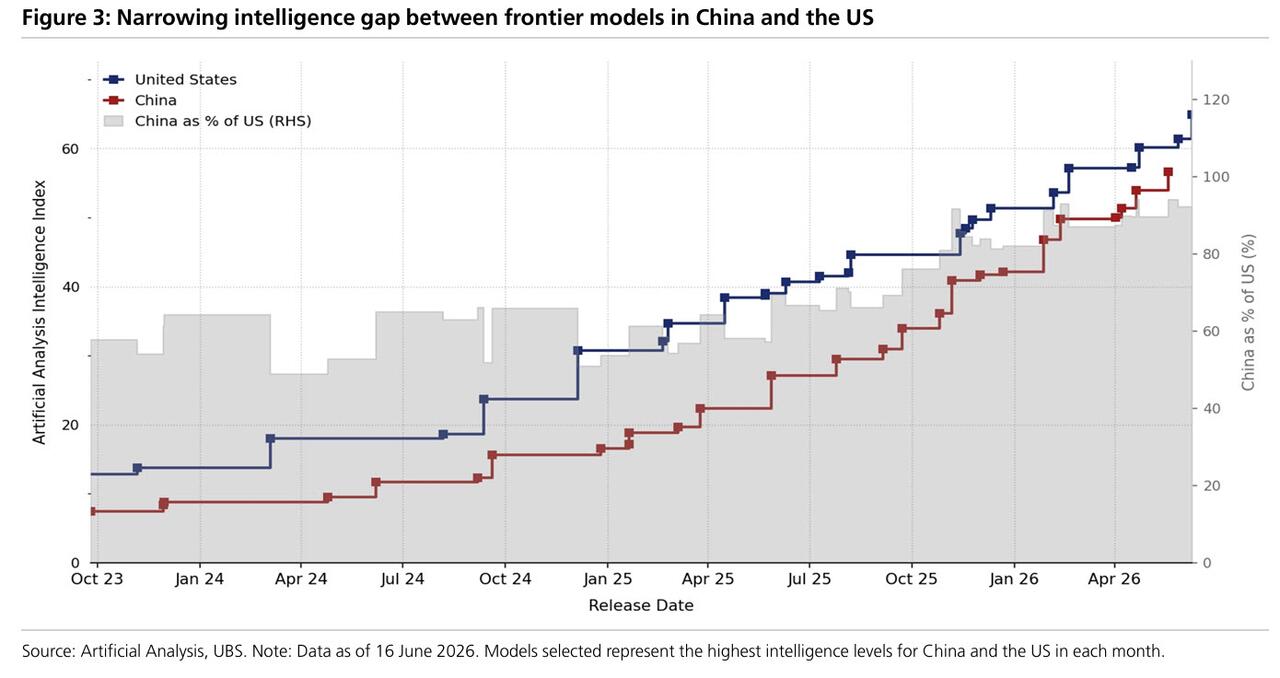

Fast forward to today when Goldman analyst Ronald Keung also addressed the $64 trillion elephant in the room, and published a 50-page China AI models LLM primer (available to pro subs), in which he agrees with our conclusion, namely that "China's AI open-source/open-weight models are reaching a critical point of intelligence performance vs. global proprietary models, with a significant ramp up in domestic enterprise & global SME adoption that will enable a positive data flywheel of further model improvement."
In the report, Goldman evaluates:
- How these models achieve such performance at low costs/tight computing resources;
- Why they pursue an open-source/open-weight approach and how they monetize;
- What the key addressable markets are, as global enterprises shift from 'token-maxxing' to ROI-first, where Goldman highlights two favored ARR quadrants for Chinese models; and
- Who the potential long-term winners will be under the bank's Competitive Positioning framework.
In keeping with the recent newsflow, Ronald notes that ongoing politicization of AI, namely any stricter access to China's future 'most frontier' models for overseas markets, Western markets' policies on China models, and access to high-end computing in model training, are three key swing factors/risks to the bank's China AI model token/revenue growth trajectory.
Additionally, the Goldman strategist introduces his Chinese AI model Competitive Positioning framework based on pricing power, cost advantage and financial strength, overlaying with token scale and market share progressions, and identify Knowledge Atlas (Zhipu, initiation) and DeepSeek (private) as the strongest positioned in foundation models, and Bytedance (private) in multi-modal.
Before we get into the weeds, excerpted from the gull Goldman report, lets start with a visual summary of China's AI Model and Hyperscaler Ecosystem...

... and a Breakdown of China's open-source models unit economics today and path to profitability

Which brings us to the core overarching theme of Chinese AI development, from cheap to smart, or as Goldman's Ronald Keung puts it:
From DeepSeek’s moment last year (on cost efficiency) to Zhipu’s GLM moment this year (on model intelligence).
China’s AI open-source/open-weight models are reaching a critical point of intelligence performance vs. global proprietary models, with a significant ramp up in domestic enterprise adoption and a proliferation of global consumer and SME demand. In this report, Goldman evaluates:
- How these models achieve such performance at low costs/tight computing resources;
- Why they pursue an open source/open weight approach and how they monetize;
- What the key addressable markets are, where the bank highlights two favored ARR quadrants and risk factors; and
- Who the potential long-term winners will be under Goldman's Competitive Positioning framework.
Chinese models are reaching a critical ‘good enough’ stage for agentic tasks/specific coding scenarios, and rising fragmentation in China’s AI model landscape (but the strong will get stronger). While pricing power remains strong for models with frontier performance/multi-modal, the lower-end segment is in a price war; nevertheless, Agentic AI is driving explosive demand for these value-for-money models at the lower-end. Access to computing will be a swing factor, where US/China regulations, balance sheet and inference efficiency are key. Accordingly, the bank introduces its Chinese AI model Competitive Positioning framework based on pricing power, cost advantage and financial strength, overlaying with token scale and market share progressions, and identify several companies its views as the strongest positioned in both foundation models and in multi-modal.
How do Chinese models achieve competitive performance at low costs/tight computing resources? By leveraging smaller-sized parameter models for equivalent benchmark performance, and Mixture-of-Expert and new architectural innovations. Chinese AI models are bifurcating into a two-tiered market where performance and time to market are key to pricing power, thereby leading to two ‘ARR maximizing’ quadrants based on token adoption and pricing. A positive flywheel is taking effect for top Chinese AI models driven by increasing actual real world coding adoption, and reducing their reliance on model distillation practices.
Why are Chinese models pursuing an open source/open weight approach, and ways to monetize? Open source allows for greater flexibility in model training/deployment, and allows for the widest adoption and an open community. Open-source models’ disclosed ARRs are likely understating total deployment and revenue potentials, and Goldman expects more shifts to open weight (with Community License, i.e., commercial terms if for commercial use) among Chinese AI models down the road.
What are the key addressable markets, domestically and internationally, and key risks? The bank highlights two favored ARR quadrants and estimate China/China AI models market to see token growth of 25X by 2030E; the coding landscape to consolidate while the agentic/low-end segment could remain fragmented. International (going global) should be a key upside, with the potential for higher pricing and global proliferation, especially in non-US markets as global enterprises increasingly pivot from a token-maxxing to a ROI-first model that prioritizes clear task boundaries, number of agents per day, back-end process automation and actual output over pure computational token volume.
Key risk factors are market access/anti-distillation and regulations, including any stricter access to China’s future most frontier models for overseas markets, access to highest-end leased computing equipment (used for training), market access to western markets, further restriction lists/entity list designations (but this could be positive for China’s path to further AI self-sufficiency across software/CPU/ASICs), and competition from SLM/threat from AI architectures.
Who are best positioned to be the long term winners within China’s AI model companies? Goldman expects players with the largest ARR scale with a gross margin advantage + financial strength to be the long-term winners. The bank highlights independent AI model companies mostly stand out in its Competitive Positioning framework in pricing power + cost advantage (in aggregate represent over US$200bn in implied valuations, based on latest market cap/funding rounds), where Zhipu and DeepSeek are the most strongly positioned in text based foundation models, while ByteDance leads in multi-modal capabilities.
Signposts for 2H 2026
Harness/agentic applications: China AI model companies will increasingly focus on positioning their harness/agentic applications as key entry points, especially in coding (e.g. Zhipu’s ZCode, Tencent’s Workbuddy, and Alibaba’s Qoder which are aggregate platforms that support the full suite of AI models) as model companies attempt to close the loop in capturing more real-life coding and agentic data for scaling. Co-work and industry expert agentic products could be the next priorities. Enterprises will increasingly focus on overall cost per task instead of headline pricing per token, with an openness to using different models (multiple-models approach).
Multiple large parameter high-end coding model launches and potentially stricter access to the most advanced Chinese AI models outside of China: Multiple new Chinese AI model launches are expected over 2H26 with significantly larger total parameter sizes of 2-5 trillion across Chinese AI model players. Coding/programming segment competition will intensify as Chinese models try to challenge Zhipu GLM’s leadership via training on high-quality real-life coding data (where available) and scaling to larger parameter model sizes. There may be a potential shift from an open-source to an open-weight approach for best-performing models (i.e. from free-for-all use cases to requiring revenue sharing/a take rate for commercial use). The addition of multi-modal/visual understanding will be the next upgrades amongst Chinese AI foundation models (e.g. for GLM, DeepSeek), while MiniMax M3 already excels in these given the multi-modal focus of MiniMax from the start. That said, press reports on potential future restrictions on overseas access to China’s most advanced AI models (both closed and open source if at the frontier level) as cutting-edge artificial intelligence is increasingly being seen as a critical national asset.
Continued suppressed API pricing for the lower end agentic-focused segment: While DeepSeek recently announced an increase in peak-hour pricing from mid-July, API pricing and therefore gross margins should remain under pressure at the lower-end pricing segment (around US$0.1-0.2 per 1M tokens) into the second half, as China’s AI model players have significant cash buffers post-fund raising to subsidize competitive pricing at zero/negative gross margins in the near term. As a result, financial strength will be one of the three most important metrics (alongside pricing power and cost efficiencies) in assessing a Chinese AI model company, where cash on hand, net cash as % of assets and valuation multiples will be the critical financial strength metrics for long-term success. This said, Goldman is Buy-rated on MiniMax as the company stands out on cost efficiency/cost advantage metrics under a Competitive Positioning framework. With its M3 model well positioned in the favored ARR maximizing quadrant (attractive pricing + high token volumes), alongside its discounted valuation at 13X P/2026E year-end ARR (vs. China/global peers which command multiples several times higher at similar ARR stage), risk-reward is skewed to the upside (Goldmanb reiterates its Buy rating of the stock). Key swing factors for MiniMax to improve its overall competitive positioning will hinge on its pricing power and financial strength. Its H3 video generation model performance (imminent launch in a more favorable industry landscape vs. text models) and time-to-market for its next M3 updates (focusing on further coding intelligence level uplift from post-training/reinforcement learning, estimated over July-Aug, and a larger parameter size M3 model later in 2H 2026) will be the next key drivers.
Multi-modal/video-generation models to see further ARR ramp-up from global adoption: Goldman expects continued healthy industry pricing and gross margins within video generation (unlike foundation text) where key players ByteDance’s SeeDance, Kuaishou’s (Buy) Kling and MiniMax’s Hailuo/upcoming H3 models to enjoy healthy growth over 2H 2026 amid new functionality breakthroughs (combination of video-generation with LLM) and tight computing resources where demand significantly outpaces capacity. According to China news reports like LatePost and 36Kr, ByteDance’s Seedance gross margins have been at a healthy 70% at its latest US$2bn+ ARR run-rate.
The bank's strategists also expect increasing domestic ASICs supply, tighter access to overseas computing resources and potential market access limitations (could mirror TikTok’s trajectory where rapid expansion in western markets was followed by more regulations/focus on ensuring data security where computing will have to be conducted within local jurisdictions).
Goldman's assessment of AI model companies: ARR scale x gross margin advantage + financial strength
- Largest ARR scale (Token scale x pricing power)
- Gross margin advantage (Training & Inference efficiency, Technology)
- Financial strength (Balance sheet, Access to computing)
Accordingly, the bank lays out its Competitive Positioning framework for AI model players based on quantifiable metrics, 1) Pricing Power (amongst which, based on Time-to-market of model launch, Arena score based on actual usage cases and pricing level), 2) Cost advantage (based on token volume scale, throughput/cache hit rate, parameter sizes/activation ratio and our estimate of inference gross margins), and 3) Financial strength (based on cash on-hand, net cash as % of assets, and valuation multiples).

Next, an overview of competitive analysis for key LLM labs’ positioning

The bank identifies two favorable ARR quadrants (in maximizing ARR) which is a combination of maximizing token volumes and/or pricing level

Comparing China’s key LLM players

Decoding China’s AI model tokens & our forecasts on token/revenue share

How do Chinese models achieve competitive performance at low costs/tight computing resources
Smaller-sized parameters models for equivalent benchmark performances, Mixture-of-Expert and new architectural innovations
As readers of our Chinese LLM primer may recall, compared with a year ago, Chinese models’ coding and agentic capabilities have reached a critical level in being able to complete more coding and autonomous agentic tasks with higher success rates as context windows have been expanded to 1 million tokens. The smaller parameter model sizes of Chinese models (spanning from 200bn to 1.6T parameters, at 2-10% of leading SOTA models, due to constrained access to high-end computing), and highly efficient architectures (MoE, Sparse Attention, OCR etc., at 3-5% activated parameters only vs. total parameter sizes) all contribute to the much lower training and inference costs for Chinese models vs. leading US models. Goldman attributes the recent step improvement of Chinese models in coding according to Arena.ai to data curation, distillation techniques and reinforcement learning post training, despite their relatively small parameter model sizes (1.6T for DeepSeek V4 Pro, 0.7T for Zhipu’s GLM5.2 and 0.4T for MiniMax’s M3). On June 27, DeepSeek introduced DSpark, a speculative decoding framework that makes existing DeepSeek-V4 models serve faster. DSpark has already been deployed in DeepSeek-V4 Flash / Pro online serving, improving per-user DeepSeek-V4 generation 60-85% faster on V4-Flash and 57-78% faster on V4 Pro without changing the model’s weights or output quality.
Chinese AI models bifurcating into two-tiered market (where performance and time to market are key to pricing power), with two ‘ARR maximising’ quadrants based on token adoption and pricing
Goldman is seeing pricing power for the highest performing Chinese AI models, e.g. Zhipu’s GLM5.2 model and Alibaba’s Qwen3.7 Max models at around US$1 per blended 1M tokens, at 5X that of low-end Chinese AI models. The reported tighter US processes in allowing most SOTA model access has also opened new arenas for China’s top performing coding models for enterprises and SMEs. Smaller parameter and activated ratios allow China’s top performing models to be priced at US$1, 10-25% vs. US SOTA models at US$4-8 per blended 1M tokens, while generating double digit 10-20% gross margins (GSe) that are lower than global SOTA models due to relatively lower pricing power. In the lower-end segment, agentic focused models are priced at US$0.06-0.2 per blended 1M tokens, which are enabling these models to tap into new global TAMs for price sensitive SMEs and one-man companies. MiniMax generates 60-70% revenues from overseas.
Note that DeepSeek announced that its V4 official version is set for launch in mid-July, alongside the introduction of peak/off-peak API pricing to better allocate resources and improve service stability. V4 Pro/Flash non-peak pricing remains unchanged, while peak hour (9am-12pm/2pm-6pm China time) will be charged at 2X non-peak rates, implying blended pricing of US$0.35/US$0.12 per 1M tokens due to strong Chinese AI model demand that is increasingly causing significant compute tightness in work/productivity scenarios.
Positive flywheel is taking effect for top Chinese AI models from increasing actual real world coding adoption, with less reliance on model distillation ahead
Compared with learning and distillation tactics from global SOTA models in the past, top Chinese models like GLM5 are reaching a critical stage of adoption by China’s major enterprises and global users. As per LatePost, AI-generated code has increased to as high as 90% at some China mega-cap companies, up from 20-30% in 2H25, which will enable a positive data flywheel effect of further improvements via reinforcement learning with actual user data (both successful and unsuccessful coding cases) and post training. These have underpinned the step improvements in GLM5.2 from GLM5.1 in just over the course of a few months in 2026, and expect to see further step improvements to Chinese AI models over the next 6-12 months.

In coding/agentic tasks, Chinese players are reaching global top-tier positions

Compared with global SOTA leading models of several tens of trillions, China open source models are mostly around or below 1 trillion parameter in size, and adopt a MoE structure, with low activated to total parameter ratios for higher inference efficiency.

Blended LLM token price (SDLLMTK) has been declining since early June, potentially driven by rising adoption of cost effective China models

Historical and projected capex for major US & China cloud service providers

Capex to operating cash flow ratio is still healthy for China hyperscalers

Case study on Meituan’s LongCat 2.0: A milestone for China’s domestic AI infrastructure
Released on June 30, 2026, Meituan’s LongCat 2.0 marks a major milestone as China’s first official 1.6 trillion-parameter open-source Mixture-of-Experts (MoE) model trained and deployed entirely on a 50,000-card domestic compute cluster. Purpose-built for agentic coding and complex software engineering workflows, the model features a native 1-million-token context window enabled by LongCat Sparse Attention (LSA) and dynamically activates an average of 48 billion parameters per token to optimize inference costs. Implications for a more self-sustainable China AI model outlook that is less reliant on foreign high-end chips for model training: The successful end-to-end pre-training and inference of a trillion-parameter class model on Chinese silicon (reportedly utilizing Huawei Atlas-950 SuperPods) fundamentally drives a more sustainable China’s AI model development outlook, in our view. While previous Chinese flagship models, such as DeepSeek V4-pro, mentioned domestic chips for inference, LongCat 2.0’s ability to overcome critical memory bottlenecks and distributed stability challenges during the compute-heavy pre-training phase proves the viability of a wider and more localized hardware stack for AI model training in the future.

Why are Chinese models pursuing an open source/open weight approach, and ways to monetize?
Open source allows for higher flexibility in model training/deployment, and allows for the widest adoption and an open community
Alibaba’s Qwen model family has long pursued an open source approach (before adopting a closed source for its largest and highest performing Qwen-Max models for better monetization), while other key Chinese AI model players have mostly pursued an open source/open weight approach including DeepSeek, Zhipu’s GLM and MiniMax M3 series models with the exception of ByteDance’s full closed proprietary approach for its Seed model. The open source approach allows for the highest flexibility in terms of the locations of where models are trained (and thus where the models can be deployed both inside and outside of Mainland China after training). An open source approach also allows for the highest adoption amongst the AI community with full transparency of the model parameters/architecture for trust, and an open community in driving more user feedback and thus model iterations/improvements. The open source approach vs. world’s leading closed/proprietary approach also provides an alternative choice for worldwide AI users when the best performing closed models have stricter user access and higher costs from their premium pricing, especially at a time when ‘token-maxxing’ has become a key cost consideration for many corporates.
Open source models’ disclosed ARRs are likely understating total deployment and revenue potentials
While open source model companies offer their own coding plans and a chargeable open platform API channel (where the model companies conduct their own model inference), the majority of open source models also allow individuals/third-party hyperscalers/neocloud providers to deploy the models without a charge even for commercial use (e.g. Alibaba Cloud’s Bailian MaaS platform can house GLM5.2 open source model without needing to pay a fee/take rate to Zhipu). As a result, while Zhipu’s last stated ARR target for year-end 2026 is at US$1bn, the actual deployment of GLM5.2 model worldwide is and will be multiple-fold higher vs. Zhipu’s own API channel token volumes and revenue. There is also increasing post training of Chinese AI models that are re-branded by global companies (e.g. Composer 2 etc.) where the Chinese AI models do not necessarily receive any revenues given the open source spirit.
Expect more shifts to open weight (with Community License) approach among Chinese AI models down the road
While Zhipu’s open source GLM model’s MIT license allows for free for all use cases (regardless of revenue), MiniMax M series models have pursed a restricted license (where the industry terms it as an open weight with Community License model), which requires MiniMax’s agreement and commercial terms (e.g. revenue sharing/a take rate) on commercial use. This will be the likely next path for other open source models in the Chinese AI model industry, in order for eventual gross profits of inference tokens to cover training costs and for each AI model company to achieve a sustainable path to returns.

What are the key addressable markets, domestically and internationally, and key risks?
According to Goldman estimates, China AI models’ aggregate API+subscription revenue to increase from Rmb35bn in 2026E to Rmb879bn by 2030E from rising model intelligence, in particular with recent models like GLM5.2 reaching a critical point for global adoption and attractive pricing. The bank's revenue pool estimates for China AI models imply total Chinese AI model daily token consumption of 350T in 2026E to increase to 4,600T by 2030E.
Goldman estimates domestic market to see token growth of 25X by 2030E; coding landscape to consolidate while agentic/low-end segment could remain fragmented.
At 140tn daily token volumes for the country in March 2026 and several hundred trillions by June 2026 as per the National Bureau of Statistics, open source/open weight models have roughly a 30% token share (vs. 70% token market share by ByteDance alone, which is closed source and mainly driven by its Doubao app enterprise and individual user base, as the #1 used AI chatbot in China). Similar to the US, the coding segment (at a premium pricing level) will continue to be dominated by SOTA best performing models. Meanwhile, the lower-end segment focused on agentic AI will remain fragmented with multiple players due to the financial strength of AI model companies/mega-caps which would sustain the lower-end segment price war for longer.
International (going global) to be the key upside; with potential for higher pricing and global proliferation, especially in non-US markets
Goldman's US research team estimates agentic AI will drive 24X growth in token consumption by 2030 (from 2026) to 120 quadrillion tokens per month (or 4 quadrillion tokens per day, from their estimate of 170 trillion daily tokens today), with the biggest driver at 55X from enterprise agents and 12X from consumer agents. The global (ex. China) landscape has seen significant token share gains from Chinese AI models, as rising model intelligence and attractive token costs have driven higher adoption across 24/7 Hermes/Claw/Productivity agents, and shifting global SME mindset on using Chinese models in managing token costs given Chinese models have reached a ‘good enough’ stage in terms of intelligence/performance.
Pivoting from ‘token-maxxing’ to ROI-focused metrics, e.g. Daily Active Agents/Agentic Work Units
The AI token proliferation is undergoing a paradigm shift from ‘token-maxxing’ (an initial focus from late 2025 to early 2026 where enterprises equated high AI token consumption directly with organization productivity) towards an ‘ROI-first’ model that prioritizes clear task boundaries and output over raw computational volume.
- ‘Token-maxxing’ has been attributed to corporate inefficiencies and cost overruns: Data from a Jellyfish AI Engineering trends study indicated heavy AI users at enterprises consumed 10X more tokens but only had a 2X increase in output. Meanwhile, multiple US Internet companies have commented back in April 2026 that either their engineering teams utilized a full year’s AI budget in just four months using agentic products (promoting stricter monthly caps per tool) or changed their internal token utilization leaderboards that previously wrongly incentivized staff to launch inefficient/low value autonomous agent tasks.
- Enterprise framework is pivoting towards an ROI-first model that prioritizes clear task boundaries, number of agents per day, backend process automation and actual output over pure computational token volume. Besides a marked increase in adoption of Chinese AI models, global enterprises have been downgrading default models to cheaper flash models for more typical tasks (while reserving SOTA models for only the top most value creating tasks like coding/programming). There is a transition from just token tracking to metrics like Daily Active Agents (DAA) and Agentic Work Units (AWU), and the overall cost per task will become more relevant than price per token metrics.
Open source/open weight approach allows for the option for U.S. hyperscalers to host Chinese models, operated within U.S. cloud ecosystem
Alphabet and Amazon’s respective cloud services Gemini Enterprise Agent Platform (via. its Model Garden) and AWS Bedrock already offer a broad selection of Chinese AI models including DeepSeek, MiniMax, Moonshot, GLM and Qwen which are fully managed by the US hyperscalers. Besides the model layer, into applications, worthy of note is Microsoft (covered by Gabriela Borges) CEO’s recent remarks at a Wall Street Journal interview (link) where he noted Microsoft is considering hosting versions of DeepSeek on Copilot as an optional, cost-effective model which could give its customers access to cheaper choices alongside US proprietary models. Microsoft indicated that if it hosts DeepSeek, the model would operate within its cloud ecosystem, ensuring customer data stays inside Azure.
Noting key risks around any potential tighter geopolitical policies given Chinese AI models inroads into western markets.
Key risks to the ‘going global’ opportunity will hinge on end market access (especially in western countries, and with a focus on where computing is done/data is stored), access to high-end computing for AI model training (that could impact iteration pace and cost structure of Chinese models), and restrictions on Chinese AI model companies could impact supplier relationships/access to US companies and/or access to US capital.

Who are best positioned to be the long term winners? Introducing our Competitive Positioning framework
Players with the largest ARR scale with a gross margin advantage + financial strength are expected to be the long-term winners.
ARR scale x gross margin advantage + financial strength
- Largest ARR scale (Token scale x pricing power)
- Gross margin advantage (Training & Inference efficiency, Technology)
- Financial strength (Balance sheet, Access to computing)
Accordingly, Goldman introduces a Chinese AI model Competitive Positioning framework based on pricing power, cost advantage and finance strength, overlaying with token scale and market share progressions, and identify Knowledge Atlas (Zhipu initiation) and DeepSeek (private) as the most strongly positioned in foundation models, and Bytedance (private) in multi-modal capabilities
Foundation models
Goldman assesses each key player’s competitive positioning from its flagship foundation model, scored across 3 aspects: pricing power, cost advantage and financial strength (of the company), with each aspect further built upon granular quantitative metrics.


Pricing Power
Time to market: Goldman assesses this in terms of how quickly and effectively a player delivers frontier competitive models. From comparing the launch date of the company’s flagship models with its prior generation & other models at similar performance level, Goldman assesses whether the release delivers a meaningful capability step-up over its past generation, and whether it narrows the gap to the current global SOTA models.
Arena score (overall text): Model intelligence is viewed as the primary determinant of pricing power, since models capable of handling higher-value tasks can deliver clearer ROI and therefore sustain their pricing premium. Here, the LMArena’s score is used instead of any static benchmark because it reflects a large scale of blind user reviews, making it a more objective read on the real-world capability.
Pricing (blended, US$ per 1M tokens): The bank refer to the realized headline price (across input/output/cached input) for flagship models, where sustained higher pricing with iteration signals stronger pricing power, whereas pricing cuts may indicate a more volume-prioritized strategy.

Cost advantage: the structural cost-to-serve (i.e. inference costs) that sets the floor for price and margin
The below metrics are referred to as proxies for inference efficiency:
- Throughput (tokens/second): Measured by the number of tokens a single GPU generates per second. The more tokens a GPU outputs per second, the more fixed hourly compute cost is spread out. Therefore, throughput is a strong indicator of inference efficiency, which depends on model architecture (sparsity & attention design) and serving efficiency (batching & utilization).
- Cache hit rate (%): The share of input tokens served from cache rather than recomputed. In conversations and agentic workflows, much of the input repeats across calls, so models can read those tokens from cache memory instead of recomputing from new inputs. A higher rate cuts compute, and since cached tokens are near-free to serve despite being billed at a discount (10X-100X cheaper than input cost), it is also margin accretive.
- Parameter size/activation ratio: The share of total parameters activated per token (available for open-source MoE models), where fewer active parameters mean fewer FLOPs per token and therefore lower inference cost, at any given level of performance.
- Inference GPM (where disclosed, or GS estimates based on total parameter size/activated parameters): The realized gross margin on model API, where ~90% of COGS is inference costs, as a direct indication on cost efficiency

Financial strength: capacity to keep funding frontier R&D and training before a profitability turnaround
Cash on hand and net cash/debt as % of assets: Goldman uses total cash on hand as a measure of balance sheet strength, with net cash as % of assets to normalize across players of different scale. Mega-caps (compared with individual players) are seen as having greater resources to accumulate compute, fund multi-modal exploration and push faster product distribution.
Valuation multiples: For independents, P/ARR 2026E multiples are used as they are not yet profitable and P/ARR is a more comparable measure of business scale and future monetization potential, and for mega-caps the P/E 2026E is used.

Appendix
China's Key Players at a Glance: Mega-caps


China's Key Players at a Glance: Key Independent Players


Much more, including the full assessment of multi-generational models, as well as upside and downside risks, in the full Goldman note available to pro subscribers.


