Export Ban: Damned if you do, Damned if you don't.
This is why America should never have elected a real estate magnate with the habit of weaseling his way out of trouble through bankruptcy or other shady deals. (Not that there was much choice between Donald Trump and Kamala Harris but that's another subject.)
The world economy doesn't work that way. You need a real strategy and if you don't, you end up facing the wall with no exit left which is now the case with Iran, Oil, Russia, China... basically everywhere you look, the outlook is grim.
The gut feeling of Trump as explained in "The Art of the Deal" is almost completely irrelevant in international relations where you must play a far more complex game of Chess and Go which is why Trump ends up in almost every single case outsmarted by his enemies who progress step by step, methodically with a long term strategy, understanding that he is the noise and the deep state is the real deal.
The price of gas and especially diesel are glaring examples. If they do not come down before the Mid-term elections, Trump is toast. But how do you achieve this without loosing more important pawns on the international stage, is what seems to be the impossible equation which must be solved in the coming few weeks.
This is why the risk is so high. Being cornered, what will Trump do? As we discussed yesterday, he may seriously be contemplating the nuclear option. Will the "system" be strong enough to oppose him successfully? It seems to be the case right now but with the pressure rising, how long can it last? Already some dissenting voice are being heard in the background: "What's the point of having nuclear weapons if we can't use them when we need them?" Let's hope this remains a minority opinion but who knows?
US Diesel Craters, EU Prices Skyrocket As Politico Reports White House Preparing Plan For 90-Day Export Ban
Summary:
- New Politico Report Suggests White House Preparing For Diesel Export Ban
- "Definitely Doesn't Work": U.S. Energy Sec Rejects Diesel Export Ban, Risks Creating Bigger Supply-Squeeze Later
Politico Reports White House Prepares Plan For 90-Day Diesel Exports Ban
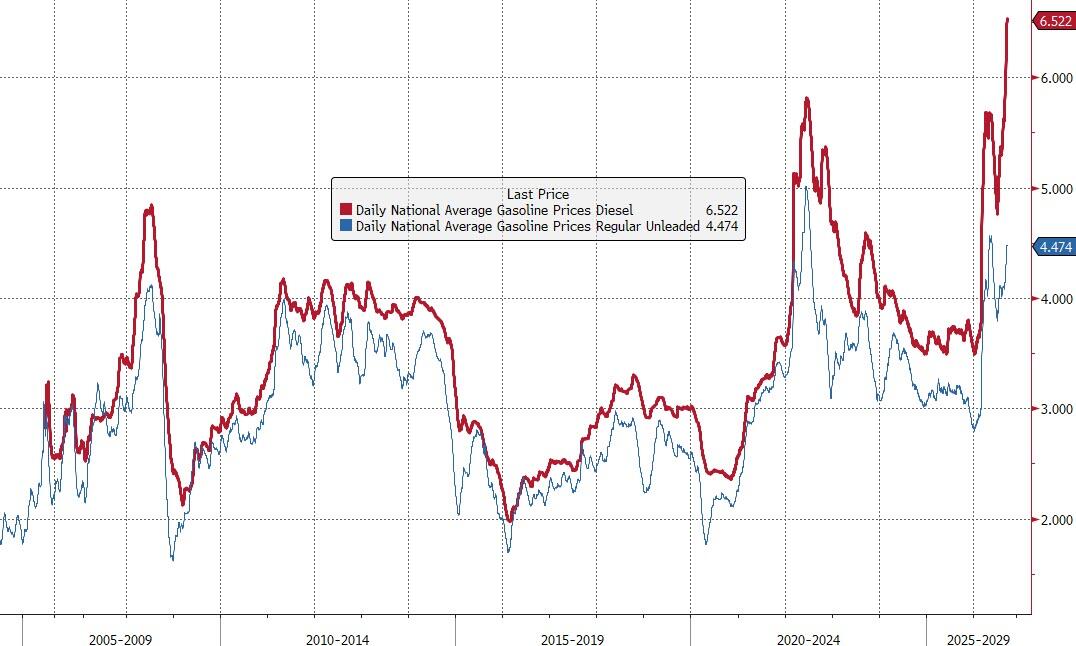
Diesel is certainly top of mind in the White House as a global refining crisis has sent prices at the pump for the industrial fuel to record-high levels, so high that Apollo's chief economist, Torsten Slok, warned earlier that it could spark a core inflation shock.
Policy maneuvering by the White House is limited, and what has been floated by Trump and some top Republicans is a diesel export ban, while top desks on Wall Street have warned that it's a terrible idea and could exacerbate prices around the world.
Earlier, U.S. Energy Secretary Chris Wright was at odds with Trump's call for a diesel export ban; Wright said, "The blunt tool of banning diesel exports definitely doesn't work."
Around lunchtime in New York, a new Politico report said the White House was preparing a potential 90-day ban on diesel exports ahead of November's midterm elections.
The report stated that the proposal remains under discussion, with its legal framework unresolved. Politico cited five people familiar with the talks.
"What has overpowered cooler heads [in the White House] is the absolutely, sky-is-falling, we-have-to-do-something concern about prices at the pump" faction, said this person, who was granted anonymity to discuss conversations with White House officials. "That camp has been swept aside by the political camp, which says, 'dammit, something has to happen.'"
AAA Diesel v. Gas at pump
A White House official commented on the report, calling it "another fake news story from Politico."
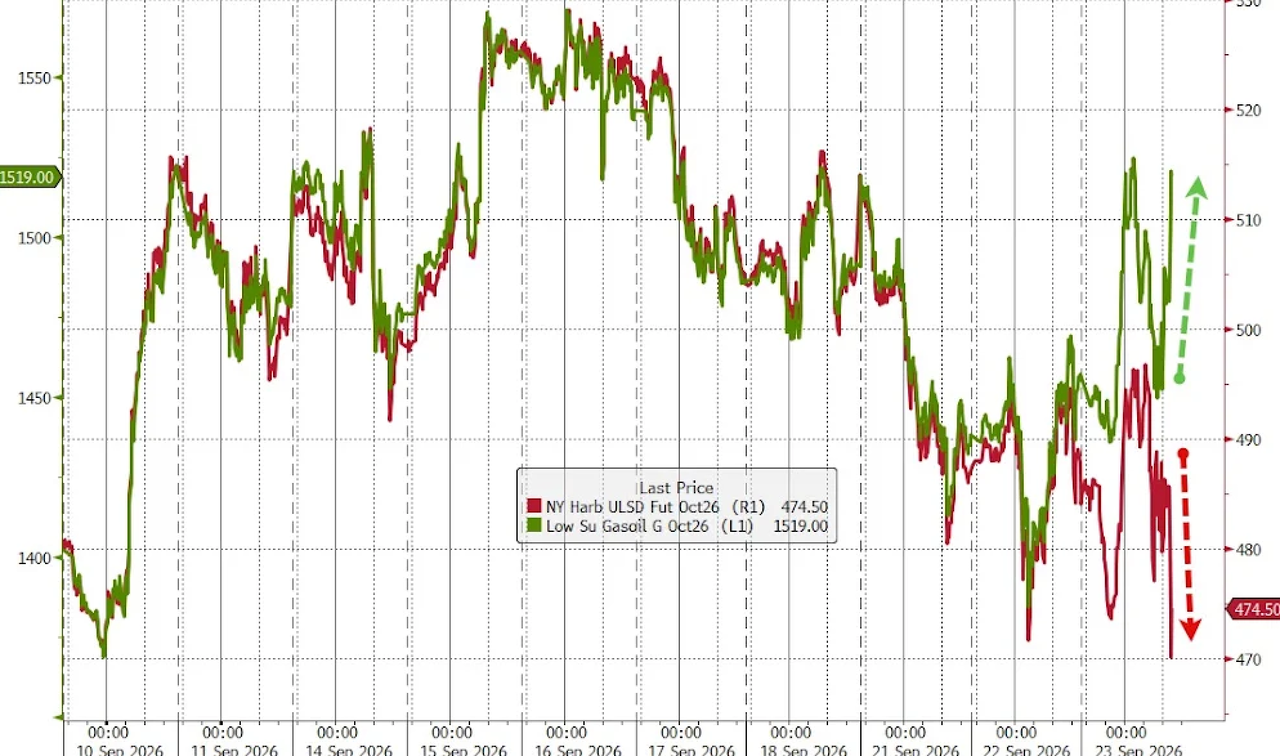
The immediate price action in the fuel markets was:
- US DIESEL FUTURES SINK MORE THAN 7% TO INTRADAY LOW
- EUROPEAN DIESEL FUTURES SURGE OVER 7% TO SESSION HIGH
Here's what happened:
Last week, Barclays refining and midstream analyst Theresa Chen warned clients that a proposed U.S. diesel export ban would be "detrimental to the US refining complex and unlikely to provide the intended price relief."
Chen outlined one major problem: keeping diesel inside the country does not guarantee it can reach gas pumps.

On Tuesday, Goldman Sachs energy analyst Nikhil Bhandari told clients the global refining system will be stretched through 2027, with diesel and gas prices expected to remain elevated.
The latest EIA data (2025) shows that Mexico is the largest buyer of U.S. diesel, followed by Chile, Brazil, the Netherlands, and the UK.
- Mexico: ~220,000 b/d (17% of total distillate exports). Still #1 but down ~18% from 2024. Mexico imports large volumes of U.S. refined products (gasoline and diesel) while sending heavier crude north.
- Chile: Second-largest destination; volumes rose ~15–16k b/d from 2024.
- Brazil: ~103,000 b/d (third). This is well below earlier peaks near 200k b/d; Brazil has taken more discounted Russian barrels since 2022 sanctions redirected Russian diesel away from Europe.
- Netherlands: ~98,000 b/d (major European trading hub/re-export point).
- United Kingdom: ~89,000 b/d (record annual average).
A case of resource nationalism? Or is the Politico report "another fake news story," as a White House source cited in the report suggests?
"Definitely Doesn't Work": U.S. Energy Sec Rejects Diesel Export Ban, Risks Creating Bigger Supply-Squeeze Later
President Trump will not be pleased...
U.S. Energy Secretary Chris Wright has publicly opposed calls for a ban on U.S. diesel exports, arguing on Wednesday that the measure would backfire by increasing gasoline and jet fuel prices.
"The blunt tool of banning diesel exports definitely doesn't work," Wright said at an event in New York, as reported by Reuters.
Wright said restricting exports would leave refiners with excess diesel inventories, forcing them to cut refinery output.
Lower refinery runs, he warned, would tighten supplies of other fuels, ultimately driving up costs for consumers and businesses.
His comments put him at odds with President Trump, who signaled support for the idea on Tuesday as diesel prices surge to record highs in the U.S. and Europe (and Treasury Secretary Bessent has been assigned to see "if it's feasible."
Trump's comments already sent European pries for the fuel surging.
With flows from the region's top supplier at risk, Bloomberg reports that European diesel's premium to Brent crude jumped to more than $95 a barrel on Wednesday, a record in Bloomberg data going back to 2011.
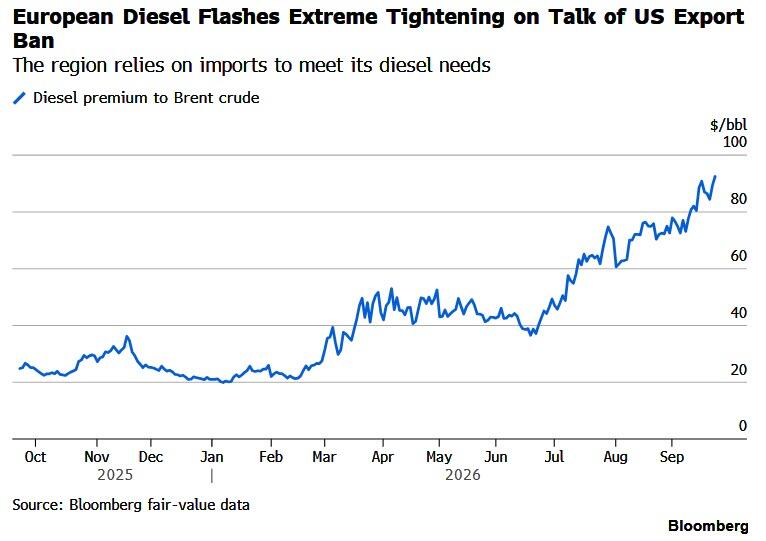
Known as crack spread, the indicator has been keenly watched by central bankers as they seek to tame inflation. The equivalent measure in the U.S., meanwhile, weakened.
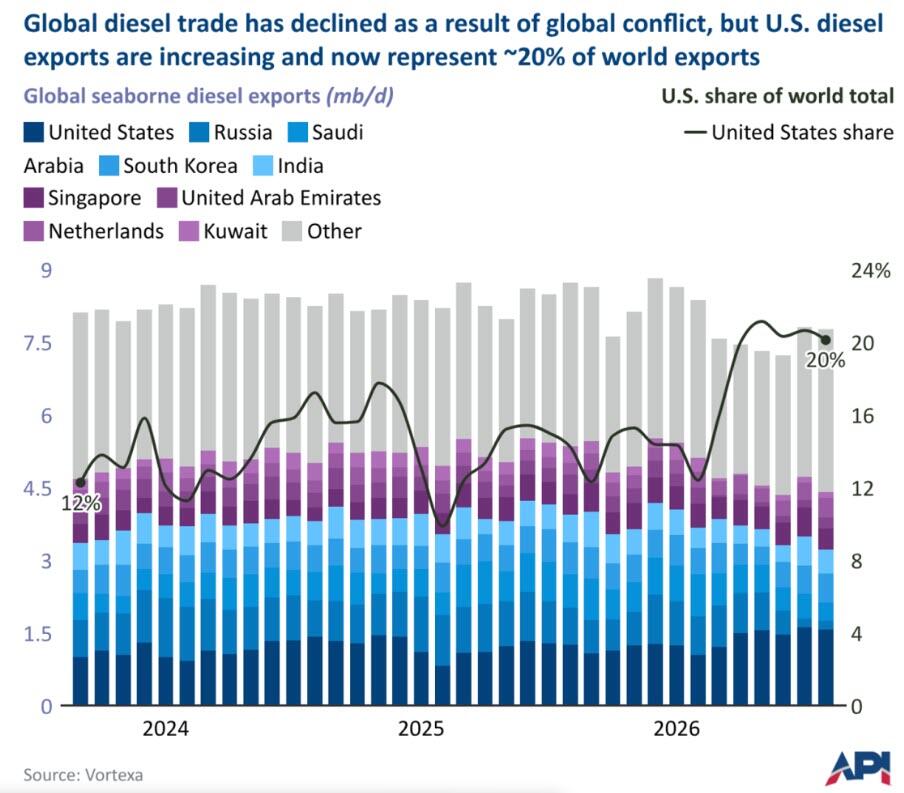
Trump's threat comes as Europe is already grappling with the loss of diesel shipments from the Middle East, and Russian export curbs have tightened the global fuel market further. The US has become Europe's main overseas supplier, with American exports of the workhorse fuel surging to a weekly record near 2 million barrels a day last month.
A key U.S. oil industry group cautioned against the move, saying it could lower American fuel production and damage the global economy.
Of the 8 million barrels of diesel traded globally by sea each day, the U.S. supplies about 1.5 million of them - about 20%. An export ban would remove the single largest source of global diesel from the market, and the consequences could be catastrophic.
"Restricting exports is not a solution to high prices," the American Petroleum Institute says.
"Removing US diesel from the market could instead result in reduced refinery runs, global economic damage and even higher US prices."
Indeed, as Bloomberg macro strategist, Michael Ball, write this morning,while The White House may be able to engineer a brief drop in U.S. diesel prices by limiting exports, it risks creating a bigger supply problem down the road.
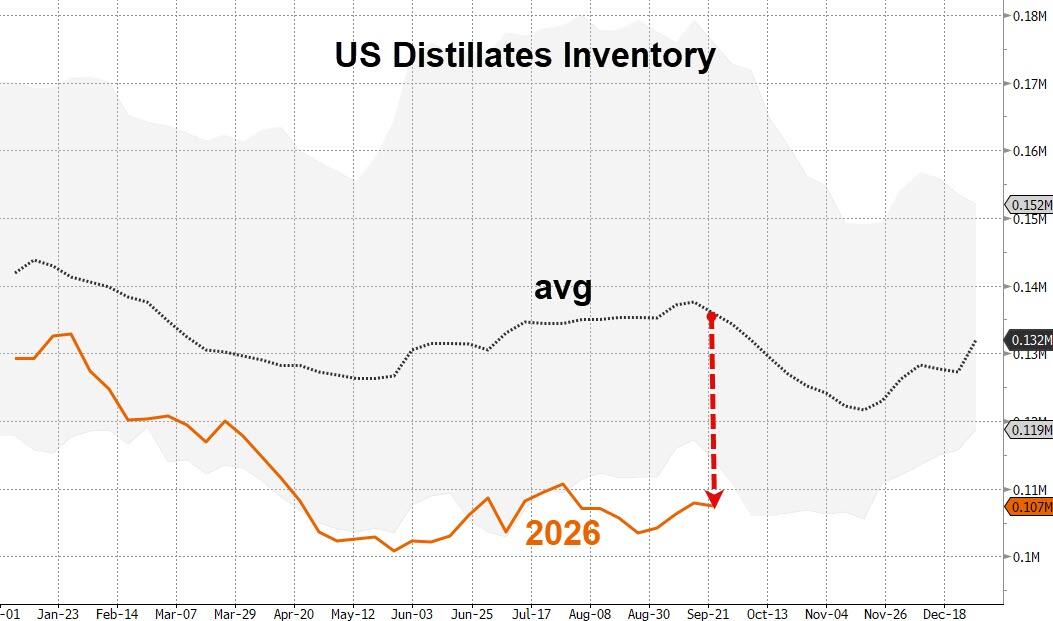
With distillate stocks at seasonally record lows...
...the appeal is obvious with U.S. diesel above $6.50 a gallon...
But a broad curb could strand as much as 1.5 million barrels a day, roughly 29% of U.S. diesel output.
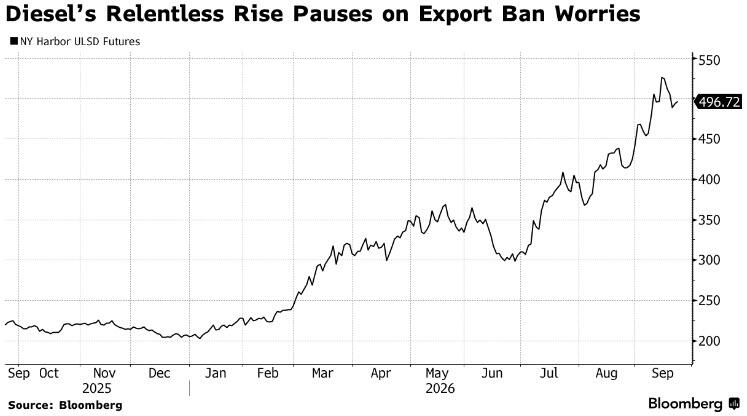
If enacted, Ball writes, the effects would be uneven across the U.S.
A surplus would build on the Gulf Coast, while pipeline, shipping and fuel-specification constraints limit how easily those barrels can reach tighter East and West Coast markets.
Bloomberg Intelligence estimates Gulf Coast storage could only absorb about three weeks of net diesel exports before constraints bite.
The global impact would be worse.
Kpler argues there is no real replacement for U.S. export volumes, leaving Latin America and Northwest Europe particularly exposed and increasing competition for Indian barrels.
China could compound the squeeze as domestic inventories fall and the risk of renewed export curbs rises.
The response from refiners would create a negative feedback loop.
If trapped barrels crush margins, refiners are incentivized to cut runs and undertake maintenance.
S&P Global Energy estimates crude runs might need to fall by nearly 2 million barrels a day - more than 10% of the current production level - to clear the surplus.
That is the asymmetry: lower U.S. diesel prices first, tighter global product markets follow, and potentially less U.S. fuel supply later.
The more aggressive the restriction, the greater the risk that today's price relief becomes tomorrow's supply problem.


No comments:
Post a Comment