Friday, November 14, 2025

Deep In The Fourth Turning: The Darkest Hours Are Before The Dawn (Must Read)

  This a long but stunning article which explains in details how this 4th turning is both similar and very different than the ones which came before. 

  The analysis is both superb and very complete, without too much partisanship which is rather rare these days. The possible outcomes are just ideas. Some better than others. It is less important. What counts is to get the analysis part right and this is very much what it does.  

Via Gold and Geopolitics Substack,

Foreword

I first thought to write this as a multi-part series, but I finally decided to group everything together as it wouldn’t do justice to this article. There’s a lot to unpack when discussing the ongoing societal changes, and I feel I barely touched on anything but the essence of that. Even then, standing at more than 6000 words, and spending nearly 10 full waking days refining it, the scope of what we’re witnessing feels almost too vast to capture in any single piece.

The Fourth Turning doesn’t reveal itself gradually—it crashes over you all at once when you finally start to see the pattern. Writing this piece felt like trying to grab sand in my hands; every attempt to contain one aspect of the transformation led to three more slipping through my fingers.

What you’ll read here is my best effort to trace the contours of something far larger than any individual could possibly comprehend.

The same boiling water that softens the potato hardens the egg.

— Roald Dahl

We’re all in the same boiling water now—the Fourth Turning’s Crisis that began with Lehman Brothers’ collapse in 2008—but whether we emerge hardened or dissolved depends entirely on what we’re made of. We’re now deep in the Fourth Turning, the winter of this historical cycle, and if you think the past few years have been chaotic?

You ain’t seen nothing yet!

History doesn’t move in straight lines. It breathes, it pulses, it turns through seasons as predictable as winter following autumn. William Strauss and Neil Howe discovered this pattern in 1997. Like clockwork, every 80 years or so - a human lifetime, America faces an existential crisis that threatens to tear apart everything we thought permanent. We’ve been through this three times before, and we’re going through it again right now.

Strauss and Howe predicted in 1997 that around 2005, some spark would ignite a Crisis mood. They suggested it might be “as ominous as a financial crash, as ordinary as a national election, or as trivial as a Tea Party”. They nailed it. The 2008 financial crisis wasn’t just another recession—it was the moment the post-World War II global order began its death spiral. Lehman Brothers’ September 15, 2008 collapse marked more than a bank failure; it marked the beginning of the end of trust in the system itself.

I’ve started following these markets around 2007, and what happened after that particular collapse was unprecedented. The Federal Reserve’s balance sheet exploded from $900 billion to $4 trillion in a matter of years, then to $9 trillion during COVID. The national debt, which stood at $10 trillion in 2008, has now reached $37 trillion as of August 2025. We didn’t solve the crisis—we papered it over with printed money and kicked the can down the road. We didn’t solve the problem—we made it exponentially worse. As someone who tracks gold markets, I can tell you with increasing clarity: the people who actually understand money are quietly converting their paper promises into something that can’t be printed.

The response to 2008 revealed something critical: our institutions no longer functioned as designed. The Federal Reserve, created to be a lender of last resort, became the market itself. Banks that should have failed were declared “too big to fail”. Capitalism’s core principle—that bad bets lead to bankruptcy—was suspended for the connected class while enforced ruthlessly on everyone else. The very people who caused the crisis not only avoided jail but got bonuses funded by taxpayer bailouts. The social contract didn’t just fray; it snapped.

What most people didn’t understand then—and many still don’t grasp now—is that 2008 never really ended. Each intervention created larger distortions requiring bigger interventions. Zero interest rates led to asset bubbles. Quantitative easing led to wealth inequality explosion. Each “solution” deepens the underlying problem: a system that could only survive through ever-increasing debt monetization. The music has stopped, but the Fed keeps the party going by turning up the volume until everyone is deaf.

The knock-on effects rippled globally. European banks, stuffed with toxic American mortgage securities, required massive bailouts. The European debt crisis followed, nearly destroying the euro. China, terrified of global depression, launched the largest credit expansion in history, building ghost cities and redundant infrastructure. Every major economy became addicted to monetary heroin, and seventeen years later, we’re still shooting up.

But the financial crisis was just the catalyst. What makes this a Fourth Turning isn’t the proximate cause but the comprehensive breakdown that follows. Look around. Every institution Americans once trusted—government, media, academia, medicine, law enforcement, intelligence agencies—has suffered catastrophic reputational collapse. When the CDC changes its story for the fifth time, when the FBI raids a former president, when the Supreme Court’s legitimacy is openly questioned, you’re not watching normal political friction. You’re watching the complete unraveling of institutional authority.

This Fourth Turning differs fundamentally from all previous ones because of technology’s role. We’re not fighting with muskets or tanks—we’re fighting with algorithms, narratives, and digital currencies. The battlefield isn’t Gettysburg or Normandy; it’s your smartphone screen, your social media feed, your digital wallet.

Previous Fourth Turnings required mass mobilization of physical bodies. Men marched to war, women worked in factories, everyone bought war bonds. Physical presence mattered. But our Fourth Turning is being fought in the realm of information and perception. When you can’t trust any source of information, when deepfakes make seeing no longer believing, when AI can generate unlimited propaganda at zero marginal cost, how do you even know what you’re fighting for or against? The fog of war has become the fog of everything.

Consider the comprehensive surveillance apparatus that’s emerged since 2008. Edward Snowden’s 2013 revelations showed us the NSA was collecting everything—every email, every text, every call. But that was just the beginning. Now we have AI-powered behavioral prediction, social credit systems, and facial recognition networks. China leads the way with 700 million surveillance cameras—more than half the world’s total—but Western “democracies” aren’t far behind. London has more cameras per capita than Beijing. San Francisco uses the same facial recognition technology as Shanghai.

The COVID-19 pandemic accelerated this technological authoritarianism by decades. Digital vaccine passports normalized the idea that you need government permission to enter a restaurant. Contact tracing apps trained us to accept constant location monitoring. QR codes made every movement trackable. What would have taken a generation to impose gradually was accomplished in months under the banner of “public health”. The ratchet only turns one way—powers gained during a crisis are never voluntarily relinquished.

Consider the Central Bank Digital Currency (CBDC) agenda that’s advancing globally while most people remain blissfully unaware. This isn’t just digitizing money—it’s making money programmable, controllable, censorable. The Federal Reserve, Bank of England, and European Central Bank are all developing CBDCs, following China’s lead with the digital yuan. Imagine a world where your ability to buy gasoline depends on your carbon credit score, where your grocery purchases are limited by your BMI, where your savings can be “expired” to force spending. Money that can’t be used for disapproved purchases, that can be frozen instantly if you express wrongthink.
It’s not imagination — China is already doing it. Europe is launching trials. The Federal Reserve is “researching” it.
This is the ultimate fusion of monetary and social control.

Bitcoin emerged from the 2008 crisis’ ashes with a message embedded in its genesis block: “Chancellor on brink of second bailout for banks”. The cypherpunks who created it—whether Satoshi was an individual or a team—understood that monetary sovereignty required technological sovereignty. But here’s the uncomfortable question: did we play them or did they play us? Bitcoin’s transparent blockchain makes every transaction traceable forever. The NSA’s 1996 paper “How to Make a Mint” described a system remarkably similar to Bitcoin. The CIA met with Gavin Andresen, Bitcoin’s lead developer, in 2011. Was Bitcoin genuine resistance or the perfect trap—getting libertarians to build their own financial panopticon?

The promise was decentralization, but the reality is increasingly centralized. A handful of mining pools control Bitcoin’s hash rate. A few exchanges handle most trading volume. BlackRock and other institutions now dominate ownership through ETFs. The rebels who thought they were building an alternative to Wall Street may have just built Wall Street 2. 0. With better surveillance.

Every Fourth Turning includes a monetary reset. The Revolution gave us the Constitution’s gold and silver clause. The Civil War brought greenbacks and the National Banking System. The Depression/WWII era ended the gold standard domestically and created Bretton Woods. What’s coming this time will be even more dramatic.

The numbers are so large they’ve lost all meaning. The U. S. national debt stands at $37 trillion as of August 2025. Unfunded liabilities—Social Security, Medicare, government pensions—exceed $200 trillion. The Federal Reserve holds over $1 trillion in unrealized losses. Commercial banks sit on $600 billion in underwater securities. We’re not approaching insolvency. We’re already there. Just one repricing away from systemic collapse. And everyone in finance knows it. The only question is whether it happens slowly (inflation), suddenly (default), or systematically (CBDC rollout).

My money, literally, is on “all of the above”.

While Americans fight over pronouns and vaccines, the rest of the world isn’t standing still. The real Fourth Turning story isn’t just about America—it’s about the end of the American Century and the birth of something new. The unipolar moment that began with the Soviet Union’s collapse in 1991 is over. We’re not transitioning to a new order but to disorder—multiple competing power centers with incompatible worldviews and no hegemon strong enough to impose rules.

Russia and China’s “no limits” partnership, announced February 4, 2022, just before the Ukraine war, represents the most significant geopolitical realignment since the Molotov-Ribbentrop Pact. Unlike that cynical arrangement between natural enemies, this reflects genuine strategic convergence.

Let that sink in.

The two largest threats to American hegemony have decided they’re better off together than apart. China needs Russian resources and military technology. Russia needs Chinese markets and manufacturing. Both need to break American hegemony. Their combined nuclear arsenals, industrial capacity, and geographic position make them essentially unsanctionable and uncontainable. While we’ve been focused on internal divisions, they’ve been stockpiling gold, building alternative payment systems, and creating a parallel world order that doesn’t need dollars or SWIFT.

I’ve called this “water finding a way”—capital, trade, and power flowing around obstacles like sanctions and finding new channels. The West sanctions Russia, so Russia sells oil to India and China at a discount. We freeze Russian reserves, so everyone else starts wondering if their dollars are safe. We weaponize SWIFT, so they’re building alternative payment systems. Every action creates an equal and opposite reaction, and we’re too arrogant to see we’re accelerating our own replacement.

But perhaps the most devastating loss isn’t monetary or military—it’s moral. The West built its post-WWII hegemony not just on military might and economic power, but on moral authority. We are the “good guys” who defeated fascism, rebuilt Europe, and championed democracy and human rights. That moral high ground is gone, destroyed by our own hypocrisy. When we lecture others about sovereignty while expanding NATO to Russia’s borders despite promises not to, when we invoke “rules-based order” while ignoring international law when convenient, when we sanction countries for actions we ourselves commit—the world sees increasingly through it.

Take Ukraine. We frame it as democracy versus autocracy, good versus evil. But Russia has legitimate security concerns that we’ve deliberately ignored for decades. How would America react if China formed a military alliance with Mexico and stationed missiles in Tijuana? We know exactly how—we nearly started nuclear war over Soviet missiles in Cuba. Yet we expect Russia to accept NATO expansion to its borders as normal. The West could have guaranteed Ukrainian neutrality and avoided this war entirely. Instead, we used Ukraine as a proxy to bleed Russia, but it’s Ukraine that’s bleeding out. Hundreds of thousands dead. For what? So Victoria Nuland could have another regime change on her résumé?

Or look at Gaza. Israel is systematically destroying an entire population—bombing hospitals, schools, refugee camps, killing journalists, aid workers, children by the thousands. The International Court of Justice is investigating genocide charges. They issued arrest warrants. Yet the same Western leaders who thundered about Russian war crimes provide Israel with weapons and diplomatic cover for atrocities that shock the conscience.
When you can watch children being deliberately starved and bombed while your government calls it “self-defense”, something fundamental breaks in your worldview. The system reveals itself as not just flawed but actively evil.

This moral bankruptcy accelerates the Fourth Turning’s institutional collapse. When people see their governments supporting genocide while preaching human rights, enabling war crimes while demanding justice, destroying countries while claiming to protect democracy—they don’t just lose trust in leaders. They lose faith in the entire Western project. Every Palestinian child killed with American weapons creates a hundred people who will never believe the Western moral claims again. Every Ukrainian conscript sent to die for NATO expansion makes a mockery of our “defensive alliance”. The hypocrisy isn’t just noted; it’s radicalizing.

The Ukraine war thus becomes a triple failure. Militarily, it demonstrates that despite spending more than the next ten nations combined, we can’t defeat Russia in its own backyard. Economically, our sanctions backfire, strengthening alternative systems while weakening our own. But most critically, morally, it exposes the lies undergirding the entire system. We’re not defending democracy—we’re pursuing hegemony. We’re not protecting sovereignty—we’re expanding empire.

e’re not the good guys.

We’re just another power, playing the same brutal game, whilst demanding everyone pretend otherwise.

The expansion of BRICS in 2024 to include Saudi Arabia, Iran, Egypt, Ethiopia, and the UAE wasn’t just about adding members—it was about creating a critical mass. BRICS now represents 45% of the global population, 35% of global GDP, and controls most of the world’s critical resources.

More importantly, it offers an alternative.

Countries can now access development funding without IMF conditionalities, trade without SWIFT, and maintain reserves without dollars. Every country that joins weakens the Western system and strengthens the alternative.

The Middle East’s transformation is particularly striking.

Saudi Arabia, America’s most important Arab ally since 1945, is now buying Chinese fighters, pricing oil in yuan, and coordinating with Russia on production cuts. The Abraham Accords, trumpeted as an historic achievement, are being superseded by Chinese-brokered agreements. When Iran and Saudi Arabia restored relations under Chinese auspices in 2023, it marked the end of American diplomatic monopoly in the region.

But the real prize is Taiwan. If China takes Taiwan —increasingly likely given war game results— without an American military response, the entire American alliance system will collapse overnight.

Japan, South Korea, the Philippines, and Australia would have to accommodate China.

The dollar would lose reserve status as countries realized American security guarantees are worthless.

It wouldn’t be a military defeat but a psychological collapse—the moment everyone realizes the emperor has no clothes.

The tragedy is that America’s military, despite spending more than the next ten nations combined, can’t win wars anymore. We couldn’t defeat the Taliban after twenty years. We can’t build ships that work—the Littoral Combat Ship, Zumwalt destroyer, and Ford-class carrier programs are all disasters. We can’t even supply Ukraine with enough 155mm shells, the most basic artillery ammunition. The military-industrial complex is optimized for profit, not victory. And now we’re paying the price.

Fourth Turnings are generational psychodramas where each archetype plays its destined role. But something’s different this time—the actors seem to be forgetting their lines.

The Boomers (our Prophet generation) should be the Gray Champions providing moral clarity during the Crisis. Instead, they are the crisis. They’ve held power longer than any generation in American history and refuse to let go. Biden, Trump, Pelosi, McConnell—all in their 80s or late 70s, all clinging to power like Gollum to his precious. The oldest president in American history is followed by the second-oldest. Congress looks like a nursing home. The Supreme Court is a gerontocracy. They won’t pass the torch; it will have to be pried from their cold, dead hands.

But which Boomer is the Gray Champion? Trump fits the archetype—the charismatic elder who emerges during the Crisis to remake society. His first term was prologue; his return in 2025 could be the main act. He has the prophetic certainty, the devoted following, the absolutist vision. But Gray Champions are supposed to unite society for collective purpose, and Trump divides as much as he inspires. Maybe that’s the point—maybe this Fourth Turning’s Gray Champion destroys the old order rather than defending it.

Generation X, my generation, are playing our Nomad role perfectly—cynical survivors building escape routes. We’re the ones stacking gold, learning skills, moving to rural areas, homeschooling our kids. We don’t believe in collective anything because every institution failed us. Latchkey kids who raised ourselves, we learned early that self-reliance is the only reliability. We’re not trying to save the system; we’re trying to survive its collapse.

But it’s the Millennials who worry me. They’re supposed to be the Hero generation—the ones who should come together, sacrifice for the collective purpose, and rebuild from the ashes. Previous Hero generations—the Republicans who fought the Revolution, the Gilded who won the Civil War, the GI Generation who defeated fascism—had external enemies to unite against. This generation can’t even agree on basic reality.

Half of them want socialism without understanding that socialism requires a social cohesion they don’t have. The other half chase wealth through crypto and day-trading while living in their parents’ basements.

They’re the most educated generation in history but can’t do basic repairs.

They’re the most connected but loneliest.

They’re supposed to be heroes, but they’re barely functional adults.

Maybe that’s harsh, but Fourth Turnings don’t care about hurt feelings.

The problem might be that this generation’s Crisis is too abstract.

Climate change is the perfect example—it’s an ever-shifting, never-reached goal that keeps moving further away the closer we supposedly get. First it was global cooling in the 1970s, then global warming, now “climate change” to cover all bases. The apocalypse is always 10 years away—in 1989, the UN said we had until 2000 before irreversible damage. In 2006, Al Gore gave us 10 years. In 2019, Greta gave us 12. The goalposts keep moving, the demands keep escalating, but the emergency never quite arrives.

You can’t defeat climate change like you can defeat Nazi Germany. There’s no V-E Day for carbon emissions, no unconditional surrender of greenhouse gases. It’s a permanent crisis requiring permanent sacrifice with no victory condition—exactly the kind of nebulous threat that demobilizes rather than mobilizes.
Systemic racism is another concept, not a Confederate army you can defeat at Gettysburg.

COVID was scary. But not scary enough. A 99% survival rate doesn't mobilize like Pearl Harbor.

Our heroes need something concrete to fight against, and they might get it soon enough.

Generation Z and Alpha, our emerging Artists, are being shaped by this Crisis in ways we don’t yet understand. They’re growing up with screens instead of friends, algorithms instead of thoughts, anxiety as baseline. Previous Artist generations were overprotected physically but connected socially. This one is overprotected digitally but isolated physically. They might be the first generation that’s more comfortable in virtual reality than actual reality. Whether that prepares them for the future or ruins them for it remains to be seen.

Every Fourth Turning includes cultural revolution—the complete inversion of previous values. What was sacred becomes profane; what was profane becomes sacred. We’re living through that inversion now, and it’s more extreme than anything since the 1960s.

The traditional family structure, foundation of every successful society in history, is now “heteronormative oppression”. Having children is selfish environmental destruction. Marriage is patriarchal enslavement. Meanwhile, drug use is harm reduction, crime is social justice, and mental illness is identity. We’re not just tolerating dysfunction; we’re celebrating it. The DSM-5 has become a character creation guide.

The gender revolution is particularly telling. Not content with equal rights—a worthy goal achieved decades ago—we’ve moved to denying biological reality itself. Men can be women. Women can be men. Children can choose their sex like they choose breakfast cereal. Anyone who points out biological facts is a “transphobe” who must be destroyed. We’re performing medical experiments on children that would have been considered crimes against humanity a generation ago, and we call it “healthcare”.

This isn’t organic social evolution—it’s engineered chaos. Every institution pushes the same message simultaneously. Corporations mandate pronoun training. Schools teach gender fluidity to kindergartners. Media celebrates each new boundary pushed. It’s too coordinated to be coincidental. Someone benefits from this social dissolution.
And it’s not the confused kids getting surgeries they’ll regret.

The racial revolution follows similar patterns. Not content with civil rights—another worthy goal largely achieved—we’ve moved to racial revenge. “Antiracism” means active racism against whites and Asians. “Equity” means equal outcomes regardless of effort. “Diversity” means everyone thinks the same but looks different. Martin Luther King’s dream of colorblind society is now considered racist. We’re re-segregating schools and calling it progress.

The religious revolution completes the trifecta. Traditional Christianity, the bedrock of Western civilization for two millennia, is now “hate”. Churches that maintained consistent doctrine for centuries are “bigoted”. Meanwhile, we’ve created new religions—wokeism, climatism, covidism—complete with original sin (privilege/carbon/unvaccination), confession (struggle sessions), and excommunication (cancellation). These new faiths are more intolerant than any Inquisition.

The purpose of cultural revolution isn’t progress—it’s demoralization.

When you can make people affirm obvious lies, you’ve broken their spirit.

When you can make them betray their children, you’ve broken their souls.

When nothing is sacred, nothing is worth defending.

A demoralized population doesn’t resist tyranny; it welcomes it as relief from chaos.

But cultural revolutions create their own antibodies.

The more extreme the push, the more violent the snapback.

Parents discovering what schools are teaching their kids become activated.

Workers forced into struggle sessions become radicalized.

Normal people told they’re evil for being normal don’t stay normal—they become resistance.

Resolution Scenarios for the 2030s

Based on historical patterns and current trajectories, this Fourth Turning will resolve somewhere between 2028 and 2033. But resolution doesn’t mean return to normal—it means transformation into something unrecognizable. Let me paint the possibilities as I see them.

The Breakup (Most Likely)

Trump returned as the Gray Champion in 2025, but not the Trump of 2017. This is a Trump unleashed, a Trump with nothing to lose, a Trump surrounded by true believers instead of establishment Republicans. He uses emergency powers to implement his vision—mass deportations, tribunals for the “deep state”, even a possible federal takeover of elections. But here’s where the script diverges from his expectations.

Trump, the self-proclaimed dealmaker and strongman, starts losing.

Everywhere.

He already lost Ukraine—Congress won’t fund it anymore, Europe can’t sustain it alone, and Russia grinds to victory through sheer attrition.
He loses Iran—they get the bomb while he’s tweeting threats, fundamentally altering Middle Eastern power dynamics.
He tries to bully Venezuela with military threats and sanctions, but they’ve learned from watching Russia that America’s bark is worse than its bite.

Each loss emboldens the next challenger. The world realizes the emperor truly has no clothes.

Seeing that he’s losing both militarily and morally—with Israel’s ongoing genocide in Gaza destroying what remained of American moral authority—Trump does what all failing empires do: he turns inward. But this creates an economic catastrophe. His tariffs, meant to punish others, punish Americans with inflation. His pressure on the Fed to cut rates despite soaring prices destroys dollar credibility. His continued weaponization of USD and SWIFT drives even allies to seek alternatives.
Suddenly, all those dollars held overseas come flooding home—tens of trillions seeking safety as global trade abandons the greenback.

The dollar hyperinflates into toilet paper.

The resulting inflation isn’t the 1970s redux everyone expects—it’s Weimar Germany. When bread costs $50 and gas hits $20 a gallon, society doesn’t slowly decay; it collapses. Supply chains that never fully recovered from COVID snap completely. Cities that depend on just-in-time delivery face actual starvation. The EBT system fails, and 40 million Americans lose food assistance overnight. The military, traditionally conservative and oath-bound, doesn’t splinter—it hunkers down, protecting what it can, essentially writing off ungovernable areas.

Blue states, which never really accepted Trump’s legitimacy anyway, make it official. California stops sending tax revenue to Washington—why fund a government that hates you? New York follows suit. Illinois, Oregon, Washington state—they all realize they’re subsidizing their own oppression. The federal government, broke from lost wars and fleeing dollars, can’t enforce compliance. It’s not 1861 where Lincoln could raise an army to preserve the union. The military won’t fire on Americans, and Trump doesn’t have the loyalty to make them.

By 2035, America follows the Soviet playbook. Not violent collapse but exhausted dissolution. The federal government, like Gorbachev’s Kremlin, simply becomes irrelevant. States stop listening, regions form their own arrangements, and one day everyone realizes the United States exists only on maps nobody updates anymore.
The empire doesn’t fall—it evaporates.

The Breakup v2 (Increasingly Possible)

The differences prove irreconcilable. After another disputed election—2028 seems likely—states start going their own way. Not through formal secession but through nullification and non-cooperation. Red states refuse to enforce federal gun laws. Blue states refuse to enforce immigration law. Both refuse to send tax revenue for programs they oppose.

The federal government, broke and impotent, can’t enforce its will. The military, asked to fire on Americans, refuses or splits. Washington becomes ceremonial while real power devolves to regions. The Pacific states form an economic union with Canada and Asia. Texas remembers it was once a republic. The Northeast aligns with Europe. The heartland goes its own way.

By 2035, America exists on paper but not in practice. The dollar is replaced by regional currencies or Bitcoin. The military splits into state militias. The federal government maintains embassies and negotiates treaties, but has no domestic power. It’s not civil war—it’s civilized divorce. Messy, expensive, but better than the alternative.

The War Resolution (Plausible but Dangerous)

Taiwan is the obvious flashpoint. China invades in 2027, calculating America won’t risk nuclear war over an island. They’re right—we won’t—but we don’t back down either. Economic war escalates to cyber war escalates to proxy war escalates to... what? Not nuclear exchange—everyone loses—but something new. Bioweapons that target specific ethnicities? AI-controlled drone swarms that can’t be stopped? Infrastructure attacks that kill millions without firing a shot?

Or maybe it’s Iran. Israel finally figures out how to strike their nuclear program. Iran retaliates. America gets drawn in. Russia backs Iran. China backs Russia. Suddenly we’re in World War III without anyone planning it. The Middle East burns. Europe freezes without Russian gas. Asia starves without Middle Eastern oil. Supply chains collapse. Billions face famine.

The war isn’t won or lost—it just ends when everyone’s exhausted. America “wins” by not losing as badly as others, but the victory is pyrrhic. A generation is traumatized. The economy is destroyed. The empire is over. We retreat to our hemisphere, rebuild what we can, and try to forget. The 2030s are about recovery, not prosperity.

The Transformation (Hopeful but Unlikely)

Maybe, just maybe, this Crisis catalyzes genuine renewal instead of collapse. A new generation of leaders emerges—not Boomers clinging to power but GenX/Millennial hybrids who understand both technology and reality. They implement radical but necessary reforms: a constitutional convention that updates our 18th-century operating system for a 21st-century reality, a monetary reset that includes a debt jubilee and sound money, a healthcare system that actually provides health rather than profits, an education system that teaches skills rather than ideology, and a political system that represents people rather than its donors.

Technology gets harnessed for liberation rather than control. Open-source AI breaks the corporate monopolies. Mesh networks break surveillance states. Cryptocurrency breaks central banks. 3D printing breaks supply chain dependencies. Unlimited clean fusion energy breaks resource scarcity. We don’t return to the past but create a future that honors what worked while fixing what didn’t.

By 2035, America is smaller globally but stronger domestically. We’re not the world’s policeman anymore but we’re not an isolationist either. We trade with everyone, ally with those who share our values, and mind our own business otherwise. The federal government is smaller but more effective. States have more autonomy but share a common purpose. It’s not utopia but it’s sustainable.

After the Storm: The Coming High

History suggests that however this Fourth Turning resolves, a High will follow. Spring always follows winter, even the harshest winter. The question isn’t whether we’ll emerge but what we’ll look like when we do.

Previous Highs shared common characteristics that we’ll likely see again. Social cohesion will replace atomization—people will desperately want to belong to something larger than themselves after years of isolation and conflict. Institutional authority will be restored—not the old institutions but new ones built by Crisis’ survivors who know what failure costs. Conformity will be valued over individualism—after chaos, order will feel like freedom. Economic growth will explode—all the delayed investment and deferred consumption will be released all at once.

But this High will be different because the world is different. It won’t be American-dominated—that era is over regardless of how this Crisis resolves. It might not even be Western-dominated. The center of global civilization could shift to Asia for the first time in 500 years. Or we might see true multipolarity—regional powers managing regional spheres without a global hegemon.

Technology will define the new High more than politics will. Artificial intelligence will be either a tool of total control or liberation depending on who controls it. Bioengineering will extend the human lifespan—but perhaps only for those who can afford it. Fusion energy might provide unlimited clean power—or remain forever 20 years away. Space colonization could open infinite resources—or remain science fiction. The choices made during the resolution of this Crisis will determine which future we get.

The Millennials who survive this Crisis will be different than the ones who entered it. The Crisis completes this Hero’s generation development—it burns away weaknesses and forges strength. They’ll build institutions with the knowledge of how previous ones failed. They’ll raise children in a stability they never knew themselves. They’ll create art that celebrates order rather than chaos.

They’ll be boring, and that will be beautiful.

Their children, the new Artists, will grow up in a world we can barely imagine. They might be the first generation that’s more machine than human—enhanced, augmented, connected to AI from birth. Or they might rebel against technology entirely, seeking authenticity in a synthetic world. Either way, they’ll be shaped by the High we create, just as we were shaped by the Crisis we’re enduring.

The 2030s and 2040s could be golden if we navigate this Crisis successfully. Imagine fusion finally working, providing unlimited clean energy. Imagine AI eliminating drudgery while humans focus on creativity. Imagine biotech defeating aging, adding healthy decades to life. Imagine space colonies opening infinite resources. Imagine governance that actually represents people. Imagine money that can’t be debased. It’s all possible—if we survive.

But survival isn’t guaranteed. Rome had its Fourth Turning and ended up with the Dark Ages. China had multiple Fourth Turnings that led to centuries of stagnation. The Soviet Union had a Fourth Turning and ceased to exist. The difference between renewal and collapse often comes down to leadership at the crucial moment. Do we get Lincoln or Buchanan? FDR or Hoover? Churchill or Chamberlain? The answer determines whether our grandchildren curse or bless our memory.

What this means for you

So we’re living through the most dangerous period in world’s history since World War II. What do we actually do about it? The answer depends on who we are and what we can control.

First and foremost: accept that this is structural, not political. Your candidate winning won’t fix it. Your party taking control won’t stop it. The system itself is what’s breaking, and it needs to break for something new to emerge. Fighting to preserve the current system is like trying to hold back winter—exhausting and futile. Better to prepare for spring while others freeze.

Secondly, position yourself for multiple scenarios. Geographic diversification matters—have somewhere else you can go if your area becomes untenable. This doesn’t mean fleeing the country necessarily, but having options. A rural property, family in another state, even just camping gear and a plan. When cities burned in 2020, those who could leave did. Those who couldn’t suffered.

Financial diversification is crucial but complicated. Yes, own gold and silver—physical metal you can hold, not ETF promises. But also understand their limitations. Gold doesn’t earn yield. Silver is bulky. Both can be confiscated or taxed into uselessness. Diversify across jurisdictions, asset classes, and storage methods. Some gold in a safe. Some silver buried. Some Bitcoin in cold storage. Some cash in small bills. Some barterable goods—ammunition, alcohol, antibiotics. Don’t put all your eggs in any basket because all baskets have holes.

Skills diversification might matter most. Learn to grow food—even apartment dwellers can grow something. Learn basic medical care—when hospitals are overwhelmed, basic knowledge saves lives. Learn to fix things—when supply chains break, repair becomes invaluable. Learn self-defense—when police won’t come, you’re on your own. Learn to teach—your children might need homeschooling. These skills have value regardless of which scenario plays out.

Community building is essential but difficult. Modern Americans barely know their neighbors, let alone trust them. But any crisis creates rapid bonding—shared danger builds relationships faster than years of small talk. Identify who around you is reliable. Build relationships before you need them. But be careful—the person flying the right flag might be an informant. The one flying the wrong flag might be an ally. Judge by actions, not words.

Mental preparation matters more than physical. This Crisis will last years more. You can’t maintain panic that long—you’ll burn out. You need sustainable vigilance—alert but not anxious, prepared but not paranoid. History is your friend here. Read about previous Fourth Turnings. Understand that a Crisis is normal, not exceptional. Our ancestors survived worse with less. You can too.

Most importantly, understand that you’re living through history, not the end of it. Yes, the West as you knew itmight be ending. But something new is being born. You get to participate in that birth. That’s not a burden—it’s a privilege. Most humans live boring lives in boring times. You get to live through transformation. Your choices matter. Your actions have consequences. Your life has meaning.

The Fourth Turning will end, probably around 2035. You’ll either be a survivor who helped shape the new order or a casualty who didn’t. The choice—and it is a choice—is yours.

The Choice Before Us

We stand at history’s inflection point. Behind us, the familiar world dissolves into memory—the American Century, the post-war order, the assumptions that guided our parents and grandparents. Ahead, something new struggles to be born—unclear, unformed, but inevitable. We can’t go back. That bridge is burned. We can only go forward, through the Crisis, to whatever awaits on the other side.

The Fourth Turning isn’t a prophecy—it’s a pattern. And patterns can be understood, navigated, even shaped by those who see them clearly. Our ancestors faced their Fourth Turnings without understanding the cycle. We have the advantage of historical perspective. We know this is temporary. We know it’s survivable. We know it’s necessary.

But knowing and doing are different things.
Knowing winter comes doesn’t keep you warm—preparing for it does.
Knowing that the Crisis peaks before its resolution doesn’t make the peak any less dangerous—it might be even more so.
Knowing previous generations survived doesn’t guarantee we will—that depends on our choices.

The water is boiling all around us. Some are hardening into stronger versions of themselves. Others are dissolving into mush. The difference isn’t random—it’s about what you’re made of and how you respond to heat. You can’t control the temperature, but you can control your composition.

These times demand passion, compassion, commitment, full-speed-ahead engagement with life.

Not because it’s comfortable—it’s not.

Not because it’s safe—it won’t be.

But because we’re living through the most consequential period in American history since World War II. Our choices will echo for generations. Our actions will be studied by historians. Our courage or cowardice will determine whether the Western experiment continues or ends.

The Fourth Turning suggests we have about five more years of Crisis before resolution.
Five years of increasing chaos, conflict, and transformation.
Five years that will feel like fifty.
Five years that will determine the next fifty.

Are you ready?

The storm is here.

The old world is dying.

The new world awaits.

What are you going to do about it?

The Swamp Got Bigger, Better Paid & More Secretive Since 2020

  Nothing much to see here! This is what administrations do. They inflate until they burst. This is true in Washington as well as in Brussels. Being a higher civil servant is a sinecure of epic proportion. No risk, all rewards. 

  Historically, this has always been the case in Japan. You start at the bottom. Spend a life, crushed in packed offices with old furniture, sucking up to the higher ups until your turn comes when you can profit mightily from your position and finally become mightily rich until you get a position of "Amakudari" (descending from the sky) as a director of a company where you have nothing to do but say yes to whatever comes for signing during sumptuous signing lunches and dinners. A profitable cancer of plutocracy which existed during the roman era and has likewise spread like a cancer to modern societies. It is unavoidable both in its growth pattern as well as later in its disastrous effects.    

  This is the world I refused to enter when I was younger and which will unavoidably condemn both Europe first and the US soon after to irrelevance. As for Japan, the effects consequences have been plain to see for the last 30 years when the country went from 16% of the world economy to less than 3%.

  The real question is: Is this a good thing? Is this what obliges us the evolve and regenerate systems which otherwise are prone to decay through rot and graft?   

Via Open The Books,

If you were told a business increased their staff headcount by 5% over four years but its payroll rose 24% over that time, all the while withholding the names of 39% of their staff, would you invest in that company?

Unlikely. But that’s just what the United State government does, funded by taxpayer dollars and operating as if accountable to no one.

Open the Books analyzed the FY 2024 payroll records of executive agencies and found that 2.9 million federal employees were paid $270 billion, compared to 2.8 million employees paid $217 billion in FY 2020. While the civilian employee ranks grew 5%, pay grew nearly 5 times as much, 24%.

The Office of Personnel Management provided the pay for over 1.5 million executive agency bureaucrats; Department of Defense provided pay for its 761,624 civilian employees; and United States Postal Service gave its 638,007 employees’ payroll, via Freedom of Information Act (FOIA) requests.

Not included are pay for judicial branch employees; the 535 members of Congress and their staff; the 1.3 million active-duty military members; the Office of the Vice President (which claims itself entirely exempt from FOIA); nor the staff of several intelligence agencies.

While payroll records don’t include benefits, adding an estimated 30% to the $270 billion payroll brings total costs to $351 billion.

That means the disclosed federal workforce costs the American taxpayer $673,000 per minute, $40.4 million per hour, and just under $1 billion per day.

Meanwhile, more than a million civilian names were redacted from payroll productions produced by Office of Personnel Management and Department of Defense.

The Trump administration has a historic opportunity to bring much-needed transparency to the administrative state. While federal employees don’t add as much to the debt as safety net programs, defense, and overall agency spending, they are an indicator of government growth.

A New Minimum Wage? $100,000 Earners

These employees are now being paid more than ever before.

The average pay exceeded $100,000 in 117 of 127 executive agencies and the White House.

In FY 2024, there were 31,452 federal employees who out-earned every governor of the 50 states. That includes the highest paid, New York Gov. Kathy Hochul, who collects a $250,000 salary.

Even worse, there were 956 federal employees who outearned the president himself.

The vast majority — 939 people — are medical officers at the Veterans Health Administration, while another 15 doctors at the National Institutes of Health earning more than $400,000.

Two more people outearned the president: Micah Nix, an emergency room doctor with the Indian Health Service, part of Department of Health and Human Services and one other redacted employee working at Bureau of Prisons, part of Department of Justice.

The highest paid federal employee is cardiologist Gary H. Gibbons, Director of the National Heart, Lung, and Blood Institute at the National Institutes of Health. He earned $519,246 last year.

Lest one think these highly paid doctors are the only ones raking in big checks, the payroll is top-heavy across the board.

Of the 2.1 million non-DOD employees in FY 2024, 793,537 people made $100,000 or more, a 49% increase from 532,784 people in FY 2020.

There were 68,445 employees who earned $200,000 or more – an 82% increase from 37,631 in FY 2020.

Those making $300,000 or more numbered at 14,144 – an 84% increase from 7,692 in FY 2020.

At least 20 federal agencies have an average pay above $150,000. Topping the list is Commodity Futures Trading Commission, where the 721 staffers make an average of $236,006.

The obscure Public Buildings Reform Board and Arctic Research Commission each pay their staff an average of $192,000, while the 1,851 employees of the Consumer Financial Protection Bureau earn an average pay of $187,120.

Boards for Civil Rights Cold Case Review, Privacy and Civil Liberties Oversight, and Surface Transportation have average pay between $166,091 and $181,903.

The Swamp Gets Larger

In the largest federal agencies, there’s little correlation between employee headcounts and increased pay.

In most cases, even a decrease in headcount still led to an increase in total pay for that agency.

For instance, the Post Office lost 6% of its staff between FY 2020 and FY 2024, yet payroll increased 11% during that time.

At Department of Justice, headcount decreased less than 1% but its payroll nonetheless increased 16%.

Social Security Administration and Department of Commerce both lost staff in those years, 4% and 8%, respectively, but their payrolls still increased 11% and 13%.

At the agencies where headcount increased, payroll soared past them. Department of Homeland Security increased its staff by 6% but its payroll went up 26%. Department of Transportation saw its staff grow by 3% but its payroll by 19%.

Those that grew headcount significantly saw their payroll skyrocket, including a 19% staff increase at both Department of Health and Human Services and Department of State, with 39% and 35% increased payrolls, respectively.

A 20% increase in Department of Energy headcount led to a 37% increase in paychecks.

Top 20 Departments and Agencies by Employee Count

FY 2024 Compared to FY 2020

“Name Withheld” for 39% of Staff

The secrecy of the federal bureaucracy has worsened.

It’s bad enough that Department of Defense redacted all 761,624 civilian employee names from their payroll, and that records production excludes pay for 1.3 million active-duty military members.

When Open the Books requested the FY 2022 federal payroll, the Biden administration had redacted the names of 350,860 rank-and-file employees.

In the most recent FY 2024 production a record-breaking 383,000 names were redacted in 58 federal agencies. Back in FY 2016, a mere 2,300 names were redacted. What gives?

Many of those include investigative and law enforcement roles in agencies including Departments of Homeland Security, Justice, Treasury and Veterans’ Affairs — which account for 97% of the redactions.

But still, dozens of additional agencies redacted names, from two each at U.S. Agency for Global Media, Office of National Drug Control Policy and Armed Forces Retirement Home, to over 1,000 each in Departments of Labor, Agriculture, Transportation and Health and Human Services. At Department of Interior, 2,331 identities were redacted.

The payroll report also contains no information about staff in the Office of the Vice President.

That’s because the Office of the Vice President claims not to be subject to FOIA and is not listed on the FOIA website.

Open the Books has tried unsuccessfully in the past to obtain the salaries through open records requests, and has accessed limited payroll information in the semi-annual Report of the Secretary of the Senate.

In the most recent report covering Oct. 1, 2024, through March 31, 2025, we can see that Kamala Harris ended her stay in the office with 43 staffers, while J.D. Vance began his vice presidential term with 23 staffers.

As the federal headcount and payroll grow, there are far too many redactions and blind spots that DOGE should have identified and fixed. We can’t have accountability for the federal workforce without better transparency.

Wednesday, November 12, 2025

Russian Gold Sales Plummet in 2025

   This is invisible, except through the price of gold but in the background, China is already preparing for a post dollar world. Many factors will influence our future in the coming years but this by far could be one of the most important.  

Where Have Russia’s Gold Sales Gone? Breakdown and China Context

Authored by GoldFix 

SocGen Notes: Between 2022 and 2024, Russian gold moved indirectly through Kazakhstan and Uzbekistan, which then re-exported tonnage to the UK and Switzerland. In 2025, this mechanism ceased.

Summary

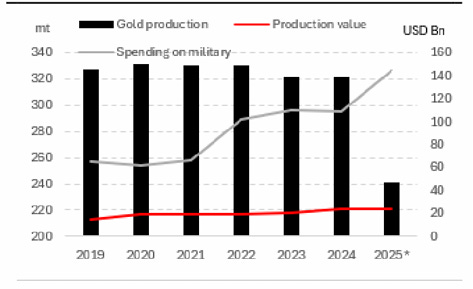
SocGen’s Commodity Compass (November 2025 via ZH) identifies a significant interruption in Russia’s gold export activity. Between 2022 and 2024, Russian output moved indirectly through Kazakhstan and Uzbekistan, which then re-exported tonnage to the United Kingdom and Switzerland. In 2025, this mechanism ceased. Both nations report export volumes below domestic output, and Russia’s central bank holdings remain stable at approximately 2,326 tonnes. Roughly 330 tonnes of annual production, valued at $24 billion, are not reflected in export or reserve data.

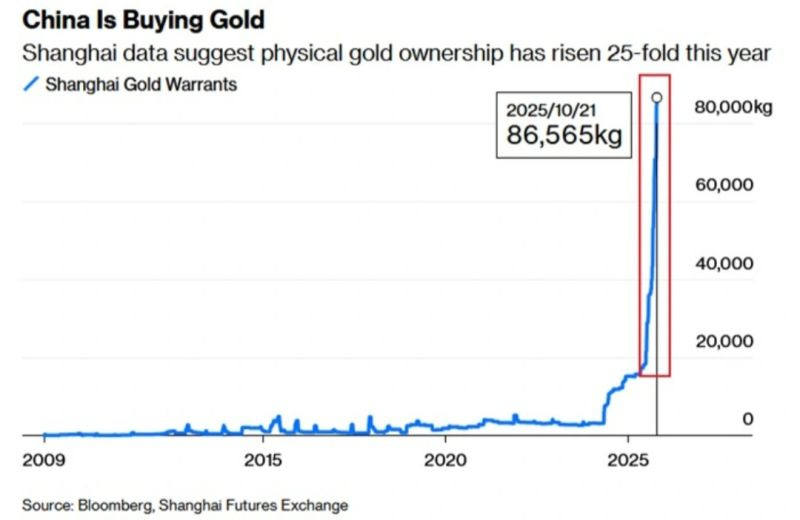
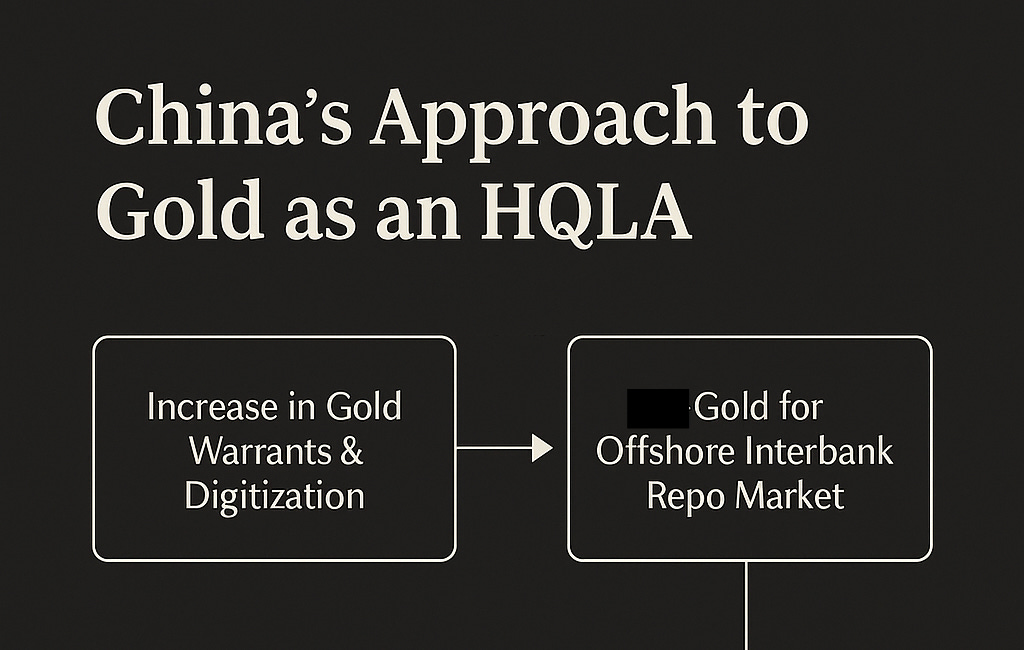
At the same time, China has expanded its physical acquisition of gold and silver, transferring holdings from state-controlled exchanges into private or offshore vaults. These developments coincide with new evidence that China is digitizing exchange-issued gold warrants for use as collateral in offshore repo markets. The combination of withheld Russian supply and expanding Chinese collateral infrastructure suggests coordinated preparation for a new liquidity framework in which gold functions as an active financial instrument.

“Roughly 330 tonnes of Russian production are unaccounted for in either exports or reserves.”

Export Behavior and Fiscal Conditions

Russia’s decision to halt exports is unusual given concurrent economic pressures. Military expenditures for 2025 are estimated at $145 billion, a 25 percent increase over 2024, while sanctions continue to restrict foreign-currency access.

Under normal conditions, these constraints would encourage higher gold exports to secure external liquidity. The decision to retain metal suggests an alternative purpose aligned with domestic or strategic financial objectives.

Kazakhstan’s 2025 production of 87 tonnes and Uzbekistan’s 129 tonnes account fully for their reported exports, implying neither is receiving Russian-sourced bullion. Re-exports that previously masked Russian flows have disappeared. The available evidence indicates a systemic withdrawal of Russian gold from international circulation.

China’s Parallel Development of Collateral Infrastructure

Evidence from Chinese financial institutions indicates that the Shanghai Gold Exchange (SGE) is digitizing physical gold warrants and integrating them with offshore interbank repo facilities through Hong Kong. The structure allows standardized, electronically transferable claims on allocated gold to serve as short-term collateral in financing transactions.

*Exclusive: China’s Next Move is HQLA/REPO Status

Sep 13
*Exclusive: China’s Next Move is HQLA/REPO Status

Under Basel III regulations, gold is recognized as a Tier-1 capital asset but is excluded from High-Quality Liquid Asset (HQLA) status. This exclusion prevents its use in repo markets on equal terms with sovereign debt. By linking gold warrants to interbank systems, China could effectively establish a mechanism that treats gold as a de facto HQLA within its domestic and offshore markets.Read full story

“Digitized warrants transform allocated gold into standardized collateral within interbank funding systems.”

The development parallels the growth of the offshore Renminbi market and represents a step toward creating liquidity instruments not dependent on U.S. Treasuries.

Analytical Framework: Gold as Substitute Collateral

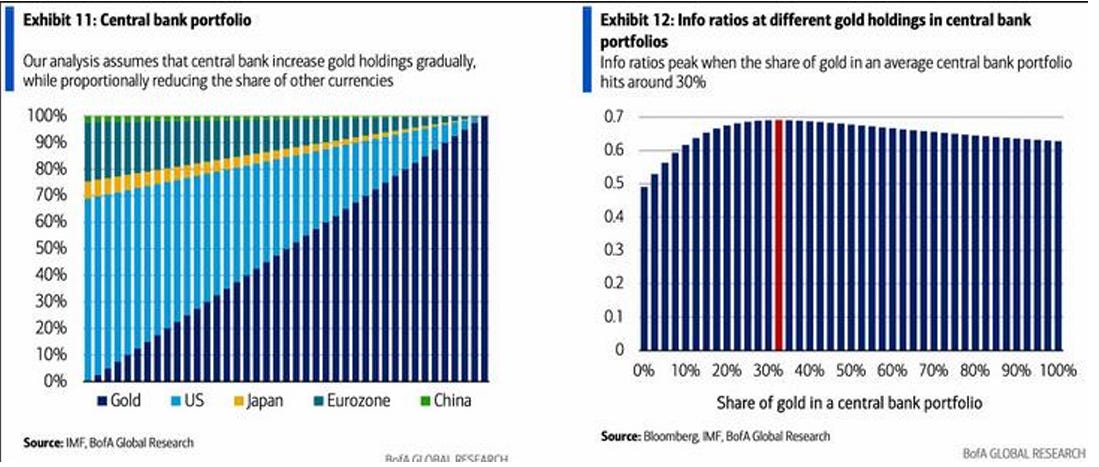
The accompanying GoldFix framework, Gold Replacing Treasuries in Repo, (PDF attached2) applies a heuristic linking central-bank reserve composition to global repo market scale. Central banks currently hold approximately 20 percent of their reserves in gold. Applying that ratio to the $17 trillion global repo market yields a baseline potential of $3.4 trillion in gold collateral, equivalent to 29,400 tonnes at $3,600 per ounce.

An upper scenario—consistent with Bank of America’s March 2025 conclusion that efficient reserve portfolios would allocate 30 percent to gold—implies $5.1 trillion in collateral, or roughly 44,000 tonnes. Both estimates exceed current official holdings of 22,000 tonnes.

Monday, November 10, 2025

The Hidden World War (Must read)

   This I believe is indeed what is going on right now: A silent war. 

   The world has become more complex and as such the ways to fight more sophisticated. But in the end, the objective is the same: Grab resources and extend power. We don't fight the old way but we fight nonetheless. 

   This has been my conclusion for at least the last 10 years. There are many other factors to take into consideration. The limitations on direct confrontation introduced by nuclear weapons for example. Soon war will change again as robots and autonomous drones take over the fields of war, the reliance on resources and energy will become even more obvious. But the core will remain the same. 

   The problem of course is when the silent conflict becomes more "noisy". Can we control better the march towards a World conflict than our ancestors in the 1910s and 1930s? Let's hope so although it is far from certain.     

Authored by Chris Macintosh via InternationalMan.com,

World War III is already underway, but most people don’t recognize it because they’re conditioned to expect war to look like traditional physical violence with bombs, guns, and battlefield confrontations.

This bias stems from centuries of warfare taking a particular form, similar to how people once couldn’t conceive of light without fire until electricity was invented.

Redefining War

At its core, war is conflict where parties use tools to increase their power and achieve outcomes that oppose others’ interests.

Think strategically about modern warfare: what would be the most effective weapons and tactics today? The answer is that physical violence — while still available as a tool — is no longer the smartest or most effective approach.

Modern Warfare Arsenal

Today’s war employs sophisticated, often invisible weapons including. Here is a list to consider. Think about experiences you’ve been having and consider where these have been used against you.

  • Information warfare: Cyber attacks, disinformation campaigns, flooding people with conflicting information to create confusion and cognitive dissonance.

  • Economic weapons: Sanctions, cryptocurrency manipulation, making populations dependent on controlled resources.

  • Political subversion: Election interference, undermining government legitimacy, bribing officials and influencers.

  • Psychological operations: Creating crises then positioning as the savior, exploiting social media platforms that control public discourse.

  • Biological and resource warfare: Famine, deprivation disguised as natural events.

  • Social manipulation: Fueling ideological divides, inflaming nationalism, targeting masculinity to prevent resistance.

Why Silent War?

Modern warfare operates covertly because war’s reputation is “ruined.” People no longer see it as noble or necessary. Public support has evaporated, in large part because politicians are now seen largely as lying scoundrels.

This is making it strategically better to gaslight populations, deny war is happening, and paint a picture that “everything’s okay.” Furthermore, leaders no longer need masses of men for physical combat, so there’s no benefit to declaring war openly.

Current War Symptoms

People are experiencing classic wartime symptoms without understanding the cause:

  • Loss of hope and inability to plan for the future

  • Widespread dread, numbness, and sense of unreality

  • Increased nationalism and “us vs. them” thinking

  • Fear of government and authority figures

  • Financial stress from inflation

  • Young people avoiding starting families

  • Supply chain disruptions and stockpiling behavior

  • Feeling like danger is everywhere

  • Limiting news consumption due to overwhelming negativity

  • Escalating protests and militarized police

  • People fleeing their countries or considering it

  • Fear of speaking out or losing rights

  • Rapid, “temporary” legal changes justified by public safety

  • Daily exposure to propaganda and radical content

  • Using basic needs (food, energy, money) as weapons

  • Fear that personal identity could make one an “enemy of the state”

Interconnected Global Conflict

What appear to be isolated regional conflicts are actually interconnected proxy wars within a larger global struggle. This breaks down boundaries between local and global conflict – a hallmark of world wars. Nations and alliances are being drawn into broader struggles for dominance and survival.

People must navigate constantly shifting geopolitical relationships, never knowing which countries or leaders are allies or enemies. This creates exhaustion, overwhelm, and a sense that nothing is safe or trustworthy.

Individual Experiences Vary

Wartime experiences differ dramatically based on location, identity, and circumstances.

This has been the case in previous world wars. It is what we are experiencing now.

The Reality Check

The key insight is that people are experiencing genuine wartime symptoms and stress, but because no formal war has been declared and it doesn’t look like traditional warfare, they fail to understand why they feel this way.

This leads to self-blame and thinking something is wrong with them personally.

Conclusion

Recognizing this “silent war” is crucial for understanding current global confusion and personal distress. Modern warfare is more sophisticated and potentially more abusive than traditional physical violence. The confusion and decision paralysis people feel is a normal response to an abnormal situation — a world war being fought with psychological, economic, and information weapons rather than conventional military force.

Realise that your feelings and experiences make perfect sense within this context, and it is, I believe, important to remove the self-blame that comes from not understanding why the world feels so chaotic and threatening.

Physical violence may still occur, but only as one tool among many in this new form of warfare that prioritizes psychological manipulation and systemic control over traditional battlefield tactics.

YouTube Removes Windows 11 Microsoft Account Bypass Tutorials, Claims ‘Risk of Physical Harm’

  I moved to Linux, the Ubuntu version about 15 years ago an never looked back. Out of 5 computers, only one, this one, still run Windows 10 in the background. 

  But from what I hear from my technical colleagues, Windows 11 seems to be a nightmare. The fact that you must be registered personally to use the software is a minor nuisance, although it is worth wondering why since you still must pay for the software upfront before your monthly subscription to keep using it. 

  The limitations and surveillance, taking a snapshot of your screen every few seconds for example, seems to be out of the chart, although it is for your own good, of course. They are protecting you, just as a stoker is protecting you from everybody else.  

  The story below about the difficulty to install a local account, is not an anecdote but a profound technical limitation. To protect you better, Windows has imposed a new technology called bitlocker on all new computers. The bitlocker is encrypting your computer disk with a separate microchip hard built on your computer. For most people, this is not really a problem since they use their computers exactly as they use their mobiles: Just run apps on them. But for more advanced users, this has become a major hindrance. If you want to bypass the bitlocker to install Linux on your computer, for example, or any non approved software, as in the past (Now only approved software can be installed from the Microsoft Store), you must first log in on your account with your 64 digit code, verify that it is you, then get the authorization to unlock your disk which itself takes quite some time. 

  The technology certainly makes you safer. It also makes Microsoft safer to do whatever they want on your computer. Pay to use software, check. Add advertising here and there on your pages, check. Control what you can and cannot access, both at the information and software level, check. Spy on your activity to monetize and resell information, check. 

  Honestly, you wonder why on earth people keep using Microsoft knowing all the free alternatives available. But then again, most people know nothing else, nor are they ready to plunge into the unknown of a new environment. It does take some time and effort to do so. But in reality, not that much. And since anyway, for most people, the only useful feature on your computer is your browser which works exactly the same whatever the operating system you use. You really wonder: What will convince people to ditch Microsoft? 

  Then let's talk about Google and YouTube. But next time. This would be overload for this post!    

YouTube Removes Windows 11 Microsoft Account Bypass Tutorials, Claims ‘Risk of Physical Harm’

November 7th, 2025

Via: It’s FOSS News:

Two weeks ago, Rich had posted a video on installing Windows 11 25H2 with a local account. YouTube removed it, saying that it was “encouraging dangerous or illegal activities that risk serious physical harm or death.”

Days later, Rich posted another video showing how to bypass Windows 11’s hardware requirements to install the OS on unsupported systems. YouTube took that down too.

Both videos received community guidelines strikes. Rich appealed both immediately. The first appeal was denied in 45 minutes. The second in just five.

86% of PCR-Positive “COVID Cases” Were Not Real Infections

 A manufactured pandemic? Who could have thought about it? Although from the beginning, it was obvious. A crime? Most certainly but the criminals are safe and rich, as should be in our neo-democratic system. 

86% of PCR-Positive “COVID Cases” Were Not Real Infections

November 7th, 2025

Via: Nicolas Hulscher:

A bombshell peer-reviewed study out of Germany just dismantled the scientific foundation used to justify lockdowns, social distancing, and vaccine mandates.

Researchers analyzed data from the Akkreditierte Labore in der Medizin (ALM) — a nationwide consortium of authority-accredited medical laboratories that performed roughly 90% of all SARS-CoV-2 PCR tests in Germany between 2020 and 2023.

When researchers compared the ALM’s week-by-week PCR positivity rates with the same labs’ IgG antibody testing data — essentially measuring who truly developed infection-induced immunity — they discovered something staggering:

Only about 14% of those who tested PCR-positive during the early pandemic period (2020–mid-2021) actually developed antibodies — meaning most early “cases” were never real infections.

Sunday, November 9, 2025

Merz At COP30: Climate Panics, German Industry Declines

  You would imagine that a Climate Summit these days would be virtual to avoid wasting precious fossil fuel. You would be wrong! It is happening as far from Europe and the majority of countries as can be, in Brazil, destroying in the process a patch of the Amazon to add to the injury and for what? A dark sinister mass against fossil fuel but as all such dogma, completely ignoring the greenest of all energies: Nuclear power. 

  "You" whoever you are, are the problem. Not the thousands of flights, public and private, rushing to the occasion. "You" pray to the wrong "gods". Growth and prosperity must be relegated to the background, even though, richer people are always far "greener" than poorer ones as they tend to care more about their environment and also have to means to do something about it. 

  But this doesn't fit the gospel of "greenery". Wind with its giant, made in China, non recyclable, propellers, destroying birds and the scenery are "green". As are solar panels, even if you must erase, square kilometers of forest, plantations or crops. Nuclear energy which does not emit any CO2, is not green. Don't ask why, the priests of this new religion said so. Only, die hard, heretics of the old, dying, fossil fuel world oppose the mantra.     

  Electric cars are green, even when you account for the huge mines needed for their heavy batteries. Gas cars, even modern ones which consume so little are not green. And on, and on. No nuances, no progress, no distinction between, for example, dirty coal and clean gas makes the cut. You can only be for or against. Killing the economy which gave us our prosperity is an unfortunate byproduct of the cult. But you can't get an omelette without breaking a few eggs, right? 

Merz At COP30: Climate Panics, German Industry Declines

by Thomas Kolbe

For the German Chancellor, one summit follows another. After the steel summit, Friedrich Merz now heads to COP30 in Brazil, the gathering of the climate club. There, participants attempt to cover the visible cracks in their construct with the familiar climate panic.

The steel summit at the Federal Chancellery was still echoing in the media when the Chancellor was already on a plane—en route to Belém, Brazil. COP30 is taking place these days under the leadership of Brazilian President Luiz Inácio Lula da Silva.

Representatives from over 70 nations have been celebrating this annual pinnacle of the global climate circus since 1995, giving it the veneer of supranational consensus. Of course, they travel by the thousands—by plane, how else—and with maximum emissions.

No one voluntarily skips the annual climate gala. A few tons of CO₂ really don’t matter anymore. After all, as insiders know, the planet is already burning, and the struggle for a habitable Earth is, in essence, already lost.

Indulgence Trade and Business

Yet, the grand figures of the climate industry wink and suggest there might still be hope for Earth. From Ursula von der Leyen to Lisa Neubauer and even the Chinese delegation, it is understood that massive investments in the green art economy might just pull the iron out of the fire.

As in spiritual circles, a little indulgence here, a CO₂ tax hike there, and magically the global temperature falls to acceptable levels—the climate god appeased.

Friedrich Merz undertakes the 9,000-kilometer journey from Berlin to Belém to assure his fellow indulgence merchants of continued German taxpayer support.

Redistributing the Wealth

The club plans to invest €1.3 trillion annually in climate measures for developing and emerging countries. Germany, as one of the supposedly strongest economies, must naturally participate. With the United States leaving the alliance, showing presence is crucial.

Merz had to travel, regardless of domestic issues. Cynically, his speaking slot was exactly three minutes. Three minutes for the envoy of the club’s hardline faithful—almost heretical considering Germany’s financial contributions.

Before the final boat ride on the Amazon, the Chancellor will lecture on industrial transformation and the energy transition—topics few have mastered as thoroughly as Germany’s top representative.

A Sad Comedy

At least in Brazil, Merz can proudly claim that Germany may meet its climate targets. Massive deindustrialization makes this possible. While UN chief António Guterres demanded radical action at the start of the event, warning in his usual panic that the 1.5° target has already been missed, the Chancellor performs his sad comedy.

Around 300,000 industrial jobs have been lost in Germany in recent years due to soaring energy prices and overreaching climate regulation. The country struggles economically and risks becoming a European Rust Belt under the climate timelines dictated by figures like Guterres.

Self-referential events like COP30, which knowingly ignore the economic fallout of hardline climate policies, distort reality, making it hard for the public to connect climate politics with economic decline.

Deep Cracks in the Construct

Since the peak of the climate movement in 2009, when US President Barack Obama legally declared CO₂ the most dangerous of all climate gases, the construct has shown deep cracks.

The Trump administration repealed this rule, and the US will fully exit the climate club on January 1, 2026, delivering a blow to the movement. Massive capital shifts follow: away from green funds, toward sectors that generate real market returns.

In the US, money flows back to nuclear and conventional energy. Renewables must now compete, as in a real market economy. True progress through free markets.

The climate movement still fails to grasp that technological progress toward cleaner, efficient, and sustainable production was driven not by the state but by market forces—materialized through price mechanisms, not socialist central planning.

China and India

The anachronism of Germany’s industrial retreat is stark where new capacity emerges—in India and China. Both ignore the rules of the Europe-dominated climate club.

India barely acknowledges them, while China plays an intelligent, though ethically questionable, game with Western climate zealots. Through a network of government-funded NGOs, Beijing has long helped anchor the European climate regime politically and in the media, while massively scaling export-oriented production like solar panels, following different domestic paths.

This year alone, China will bring 80 GW of new coal capacity online, invest in nuclear, and, where market-viable, in renewables—pragmatically and unideologically, the Chinese way.

The Taxpayer Cash Cow

From the EU perspective, COP30 must be seen for what it is: a media spectacle designed solely to keep the European climate subsidy machine running at full throttle.

The EU Commission plans around €750 billion for climate subsidies from 2028 to 2034, on top of national subsidies and aid. A massive business, with “partners” of the climate movement holding out their hands for European tax funds through development aid and countless climate funds.

Merz himself knows this game is flawed. Before the summit, he repeatedly stressed that climate protection is central, but must be pursued while safeguarding economic competitiveness and technological openness.

Yet, experience from the first half-year of the Merz government shows that the Chancellor will not challenge Brussels’ destructive climate policies. The combustion engine ban remains; the senseless heating law continues, costing German households billions. The mantra: stay the course, with industrial electricity prices and other subsidies, straight into economic decline.

The False Temperature Claims That Underpin The COP30 Alarmist Agend

   "Lies, damned lies, statistics and climate" could be the subtitle of the COP30 Climate Change Conference in Brazil. The country which destroys the largest area of rain forest year after year is lecturing the world about CO2 capture! Why not have a conference on chastity in a whore house? It would be no less incongruous and would leave the participants with a nice memory instead of a guilty feeling of doing something wrong by just breathing. Not that it would change much for the UN and other participants. The problem is "you", not private jets. 

  Once you understand that the climate is the result of millions of interdependent cycles, action and retro-actions at different levels that we still know very little about, you slowly grasp that the models we build are approximations with countless unknown factors that need to be adjusted and miraculously are to represent past estimates of the climate. That much is interesting as it gives us an idea of what could have happened in the past. But as soon as you try to extrapolate to the future, you enter the unknown and suddenly realize that we truly understand far less than we believe.     

  In its own way, and as all ancient religions recognized, the planet due to the sheer complexity of the system is alive. This concept of "alive" under the modern interpretation of James Lovelock and his Gaia hypothesis has nothing to do with animal life as we understand it, but simply describe a complex auto-regulating system. This being the case, in such a context, "runaway temperatures" has no meaning. What is happening, is necessarily part of a long term cycle which will peak and later decrease. And only much later, during a later cycle could we identify a possible "human" effect with a +/- 2C temperature variation. 

  Right now, we are in a slow, gradual ascendant trend which has been going on for over 300 years, since the minimum of the "Bruegel" era, and will soon take us back to the temperatures of the Middle Age optimum. The cycle before that was the Roman optimum. Both were eras of high temperatures and prosperity thanks to better yields from agriculture. Which by the way, is exactly the trend we are witnessing right now. 

  But no, such message would be empowering and would not lead to the desired outcome. Now that people cannot be controlled so easily by religious beliefs, the "original sin" has been resurrected under a pseudo-scientific form: "You live, therefore you pollute" by producing CO2, CH4 and other gases. Pseudo-scientific because it is a new dogma which cannot be discussed less "climate skeptic" or worse "climate denier" is thrown at you with the desired silencing effect.   

  If you still doubt this fact, remember that the people who tell you to use less CO2, less the planet warms 1 or 2C, are the same ones who order the fabrication of nuclear weapons who can easily warm the atmosphere, locally, by 1 or 2 million degrees. So we need to save the planet urgently by limiting the tiny, hypothetical, impact of CO2 but not the huge, certain, impact of nuclear weapons? Although again limiting nuclear weapons would also free huge funds which could be reinvested in cleaner energy, or preserving the rain forest? Governments are either mad, or obsessed with control. No prize for guessing the right answer.  

by Chris Morrison via DailySceptic.org,

The next two weeks of COP30 will see three favourite climate scares relentlessly broadcast to promote the fast-fading hard-Left Net Zero fantasy.

They are:

  1. breaching a 1.5°C global ‘threshold’ leading to runaway temperatures;

  2. human-caused tipping points producing unimaginable natural disasters;

  3. and attribution of single-event bad weather to the use of natural hydrocarbons.

The 1.5°C figure is a meaningless number invented by politicians and activists to concentrate Net Zero minds; tipping points are climate model codswallop; and ditto attribution crystal ball-gazing.

None of them are backed up by credible scientific evidence and observation.

Which of course is why political elites have trashed the scientific process of inquiry, banned and cancelled any dissenting discussion and declared the matter ‘settled’.

The foundation scam is temperature. The world is said to be warming dramatically, leading to tipping points and worsening extreme weather. Changes are said to be occurring at unprecedented rates and are caused primarily by humans increasing atmospheric levels of carbon dioxide. In fact the temperature rise is small, about 1°C over 200 years (making allowance for all the fake temperature estimates and urban heat-ravaged measurements) and similar rises are commonplace in both the historical and paleo record. The recent ‘hottest evah’ rises have been seen in the past – sudden changes in temperature are caused by sudden local events such as volcano eruptions. As it happens, the underwater Hunga Tonga volcano released vast quantity of water vapour into the upper atmosphere in 2022, a ‘greenhouse’ warming event that would have been helped along by a recent strong El Niño oscillation. Recent accurate satellite measurements show the overall global temperature has been falling during 2025.

Don’t take my word for all this natural movement. Professor Mark Maslin is a Professor of something termed Earth Systems Science at UCL and one of the authors of a recent tipping point report timed for COP30. This particular computer model-based bilge suggested that warm water corals may already be crossing their “thermal tipping points”, despite the fact that coral has been around for hundreds of millions of years and survives in waters between 24-32°C. This would appear to be the same Mark Maslin who as a humble geography lecturer in 1999 wrote a paper that said possibly most of the large climate changes involving movements of several degrees occurred at most on a timescale of a few centuries, sometimes decades, “and perhaps even a few years”. These days he whines that “Earth is already becoming unliveable”, while climate change politics helps build “a new political and socio-economic system”. In 2018, he was one of a number of eco-activists who signed a letter to the Guardian saying they would no longer “lend their credibility” by debating climate science scepticism.

No wonder people like Maslin – needless to say a BBC regular on all learned climate Armageddon matters – walked away from climate science debate.

Tying CO2 levels to rising temperatures to make Left-wing political capital relies on observations from just a few recent years. Widen the observations out to hundreds and then hundreds of millions of years gives a different picture. Sometimes temperatures rise and fall at the same time as CO2, sometimes not. Sometimes even CO2 levels rise before the following temperatures, more often than not they don’t. The simple explanation that warming gases such as CO2 become ‘saturated’ once they pass certain concentrations, with heating falling off a logarithmic cliff, is a scientific hypothesis or opinion, but it has much to offer when past observational evidence is considered.

Let us consider some of these observations starting with the long term record over 600 million years. The graph below shows wide temperature-CO2 divergence.

Over 600 million years it is difficult to observe any general lockstep connection between temperature and gas. It might, however, be noted that over 600 million years, CO2 has generally been declining in the atmosphere to the near denuded levels seen today. As we have seen over the last 40 years even small rises in CO2 lead to significant planet-wide biomass growth. All that CO2 was good for the dinosaurs who roamed the Earth until 66 million years ago, with levels more than three times higher than today. The little extra has also been good for humans since recent crop yields have soared and helped to alleviate naturally-occurring world famine.

These records of course are very long term and are compiled from proxies with accuracy only to a few thousand years. In the more immediate record we find additional and conclusive proof that CO2 is not the main climate thermostat. Temperatures in medieval times were similar to today, possibly slightly higher in the Roman period and often 3-4°C higher in the Holocene thermal maximum around 8,000 to 5,000 years ago. During these periods, CO2 was remarkably stable around 260 parts per million, a mark that is in fact dangerously low to sustain life on Earth. The notorious Michael-Mann-1,000-year temperature ‘hockey stick’ removed the linking problem by abolishing the medieval warming period and the subsequent little ice age that ran up to around 1800.

Remarkable recent scientific evidence has emerged to suggest that abrupt rises in temperature have been a feature of the global climate going back to the iceless Jurassic period over 150 million years ago. Dramatic temperature changes based on 1,500-year cycles, as the younger Maslin can testify, have been known to have occurred in Greenland and the North Atlantic. But a group of French scientists led by Slah Boulila from the Sorbonne found large temperature hikes going back millions of years across the globe. The scientists noted warming up to 15°C within a few decades, “pointing to abrupt and severe changes in Earth’s past climate”. The 1,500 year cycles are often called Dansgaard-Oeschger (DO) events after the scientists who discovered them. Some scientists have downplayed the initial DO findings and suggested the short term temperatures rises of around 1.5°C were caused by specific northern hemisphere oscillations of ice sheets and surrounding waters.

However, the French scientists note: “The 1,500-year cycle is documented in both hemispheres, in other oceans and in continents.” Their work is said to support the global nature of DO-like events, and in particular that their potential primary cause is independent of ice sheet dynamics. Meanwhile, scientific evidence continues to grow indicating much higher temperatures a few thousand years ago. One recent paper found the plant Ceratopteris had grown 8,000 years ago at 40°N in northern China, suggesting winter temperatures 7.7°C higher than today. Another found types of molluscs surviving in the Arctic Svalbard 9,000 years ago that indicated temperatures were 6°C warmer.

The current Net Zero fantasy rests on catastrophising tiny temperature rises that frankly are not even measured properly, demonising CO2 boosts that are helping Earth return to a more healthy biosphere and atmospheric balance, inventing ‘tipping points’ using junk computer models and insulting the intelligence with untestable tales claiming humans are making the weather worse.

And they call us skeptics the ‘deniers’.

Saturday, November 8, 2025

"All Wars Are Based On Lies"; Renowned WWII Historian Faces Official Narrative Assault

   As we are once again approaching a time of wars, it is worth remembering how wars are manufactured. In time of stress, the great depression in the 1930s, the great bubble today, the easiest solution is always to vilify outsiders for internal problems. It doesn't mean outsiders themselves are blameless. The NAZI and other fascists in Italy or the military government in Japan before the second world war, or the Chinese today. But they are not the cause of the economic problems which popular opprobrium must be deflected away from.  

   In Japan, the new Prime minister has been specifically elected to deal with the "problem" of exploding foreign residents, read Chinese, in the country. This is the mild version of the militarist government measures in 1936 but nevertheless once again a huge step towards a conflict with China, although China has nothing to do with the current decline of Japan since 1990, except for being more competitive than Japan, just as Japan was more competitive than the West before. Can this really be the reason for a casus beli? The answer from history is a clear: Yes. We just don't know any better than going to war when society is under economic stress. Let this fact sink in as you read bellow about the past. And what may once again happen sooner than later. (The longer video can be accessed by following the link to Zero hedge.)

"All Wars Are Based On Lies"; Renowned WWII Historian Faces Official Narrative Assault

Mainstream historian Jim Holland and Libertarian Institute editor Keith Knight clashed over one of history’s most sacred narratives — the justification for America’s entry into World War II. Moderated by Mario Nawfal, the discussion cut through decades of conventional wisdom to ask uncomfortable questions like whether Roosevelt’s administration provoked Japan into attacking Pearl Harbor or whether Winston Churchill ought to be lionized as a great hero.

Did the war, which killed over 70 million people, actually preserve “the west” and could the death have been avoided by diplomatic means? Take a look at the highlights below, but we encourage listening to the full debate so you can decide whether the “good war” was truly good.

“Provoked Into War”: Knight’s Case Against The Pearl Harbor Narrative

“The attack on Hawaii… was intentionally provoked,” argued Knight, “so Roosevelt could engage in diversionary foreign policy after his New Deal led to the double-dip recession of 1937.”

He cited Navy Captain Arthur McCollum’s October 7, 1940 memo outlining “eight ways the United States can provoke Japan,” ending with the line: “If by this means Japan could be led to commit an overt act of war, so much the better.”

“Roosevelt supported the policy of provoking the Axis powers,” Knight continued, pointing to a New York Times article from January 2, 1972, “War Entry Plans Laid to Roosevelt,” describing Roosevelt and Churchill’s 1941 meeting. Churchill admitted Roosevelt “would wage war, but not declare it… everything was to be done to force an incident.”

Knight added: “On November 25, 1941, Secretary of War Henry Stimson wrote in his diary, ‘The question was how we should maneuver them into the position of firing the first shot without allowing too much danger to ourselves.’”

“War with Japan was not inevitable,” he said, “but an intentional policy pursued by the Roosevelt administration.”

Citing Robert McNamara’s The Fog of War, Knight quoted: “Proportionality should be a guideline in war. Killing 50% to 90% of the people of 67 Japanese cities and then bombing them with two nuclear bombs is not proportional.” McNamara recalled, “In that single night, we burned to death 100,000 Japanese civilians in Tokyo.”

Knight concluded, “The unconditional surrender of Japan destroyed America’s bulwark against Mao’s China and opened power vacuums in Korea and Vietnam—leading to millions of deaths and communist victories in both.”

Pearl Harbor, he said, “was not the price of peace—it was the product of provocation.”

Conscription: Is It Moral?

To the Libertarian Knight, compulsory military service is outright immoral. “Conscription is an indicator that the people you’re claiming to represent don’t actually think something is worth fighting for.”

Holland pushed back, arguing that, during WWII, while popular opposition to war was strong, “there is a balance to strike.” “If you give too much fuel to this bully [Hitler], he’s only going to get stronger,” he said. “There’s a point where the political metric is that you’ve got to come and stand up to this.”

“Conscription comes in for the first time ever in peacetime in March 1939. Chamberlain, who is the prime minister—not Churchill—is really nervous about suggesting conscription, and there is not a public outcry at all.” Instead, Holland said, “There is an acceptance amongst the British public that this is something that needs to happen.”

“The United States goes from very, very strongly isolationist to more and more in favor of massive rearming in the summer of 1940,” Holland noted. “When conscription comes in… there’s barely a flutter of eyelids.”

While acknowledging Knight’s moral ideal, Holland insisted that liberty itself was on the line. “The whole point about the Second World War,” he said, “is that democratic nations are standing up against authoritarianism and the taking away of personal freedoms. That’s the whole point of Nazism… the state runs everything… personal freedoms are taken away.”

Saturday, November 1, 2025

Germany's Geopolitical Freefall: Beijing Shows Berlin The Red Card

   The spiral downward for Europe and especially Germany is accelerating. Whatever Brussels or Washington may announce to shore up financial markets mostly endowed with the memory capacity of a goldfish, industrial and energy policies take decades to build and implement. Countries have no "friends", only interests. 

   Replacing actual economic activity with financial virtual growth is actually hollowing up European countries the one after the other. The UK started early thanks to the City. France followed, and now Germany. 

   The absurd hope of expansion Eastward is now bumping against the Russian wall as it will become clear in the coming weeks in Ukraine. Then what? Doubling down again with no real industrial strength to back-up military might? What are these people thinking?   

Germany's Geopolitical Freefall: Beijing Shows Berlin The Red Card

Submitted by Thomas Kolbe

Germany’s dramatic economic collapse is dragging its geopolitical standing down with it. Foreign Minister Johann Wadephul has now learned what it means to be treated as a second-tier diplomat, receiving the red card from Beijing. A humiliation and a reprimand for Germany.

Johann Wadephul, Photo Bloomberg

The school of life can be cruel. Growing up usually means losing lofty ideals, fringe ideologies and the dreamy mindset of an inexperienced existence to the harsh reality of the world. Reality follows its own rules, unimpressed by self-delusion.

That moment of maturity, the exit from the bubble of hermetically sealed party ideology, has now arrived for Germany’s top diplomat.

A Minister of Fantasies

Johann Wadephul, who only recently wandered through wonderland attributing the German economic miracle to Turkish immigrants, had to cancel his first official visit to China at the last minute because Beijing saw no need to speak with a German delegation.

The Christian Democrat is learning, much like his BlackRock-seasoned party colleague Friedrich Merz, that Germany’s dramatic economic decline is being followed instantly by a loss of geopolitical relevance.

Wadephul’s first China trip was intended as a reset in the strained diplomatic relationship with Beijing. A high-profile business delegation was set to accompany him and help ease tensions over critical rare earth supplies.

China has been threatening a complete export ban for weeks, a measure that would instantly paralyze key German industries.

Suddenly Business Matters

The delegation was to include representatives from the German automotive industry, Siemens Healthineers, the German Robotics Association and a leading importer of rare earth elements. Together, they were meant to relieve pressure in Beijing and secure access to the essential resources that Germany’s industrial base cannot function without.

When Beijing made clear that it would not entertain additional talks beyond the mandatory meeting of foreign ministers, Wadephul was forced to cancel the trip late Friday. A last-ditch attempt to save face and limit the political damage.

Perhaps Wadephul should have copied his predecessor Annalena Baerbock and focused on moral-philosophical escapism such as feminist foreign policy. It is harmless, fits the German zeitgeist and would have earned him brownie points among left-leaning coalition partners.

The Giant’s Achilles Heel

Right now Europe would desperately need a delegation that positions itself smartly in the slipstream of the Americans.

Every giant has a weakness. China’s economy is caught in a self-reinforcing deflationary spiral triggered by draconian US tariffs and a long-festering property crisis caused by massive state-driven capital misallocation.

Deflation is fatal because China’s growth relies on the fiat-credit machine. Rising insolvencies mean shrinking loan books. The credit turbo sputters, collateral values collapse through fire sales and oversupply, especially in real estate. Then the state must intervene again, inject more government credit and weaken its currency further.

It is a vicious cycle gripping nearly every modern economy.

China’s answer has always been the same: a colossal export-subsidy engine, a mercantilist model built at the expense of trade partners who lost production capacity to China.

Beijing’s trade surplus accounts for roughly 1 percent of global GDP. Roughly 1 trillion US dollars, fueled by massive export aid.

On top of that come geopolitical Trojan horses like the Belt and Road Initiative, opening markets wherever China needs raw materials.

China Is Desperate for Replacement Markets

Europe’s internal market has become essential for Beijing to dump excess production. The US market is increasingly blocked since Donald Trump’s tariff offensive: Chinese exports to the United States have crashed by a staggering 27 percent.

At the same time, Chinese exports to Germany rose 10.7 percent in the first half of the year.

To prevent a labor-market meltdown at home, Beijing is flooding alternative markets with overcapacity. The Communist Party is facing a youth unemployment rate likely around 20 percent. The social explosive lies right there.

This is precisely where Europe — especially Berlin — could apply leverage. In the escalating struggle for rare earth access, crucial for German industry and especially automakers, Europe could build real bargaining power by teaming up with the United States.

Irresponsible and Stubborn

It is irresponsible, considering China’s 90 percent dominance in rare-earth refining, not to side with Washington and secure strategic advantages for Europe’s own industrial survival.

Ideologically rigid, strategically naive and severely weakened by its trade debacles with the US, EU Commission President Ursula von der Leyen is stumbling from one pseudo-summit to the next like a dethroned Brussels queen.

One gets the impression that the entire climate circus, the theatrical solidarity on Ukraine and the delusional green posture have become a psychological overcompensation for the visible failure of the Brussels project.

Time to Seek Alliance with the United States

Europe should have embraced geopolitical division of labor with Washington from the start. Especially now that the US, under a hyperactive foreign-policy president, is openly claiming leadership. Trump is right to point at EU protectionism, ubiquitous climate regulation and a policy increasingly hostile to markets.

Washington is on the offensive: deregulation, tax cuts, junking the quasi-religious climate cult. It’s working: the US economy is growing 3.8 percent, new debt fell from 6.7 to 5.8 percent. Trump is recalibrating the system while Europe tumbles in the opposite direction: higher debt, deeper recession.

Wadephul and his fellow European diplomats must finally accept this reality and drop their escalating crusade over censorship laws, scrap the Digital Services Act, the Digital Markets Act and the online-surveillance regime entirely. Instead, they should seek fair trade with the US without hidden climate protectionism.

Europe is resource-poor and energy-dependent, importing up to 60 percent of its energy. Without Russian energy and raw materials, Europe’s prosperity model collapses.

And the attack on a Eurasian rapprochement between continental Europe and resource-rich Russia did not come from Washington, despite media mantras to the contrary. It came straight from the heart of the European Union.

Ukraine Is Defending Itself With Money Europe Doesn't Have

    What happens when you lose a war? Europe is about to learn the lesson the hard way. Even to the least acute observers at the EU, it mus...