The purely financial analysis of the debt crisis in France below is not what will help you understand the problem the country is facing.
The armies of young "students" revolting against institutions which have forsaken them will get you a step closer. And the other, far more silent but costly army of early retirees enjoying their later years at government expense will finally get you to the core of the problem.
France is broke. socially, culturally and of course financially. That deadly combination guaranty that nothing of consequence can happen before the slate is wiped clean and wiped it will be. In the good old days, the country would go through some convulsion, devalue massively and after internal conflicts, declare a new republic to start anew. Europe prevents such an "easy" exit. And unfortunately any other exit in fact except austerity which is of course unacceptable to the large majority of French voters. So nothing will happen until the crisis escalate to the next level.
Already the country has no budget for 2027. The deficit in 2026 may be close to or above 8%. Nobody knows. The only thing which can stop the profligacy is the inability of the country to refinance its debt. And we are not including any fund to maintain the infrastructure or invest in future manufacturing capabilities.
The bad news is that France is just the canary in the coal mine. England is a little less bankrupt financially but more socially. Germany has completely betrayed its industrial and energy core and will pay dearly for it, etc...
The decline of Europe is not an event but a process. It has been going on for over 50 years, since the oil shock of the 1970s which stopped the postwar reconstruction cold in its tracks. It is just moving up from the gradually to the suddenly according to the Hemingway's observation of how to go bankrupt.
Authored by Robert Burrows via BondVigilantes.com,
A spread can be historically wide and still offer inadequate compensation for what lies ahead...

At around 150 basis points over Bunds, French ten-year government bonds look tempting. The spread is exceptionally wide by France's historical standards. For investors accustomed to treating France as a core European sovereign, the instinct is to buy the dislocation and wait for normality to return.
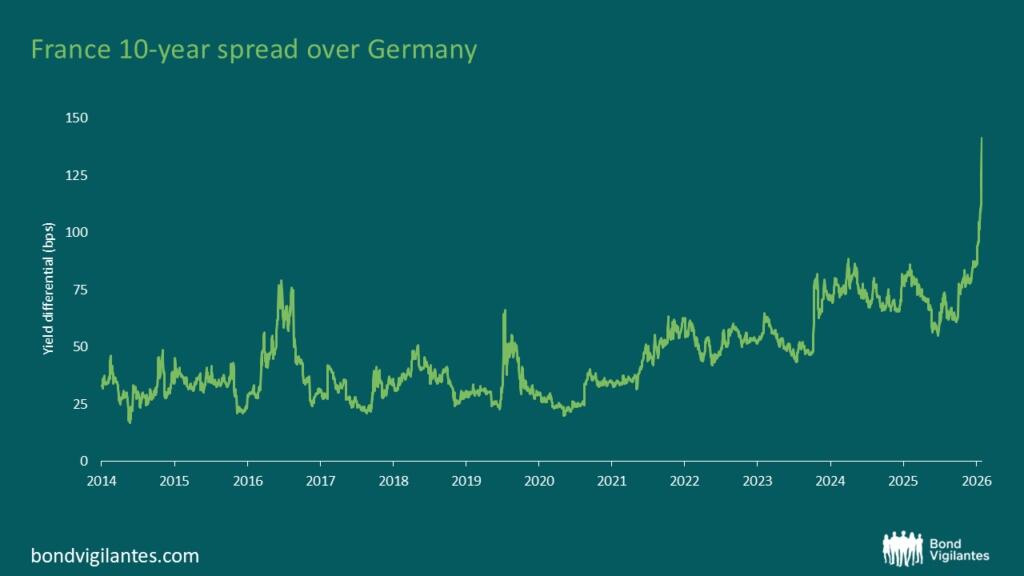
But that instinct risks anchoring to a past that no longer provides a reliable guide. A spread can be historically wide and still offer inadequate compensation for what lies ahead.
A couple of years back, I argued that France's fiscal pressures and political fragmentation threatened more than its own creditworthiness. They challenged the cohesion of the eurozone itself. I more recently questioned another assumption underpinning European sovereign valuations: that Germany would always have the economic strength and fiscal capacity to support the rest. Those two concerns are now coming together with worrying implications.
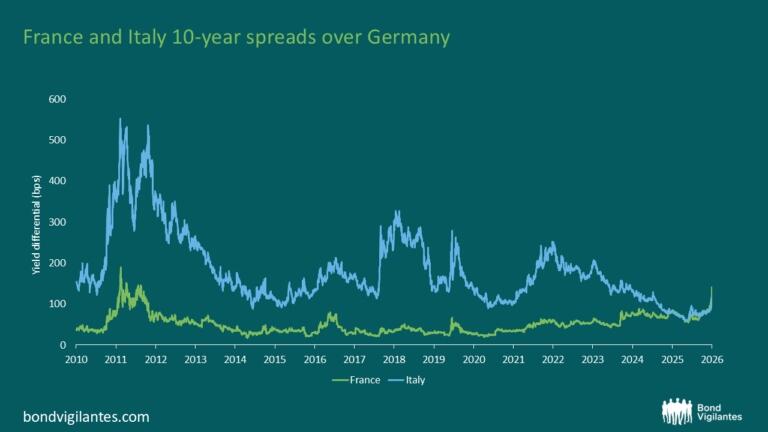
Investors should therefore consider a different reference point: Italy's historical spread over Germany. Italian spreads exceeded 500 basis points during the sovereign debt crisis That is not a forecast for France, but it demonstrates how far spreads can move when markets lose confidence in fiscal sustainability and the credibility of European support. France's own trading history may be a poor measure of its potential downside in a different regime.
The central problem is moral hazard. Providing unconditional support to France would weaken the incentive to repair its public finances and invite other governments to expect similar treatment. Yet withholding support risks allowing higher borrowing costs to worsen the fiscal position and transmit stress across the monetary union.
The ECB's tools do not remove this dilemma. Its Transmission Protection Instrument considers fiscal sustainability and compliance with European policy commitments, and is intended to address unwarranted, disorderly market pressures. A repricing driven by deteriorating fundamentals presents a much harder case for intervention.
In my view, durable support would require a concerted French effort to restore fiscal credibility. The approaching presidential election complicates that bargain: European institutions need confidence that the government making commitments can deliver them and that its successor will honour them. There is no formal requirement for the ECB to wait until the election, but political clarity may be necessary before meaningful conditions can be sustained.
Germany's changing position makes this more difficult. It can remain the relative haven within Europe while becoming less able or willing to underwrite its neighbours. Bund outperformance during a crisis would not prove that the capacity for collective rescue is unlimited..
An interesting expression of this risk is to short Spanish government bonds against duration-matched Bunds. My argument is that Spain's still relatively tight spread offers too little compensation for a broader fragmentation episode. A narrower starting spread also means less negative spread carry than shorting France.
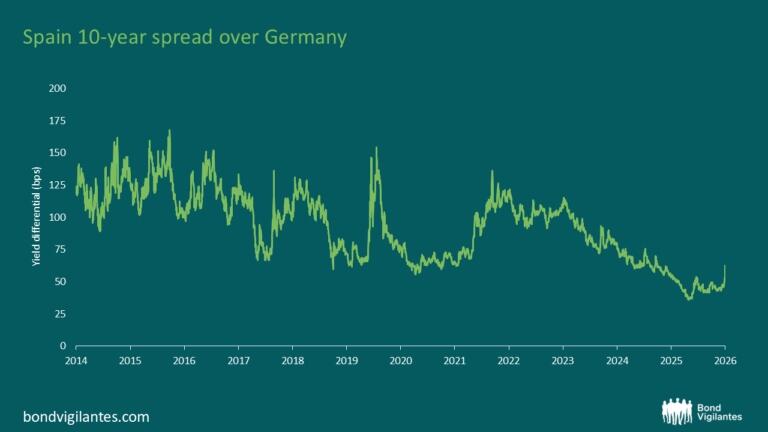
Spain offers a potentially inexpensive way to position for investors questioning the eurozone's collective insurance policy, with relatively limited downside. Let's not forget Spain does have a debt to GDP ratio of 100% and is governed by a minority Government who just yesterday called a snap election. A tempting asymmetry given the growing risks.
France at 150 basis points may look cheap against yesterday's France. Investors should be extremely cautious about assuming that yesterday is coming back.


No comments:
Post a Comment