Let's start with Yemen of course. 10 years ago, Yemen was already in a civil war opposing different factions controlling large areas of the mountainous country. Then Hansar Allah (Commonly referred to as "the Houthis") took the ascendancy and slowly rolled over the opposition supported by Saudi Arabia and the Emirates.
Saudi Arabia has oil money on its side but Yemen has a longed coherent history going back thousand of years. We are currently witnessing two converging trends. Drones and precision missiles which are flattening the playing field as well as oil facilities and the fact that the growing modern mercenaries do not form strong, efficient armies. The Saudis could have learned the lesson from the Romans who had little positive comments on the German mercenaries manning the borders of the Empire. But then again what alternative do they have, except of course not interfering in internal Yemeni affairs? Bombing airports and pipeline compression stations is much easier than bombing... what exactly can you bomb in Yemen? This conversely is a lesson the Saudis should have learned from the Americans in Vietnam: No army can fight efficiently against a determined, ragtag army in sandals, especially if that army has the few technicians it needs to fit modern navigation modules on old Sam missiles.
The risks are huge for Saudi Arabia as without oil, the country is no much of a country at all, having spent most of its history under the control of one empire of the other: The Ottoman and the British most recently. The reality is that the borders of the Gulf countries are completely artificial. They could consequently dissolve faster than we realize starting with Iraq, Syria, Saudi Arabia of course and all the little Sheikh kingdoms scattered around the Gulf. The only historic, cultural and geographic features of the Middle East are Turkiye and Iran, and to a lesser degree, Egypt.
And then nearby, there is the cauldron of the horn of Africa where the complexity is mind boggling and the risk of a major explosion even higher than in nearby Arabia. The giant of the area is of course Ethiopia but its cultural diversity makes the country almost impossible to govern and prone to conflicts with a little help from its not so friendly neighbors which almost all happen to be in a state of internal turmoil. Somalia has had the bad luck of not having a strong central government for over 50 years resulting in the non-recognized independence of Somaliland. Erythrea is populous and different enough so that it ended-up likewise splitting away from Ethiopia.
In other words, a long list of smoldering conflicts exacerbated by the local population explosion and foreign "ingerence" due to the geographic importance of the Bab el mandeb. (Strait of Tears) As in a Netflix saga, if you did like the Hormuz Strait imbroglio, you will love the Bab el mandeb Strait conflict which will involve more countries, near and far.
In the end, the real question is: Can a world war emerge from this mess? The Strait of Hormuz conflict for the time being concerns only two protagonists and consequently, a diplomatic solution can or rather could be negotiated. Not so for the Bab el Mandeb Strait. The complexity between different factions and conflicts is such that no compromise is possible. It is not by accident that the US does not wants to get directly involved in Yemen. The quagmire potential is huge. But so are the potential effects on world trade and oil flows and therefore the risks of a much wider conflict.
Airlines Suspend Flights To Saudi Capital After Devastating Houthi Strikes On Airport
Update(1604ET): There are reports that possibly several parked aircraft were damaged or destroyed after the earlier Thursday Houthi ballistic missile attack on King Khalid International Airport in Riyadh. And now international reports are saying a slew of airliners are suspending flights to the city, some tentatively for up to a week:
In response to Thursday's attack, Germany's Lufthansa Group and Air India as well as two other carriers from the country, all suspended flights to the city.
The rebels had earlier warned global airlines "for the last time" about the consequences of operating in Saudi airspace, which they called a theatre for their military operations.
Saudi authorities issued a NOTAM, and so many more airlines are expected to cancel. Also quite significant is the US State Dept alert telling diplomatic personnel to not use the capital's airport and to stay away from the border region with Yemen.
"U.S. government employees working in Saudi Arabia now require special authorization to use the King Khalid International Airport in Riyadh," the fresh emergency notification says.
More emerging photos have shown extensive destruction:
* * *
King Khalid International Airport in Riyadh has come under Houthi attack once again on Thursday, and may have suffered a hit, as eyewitnesses have told Reuters of smoke rising from an aircraft at the major travel hub in the Saudi capital. Some new, unverified shocking images emerging...
Witnesses were also cited in The Associates Press as having heard "several explosions" - after which an urgent evacuation notice was given.
The Houthis in Yemen have been going after airports as well as Aramco oil facilities. In two separate attacks on Tuesday and Wednesday, the kingdom's Abha International Airport and King Khalid International Airport were targeted by Houthi missiles.
The AP details of the Thursday flight stoppage in Riyadh as follows:
King Khalid International Airport “closed again,” the Flightradar24 monitor said Thursday afternoon on X not long after the blasts. “Last landing 80+ minutes ago. Last take off 90+ minutes ago.”
Fire and ambulance crews deployed and smoke was visible, the witness said, speaking on condition of anonymity because they were not authorized to speak to the media.
The witness said outgoing flights were halted and passengers were instructed to leave checked-in luggage behind and evacuate. It was not immediately clear how many flights were disrupted.
The prior 72 hours has seen three civilians killed and 36 injured in Houthi-claimed attacks across Saudi Arabia. "An Egyptian and an Algerian national were killed at Abha airport, and a Sudanese national was killed at the airport in Riyadh, the agency said, with 36 people wounded in the attacks," Middle East Eye details
On Thursday, Saudi-led coalition spokesman Turki al-Maliki said his forces intercepted and destroyed a pair of Houthi ballistic missiles on Riyadh and towards Khamis Mushait.
As for the latest airport attack, which has reportedly shut down the international hub, the Houthis are claiming responsibility and say there was a direct hit and damage, while Saudi authorities have remained silent in the initial hours.
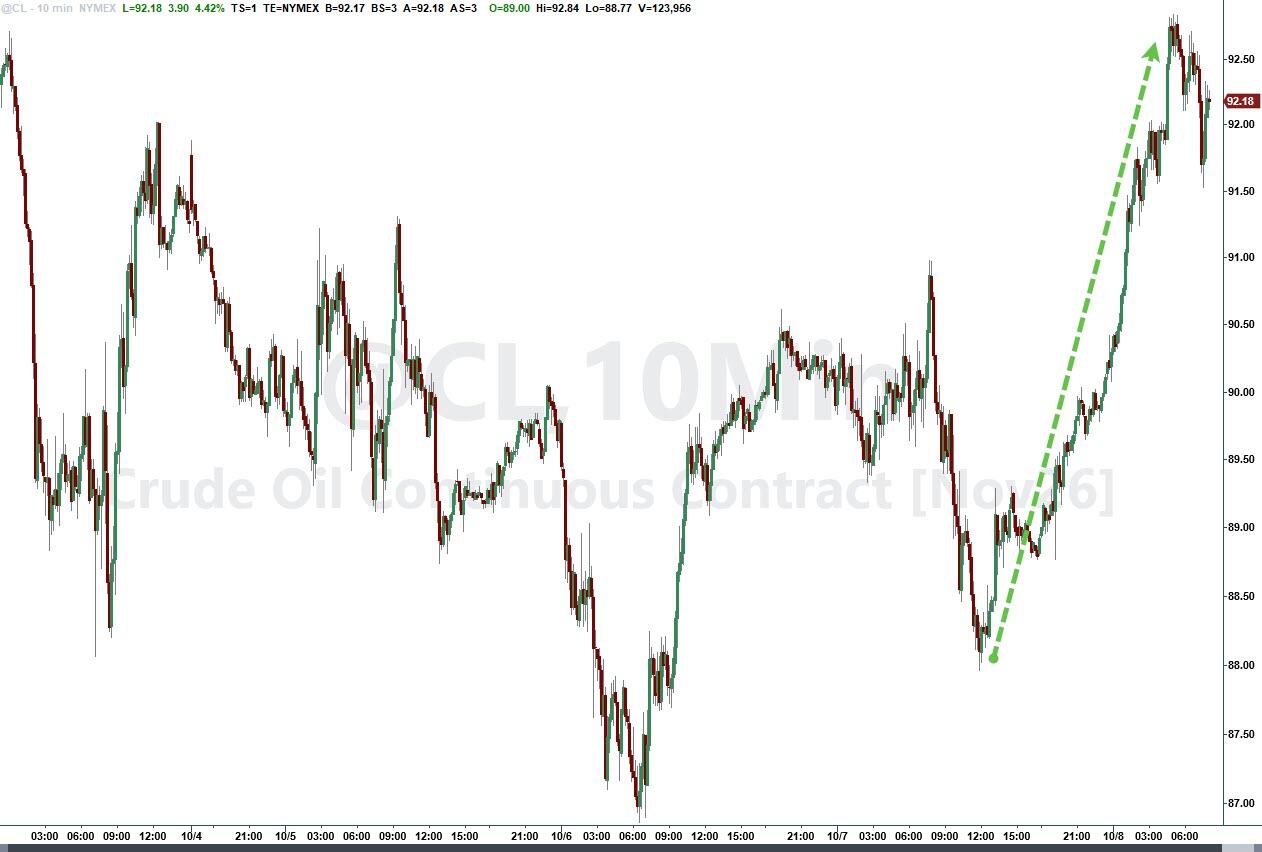
All of this, plus last evening's headlines that President Trump is mulling a new bombing raid on Iran possibly before the November midterm elections, has pushed oil prices higher throughout the Thursday morning hours...
Over in Yemen, fighting has intensified in the Taiz region and in rural areas. Al Jazeera details:
Fighting is raging in al-Shamayatayn, al-Maafer and the southern and western countryside of Taiz governorate.
The Houthis are pushing into rural areas that have not seen conflict for years, aiming to open a supply route because their lines towards al-Kadaha and al-Waziiya, which link Aden, Lahij and Taiz, are nearly cut off by advancing government forces.
Those forces are moving towards al-Waziiya and the Kahboub Mountains overlooking Bab al-Mandeb.
Government forces expected a dangerous escalation over the next 48 hours after the defense minister said Houthi-held areas will be recaptured soon. Government forces reported more than 2,000 operations, including attacks, supply line cuts, repelled attacks and territory retaken.
The three deaths reported by the Saudis on Wednesday are the first civilian deaths reported in the kingdom since the conflict with the Houthis was renewed several weeks ago.
Crown Prince Mohammed bin Salman is likely going to press allies harder to join the counteroffensive against the Houthis in Yemen, after Pakistan and Turkey have announced defense assistance based on the Mecca Defense Pact.


No comments:
Post a Comment