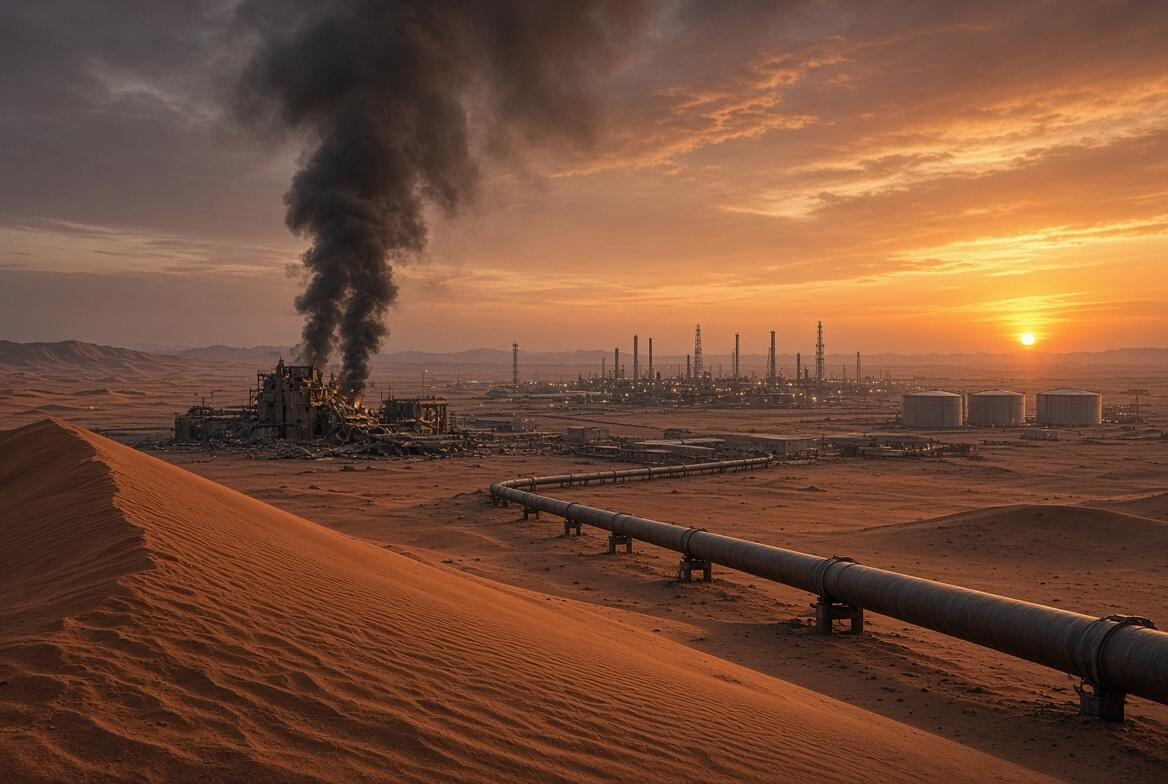
We have already discussed this subject several times but what the US is destroying is the Middle East is not Iran but its Arab allies. What a stunning lesson for the rest of the world!
While the ill-thought and badly planned attack on Iran* (see article bellow) has strengthened the country, it has conversely irremediably weakened the Gulf monarchies starting with Saudi Arabia which as explained in detail by Brian McGlinchey may not be able to weather the conflict much longer. And what is true for Saudi Arabia is even more so for smaller and weaker countries like Kuwait, Bahrain or Qatar with little historical legitimacy.
Like it or not this will only accelerate the transition away from oil worldwide. This may sound like a good strategy for the US since the country has plenty of resources, but this is ignoring the fact that the American Empire is built upon the petro-dollar. In this respect, to be able to survive in autarky while the global supply chain and energy links wither looks like a double edged sword.
What we are witnessing is the fraying of the arrangement of the last 50 years put in place by the oil shocks of the early 1970s. Whatever the current hype may say, (You always hear about endless growth at the top of a bubble.) what's coming next will be harsher with less energy available and at a much higher price.
By Brian McGlinchey via Stark Realities
While the disastrous US-Israeli attempt to impose regime change on Iran has commanded the world’s attention, most people are oblivious to the rising probability that regime change is instead coming to a major US and Israeli partner: the Kingdom of Saudi Arabia.
Owing to financial strains, demographics, military failures, and simmering domestic discontent, it may only be a question of magnitude. That is, will Crown Prince Mohammad bin Salman (MBS) be removed by fellow members of the House of Saud, or will the 94-year-old kingdom collapse altogether? Most likely, we’ll see both things happen in fairly rapid succession.
To understand why Saudi Arabia is in danger of falling apart, it’s important to first understand what’s been holding it together since Ibn Saud united a land of many tribes into a huge new state in 1932:
- Power-sharing across the branches of the Saudi royal family. Traditionally, authorities were shared among many senior princes, with their ministries providing each with a base of power and a well of patronage to tap. Major decisions were made by consensus, consistent with the Islamic principle of shura, which is expressly encouraged by the Quran.
- The integration of the Wahhabi religious establishment into Saudi government. Wahhabism is an austere and puritanical variant of Sunni Islam that arose in central Arabia in the 18th century and came to dominate it. In exchange for the Wahhabists’ bestowing of religious legitimacy on the monarchy, the Wahhabi religious authorities — or ulema — were given authority to guide schools, run charitable entities and enforce social norms.
- Tribal loyalty given in exchange for patronage and influence. The Arabian peninsula is home to dozens of tribes, with histories stretching back several hundred years or more. Their acquiescence to rule by the House of Saud has been secured via ongoing consultations and by government jobs, subsidies and contracts. Tribes have helped maintain internal peace by recognizing the monarchy’s authority, and by acting as mediators of disputes, and negotiators of access to tribal land and resources.
Everything changed when MBS became crown prince in 2017, as he radically concentrated power and decision-making in his own hands and those of a tight circle of trusted allies, to the detriment of the tribes and other members of the royal family. More than just a political maneuver, this was a bona fide revolution against the arrangement that had hitherto ensured the House of Saud’s survival.

In one of his first moves, MBS rounded up hundreds of Saudi royals and top business leaders and imprisoned them in the Riyadh Ritz-Carlton hotel. Most of them were reportedly abused, both psychologically and physically. Seventeen were hospitalized, and a major general died in custody. Faced with corruption accusations, detainees secured their freedom by forking over $107 billion, according to the claims of Saudi officials.
MBS also provoked the Wahhabi ulema, as he undertook an agenda of liberalization and Westernization aimed at improving Saudi Arabia’s image and keeping the country’s youth content. These moves included allowing women to drive cars, ending the requirement for traveling women to have male guardians, relaxing women’s dress codes, re-opening cinemas after a decades-long ban, and allowing rock concerts and art festivals. He also stripped the Saudi religious police of their investigation and arrest powers, shifting the overseers to an advisory role.
“He has offended virtually every constituency of the royal family,” Chas Freeman, former US ambassador to Saudi Arabia, said on Judging Freedom. “He’s also offended the reactionary religious establishment, so he’s made a hell of a lot of enemies.”
MBS’s concentration of power isn’t entirely self-serving. His power grab was driven in part by a sense of urgency as Saudi Arabia stares down a looming financial disaster, which is rooted in the nature of the Saudi state, and exacerbated by its demographics.
Like many other states in the region, Saudi Arabia is an example of a rentier state — a state that derives the great majority of its revenue from sale of resources to other countries, rather than from the taxation of domestic economic and entrepreneurial activity. In rentier states, the relationship of the people and the government is far different from the norm. Instead of relying on the citizenry as a source of funding, rentier states use their resources to distribute money to the citizenry. “The state doesn’t need its citizens to work hard and pay taxes. It needs them to stay content,” explained The Marrow in a video report on Saudi Arabia’s challenges.
Rentier states are put in danger when revenue becomes insufficient to sustain the flow of money to the people. For Saudi Arabia, two variables have been moving in dangerous directions: the population has grown by leaps and bounds since the 1970s, and oil revenues haven’t kept up.Saudi Arabia now has an extraordinarily young population: Nearly two-thirds of Saudi citizens are under age 30. In a typical state fueled by economic activity, a large, youthful population can be a great asset. In a rentier state, it’s a liability — one that strains the government’s ability to keep them financially secure, with the failure to do so carrying the risk of dangerous discontent.
A primary means by which the Saudi government has distributed wealth — and prevented idleness that facilitates mischief — is government employment. As of 2016, an extraordinary two-thirds of employed Saudis held government jobs, and their salaries consumed 40% of the kingdom’s budget. Government jobs’ domination of a market becomes a self-sustaining phenomenon. Private industry struggles to hire workers who’d prefer the lower demands, higher pay and greater job security of a government job. That, in turn, inhibits the growth of a private sector that could reduce the need for a large and costly public sector.
Recognizing the need to completely re-engineer the Saudi economy and relieve its reliance on oil money, MBS in 2016 unveiled “Vision 2030,” with a goal of spurring private-sector investment and employment, and improving the quality of life for Saudi citizens.
Many of MBS’s visions were the stuff of science fiction. A huge ski resort in the desert. A gigantic cube-shaped skyscraper in Riyadh as voluminous as 20 Empire State Buildings. A city for nine million people called “The Line,” comprising two parallel buildings 1,640 feet tall, 660 feet wide and stretching a staggering 110 miles.
One by one, Vision 2030 projects meant to dazzle the world have gone dim as the 2030 due date grows closer. The ski resort, which was supposed to host the 2028 Asian Winter games, has been put on ice. The Line has been suspended, leaving only a few kilometers of construction and a 70-mile-long trench. The colossal cubic skyscraper has been halted after initial excavation and installation of foundation pilings.

The curtailing of those ambitions reflects an irony embedded in the kingdom’s predicament: Its quest to end its dependence on oil revenue itself depends on oil revenue. Since the announcement of Vision 2030, oil prices haven’t cooperated. As MBS’s grand visions evaporate, they’re increasingly regarded as wasteful vanity projects that have only worsened Saudi Arabia’s situation. Questions about his judgment aren’t confined to economic matters — his military decisions have been even worse.
After his appointment as Saudi defense minister in 2015, MBS immediately sought to establish his military credentials by intervening in Yemen’s civil war, which had seen that country’s Saudi-allied government ousted from the capital by Ansar Allah, a Zaidi Shia group widely referred to as “the Houthis.”
It was an enormous failure. Even with refueling, arms and other assistance provided by the United States, the Saudi intervention failed to defeat Ansar Allah. It also inflicted enormous damage on Saudi Arabia’s reputation, as bombings routinely caused mass casualties among Yemeni civilians, and a Saudi blockade created one of the world’s worst humanitarian disasters.
Saudi Arabia finally joined a truce in 2022. Despite his earlier humiliation, MBS stirred things back up again in July of this year, violating the truce by bombing an airport in Yemen’s capital to prevent a Yemeni delegation from landing in an Iranian jet, after attending the funeral of Iran’s Ayatollah Khamenei.
What followed has been devastating to Saudi Arabia. Ansar Allah retaliated, declaring the imposition of a blockade on Saudi Arabia to counter the Saudi blockade on Yemen. Furthering their ability to make good on that promise, Ansar Allah unleashed an offensive in which they rapidly seized the remainder of Yemen’s west coast, positioning their forces to easily threaten Saudi shipping entering the Red Sea via the Bab al-Mandab Strait.
Worse, Ansar Allah has taken the battle into Saudi territory, repeatedly inflicting damage on oil and gas facilities. Iraqi Shia militias joined them in that endeavor, shutting down the east-west pipeline that Saudi Arabia had been using as an alternative to the Iranian-blockaded Strait of Hormuz. Ansar Allah has also struck Saudi airports. In the worst such attack, a Yemeni cruise missile hit a passenger terminal at Riyadh’s King Khalid International Airport, killing 13 people, wounding more than 300, and causing a weeks-long closure. President Trump has compounded MBS’s ongoing military humiliation by refusing his repeated pleas for US forces to rejoin the war on Ansar Allah.
The destruction resulting from MBS’s renewal of the war in Yemen comes on top of damage caused by Iran, which has deemed any country that hosts US forces as fair targets for retaliation. Some analysts predict it will take seven to 10 years to replace all the specialized oil and gas equipment and fully restore production.
The physical damage from missiles and drones will be hard enough to repair, but the most enduring damage may have been inflicted on Saudi Arabia’s reputation as a safe place to visit and to open businesses — directly undercutting the kingdom’s quest to attract foreign investment and remake its economy.

In a vivid illustration of such damage, Ansar Allah’s attacks recently forced the postponement of Saudi Arabia’s annual Future Investment Initiative, which is hosted by the kingdom’s Public Investment Fund. First held in 2017 and nicknamed “Davos in the Desert,” the highly-anticipated October event was poised to bring major-corporation CEOs — including the leaders of JPMorgan Chase, Citigroup, Goldman Sachs and Blackrock — to Riyadh. Major sports events, such as F1 races, have also been cancelled or postponed, and the E-Sports World Cup was moved from Riyadh to Paris.
“MBS has staked everything on Vision 2030, the promise that Saudi Arabia will become a global hub for business, tourism, sport and investment,” writes former CIA intelligence analyst Larry Johnson. “Every one of those businesses depends on one thing: the perception that the kingdom is safe. The Houthis are attacking that perception directly.”
As bad as the military situation is for Saudi Arabia and MBS, it may get far worse. As Ansar Allah continues to expand its control of Yemen — where the group already has the capital and territory in which 70 to 80% of Yemenis live — there’s growing wariness the group could retake three provinces from southwest Saudi Arabia that were historically part of Yemen, but were annexed by Saudi Arabia in 1934.

With Saudi Arabia facing increasingly dire circumstances, MBS could be targeted for removal by those who see him as incapable of steering the kingdom out of peril. There are Saudi precedents for that. Faulted for extravagant personal spending and poor management of the kingdom’s finances, King Saud al Saud saw his powers reduced in the late 1950s. Then, in 1964, he was dethroned in a bloodless coup organized by his younger brother, Crown Prince Faisal, who became king.
Eleven years later, King Faisal was himself removed from power — in bloody fashion. In 1975, after returning from a trip to the United States, he was shot to death by his nephew Prince Faisal bin Musaid, who was apparently outraged by the king’s drive to Westernize and liberalize Saudi Arabia. Revenge was also thought to be a factor, as the prince’s brother was killed in 1966 amid a violent protest of the introduction of television to the kingdom.
In October, there were reports that MBS was moving from bomb shelter to bomb shelter beneath heavily-guarded palaces. “[Supposedly] for fear of a Houthi assassination,” Alistair Crooke told Judge Napolitano. “Actually, what he’s frightened of is an assassination by one of his own family or a military officer.”

“There’s a long history in the Arab world of the overthrow of monarchy,” Freeman noted. “It’s facilitated because Islam, in the Holy Quran, is actually very much against monarchy.” As Saudi Arabia’s condition weakens, its political and economic landscape has become fertile ground for countless seeds of discontent:
- Vision 2030 construction projects have forced thousands from their homes and granted compensation that many say is far too little.
- Government jobs have lost some of their luster; pay raises are harder to come by, and limits on overtime and annual leave have been imposed.
- Citizens who were accustomed to a largely tax-free existence are getting a taste of non-rentier-state life: In 2018, Saudi Arabia adopted a 5% Value Added Tax and later tripled it to 15%.
- Saudi royals — which number between 15,000 and 25,000 — have seen their perks and stipends reduced, forcing many of them to sell homes, yachts and art to raise cash. Princes who were subjected to abuse at the Ritz-Carlton and the confiscation of their assets are likely yearning for revenge.
- Resentments are growing over uneven financial treatment. Crooke offers an illustrative example of two military officers working side by side: one, a highly-placed tribal member who isn’t well-paid, the other a royal of the same rank whose income is padded by a stipend.
- Military cohesion and operational efficiency has been impaired by the silo-ization of the various service branches — which is meant to reduce the ease with which a coup could be mounted. “[MBS] has divided the military, set them against one another, [and] used the National Guard to keep an eye out for any disaffection within the army,” explained Crooke.
- Though often characterized as a Sunni country, Saudi Arabia has a significant Shiite minority, accounting for about 12% of the population. Critically, they’re concentrated in two important areas: Saudi Arabia’s Eastern Region, which is the center of the kingdom’s oil production, and Saudi Arabia’s southwest corner, adjacent to the Shiite population in northwest Yemen, where Ansar Allah rules.
- The kingdom faces reputational damage and a major financial hit that’s likely to arise in a US civil suit in which victims of the 9/11 attacks are building an overwhelming case that Saudi government officials aided the Al Qaeda plotters.
- MBS’s marginalization of the Wahhabi religious establishment holds great peril. Clerics may no longer tell their followers to ignore the lavish royal lifestyles that violate the core tenets of Wahhabism, setting the stage for a radical Islamic insurrection.
Saudi Arabia isn’t alone among Middle East countries in facing the likelihood of major upheaval. Other Gulf rentier states are similarly exposed, and Kuwait could vanish via conquest by Iraqi Shiite militias. As Crooke recently said on Daniel Davis Deep Dive, “People just do not see the huge geopolitical shifts that are taking place today. The Middle East is going to change. You will not recognize it in two years’ time.”
Check out other articles and join more than 4,000 free subscribers at starkrealities.net
- Trump's Damage to US Diplomacy Could Last a Generation
- Anti-Zionism Was Pioneered By Jews
- How the US-Israel Relationship Weakens America and Harms the World
* Ex-CIA Officer Says The Agency Delivered The Same Iran Verdict Three Times Before The War
Former CIA officer John Kiriakou says the agency produced three separate national intelligence estimates before the Iran war began, and each one found that Tehran had no nuclear weapons program. He made the claim on the Nov. 6 "Intelligence Community Roundtable" edition of Judge Andrew Napolitano's Judging Freedom, alongside Larry Johnson.

Napolitano asked what the CIA had told the president "about the practical consequences of his plan with Netanyahu to win the war in six days." Kiriakou answered that "we know a little bit from leaks," then said: "the CIA had published three separate national intelligence estimates and all three times concluded that the Iranians did not have a nuclear weapons program. It just simply didn't exist."
Director of National Intelligence Tulsi Gabbard told Congress in March 2025 that the intelligence community "continues to assess that Iran is not building a nuclear weapon," and Trump answered that he didn't "care what she said."
Kiriakou said the agency's analysts were just as consistent on what a war would cost. "The CIA was pretty consistent that this was a bad idea from the very beginning," he said, arguing that the analysis held "the Iranians were far tougher than we as policymakers believed." In his telling, a look at the map was enough: Iran is "the size as the whole of Western Europe," ringed by mountains on three sides, with "92 million people, all of whom will go to their deaths to protect their homeland." Conquering it, he said, would have taken "one million ground troops."
He also pointed to a leak from "less than three weeks ago." A CIA "red cell" team, the kind of group meant to "think outside the box," had concluded that "it was Israel that could break up and fall apart and cease to exist because of all of this, not Iran," Kiriakou said. The person who leaked it, he said, was a CIA contractor who passed it to his girlfriend, who put it in her blog. That matches the case of Ian Brinksman, the contractor the FBI arrested last month, as we reported. His case is ongoing, and Kiriakou's account of what the red cell concluded rests on the leaked reporting, not on a document we have seen.
The segment was part of a broader hour in which Johnson and Kiriakou argued that Trump's Iran policy cost Republicans in Tuesday's midterms. Both are known critics of the war, and the claims above are theirs.